



A few years ago I helped a friend move a “farmhouse” dining table she’d bought online two years earlier, and the tabletop came apart at one corner the moment we tilted it onto its side. It wasn’t solid wood underneath that convincing plank-style finish — it was MDF with a printed wood-grain laminate, and the particleboard core had swollen and delaminated from years of humidity in her kitchen. She’d paid real furniture money for something that, structurally, had more in common with a bookshelf from a big-box store than with the farmhouse tables it was styled to resemble.
That’s the trap with this category more than almost any other style of furniture. “Farmhouse” has become such a dominant aesthetic over the last decade that it’s applied to everything from genuinely well-built solid oak trestle tables to flimsy veneered pieces that just happen to have turned legs and a distressed white finish. The look is easy to copy. The construction underneath it is not, and that’s exactly where this guide is going to spend most of its time.
What “Farmhouse” Actually Means as a Furniture Style
Before getting into wood species and base styles, it’s worth being honest about what this term is actually describing, because it gets used loosely enough to cover several genuinely different looks.
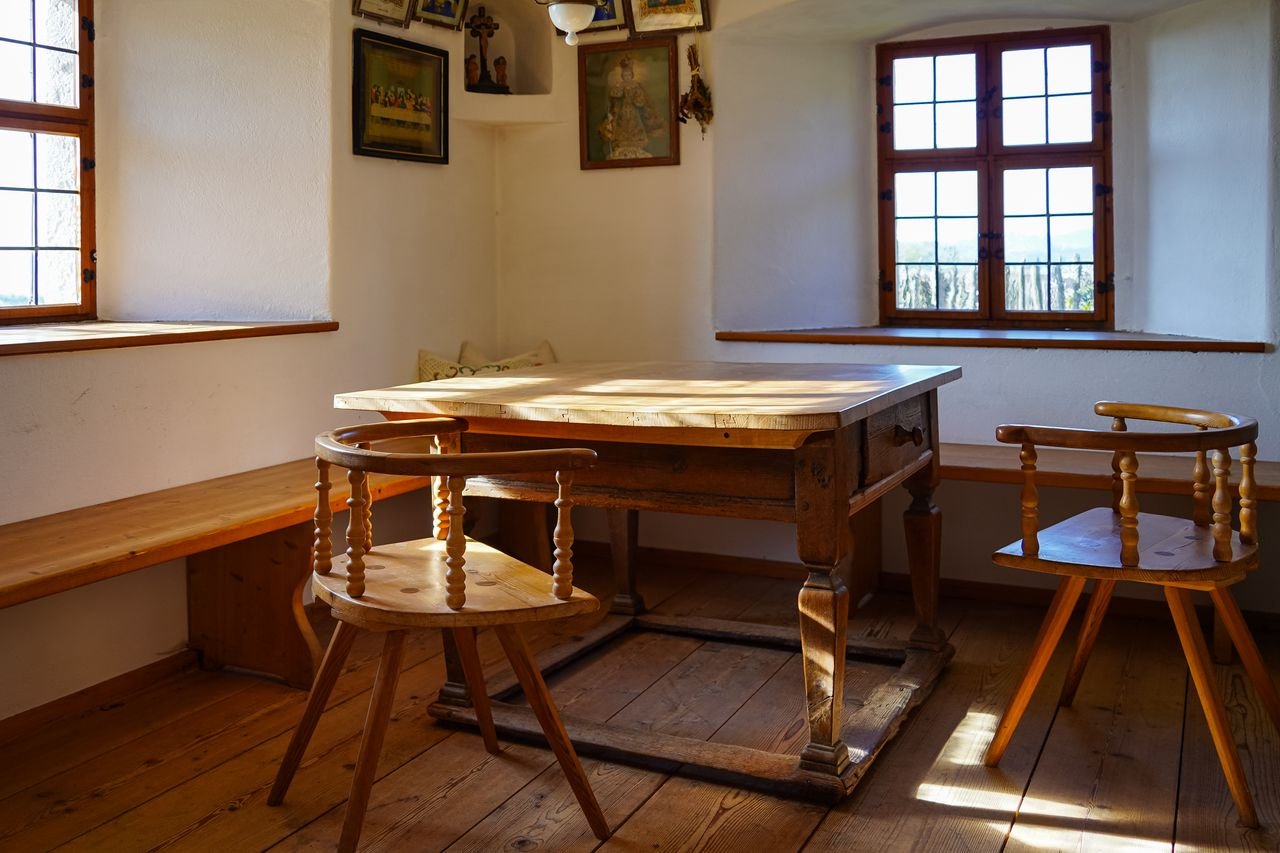
Classic farmhouse furniture traces back to real American and European farmhouse kitchens — sturdy, unfussy tables built by local joiners to survive decades of rolling dough, canning vegetables, and feeding large families, usually in a plain wood finish or simple painted white. Modern farmhouse, the version that exploded in popularity through shows like Fixer Upper, took that same silhouette and cleaned it up: straighter lines, less ornamentation, often paired with black metal accents and a more neutral, matte finish. Rustic farmhouse leans harder into visible knots, distressing, and reclaimed wood character. And industrial farmhouse blends in metal trestle legs or hairpin bases with a wood top, which is really a hybrid style rather than traditional farmhouse at all.
None of these is more “correct” than the others, but knowing which one you actually want matters when you’re reading product descriptions, because retailers use “farmhouse” as a marketing umbrella covering all four.
Solid Wood vs Veneer: The Distinction That Determines Everything Else
This is the single most important thing to understand before you compare a single product, because it affects durability, repairability, weight, and price more than wood species, finish, or brand ever will.
Solid wood construction means the visible surfaces of the table are genuinely made from planks of real wood, joined together — you can sand it, refinish it, and if it gets damaged, a competent furniture repair person can actually fix it. Veneer construction means a thin layer of real wood, sometimes only a fraction of a millimeter thick, is glued over a core of engineered material like MDF or particleboard. Good veneer work, done over a stable engineered core, isn’t automatically bad — plenty of respected furniture makers use veneer intentionally on tabletops to control wood movement on very large surfaces. The problem is cheap veneer over a weak core, which looks identical to solid wood in a product photo and behaves completely differently in a humid kitchen or under a hot dish.
Here’s the honestly annoying part: even well-known retailers mix these construction methods within the same “farmhouse” collection. I found this directly while researching current listings — a round extending farmhouse-style table from a major retailer lists its material as solid wood, engineered wood, and veneer all in the same product, which is common practice for extension tables where the leaves or apron use engineered wood for stability while the visible top surface is solid or veneered wood. That’s not necessarily a dealbreaker, but it means you genuinely have to read the materials section of a listing rather than trust the word “farmhouse” or even a photo of visible wood grain to tell you what’s structurally underneath.
Choosing Your Wood: A Real Comparison
Assuming you’ve settled on solid wood, species is where the real differences in look, price, and durability show up.
Pine is the traditional farmhouse choice, and for good reason — it’s what a lot of genuine antique farmhouse tables were actually built from, since it was cheap and abundant. It’s a softwood, which means it dents and scratches more easily than a hardwood, and honestly, on a farmhouse table, that’s often part of the appeal rather than a flaw — a pine table develops a lived-in patina of dings and wear marks over years that suits the style perfectly. It’s also noticeably lighter than oak or acacia, which matters if you’ll ever need to move the thing yourself.
Oak is the benchmark hardwood for a reason.
It’s dense, resists warping, barely shrinks or expands with seasonal humidity changes compared to softer woods, and it can be refinished multiple times over its life if it gets scratched or the finish dates. It’s heavier and pricier than pine, and its strong, open grain reads a bit more traditional than rustic, but if you want a table that genuinely gets passed down a generation, oak is the safe, boring, correct answer.
Acacia has become the default “farmhouse-adjacent”
Hardwood over the last several years, and it earns the popularity honestly — it’s extremely dense (often exceeding 2,000 on the Janka hardness scale, which rivals or beats oak), naturally water- and rot-resistant thanks to its own oils, and it has bold, dramatic grain figuring that no two boards repeat exactly. The tradeoff is that dramatic grain can read as a bit busy or heavy next to the plainer, calmer look some people want from farmhouse style, and it commands a real price premium over oak in a lot of markets.
Mango wood is the value pick worth taking seriously rather than dismissing as cheap. Expect noticeable color and grain variation from piece to piece, which some people love and others find inconsistent.
Reclaimed wood, usually reclaimed pine or oak pulled from old barns, factories, or demolished buildings, is the most authentically “farmhouse” option in the literal sense, since it’s often actual antique farmhouse lumber. You’re paying for that history and character — nail holes, weathering, tool marks — and it comes at a real premium, plus the surface can be genuinely uneven in a way that some people find charming and others find impractical for everyday use with glasses and plates.
Table Base Styles: Why the Legs Matter More Than They Look Like They Should
Three base styles dominate farmhouse dining tables, and the choice affects both how the table feels to sit at and how sturdy it is under real use.
A trestle base — two solid end supports connected by a stretcher beam running underneath the table — is the classic farmhouse look, and it’s genuinely strong, since the weight transfers down through two wide, stable points rather than four thin legs. The tradeoff is that the stretcher beam sits low and central, which can occasionally bump the knees or feet of anyone sitting at the very ends of the table, so it’s worth checking that detail if you’ll regularly seat people at the short sides.
A skirted or apron base — four legs connected by a wood frame running just under the tabletop edge — is what most people picture as the “standard” table shape, and it leaves the legroom completely open underneath, which is the practical advantage. The apron also adds real structural rigidity, bracing the legs against racking side to side, so a well-built apron table is genuinely sturdy despite looking lighter than a trestle design.
A pedestal base, usually reserved for round or oval farmhouse tables, uses a single central column instead of legs at the corners, which maximizes legroom for everyone at the table and makes an odd number of diners much easier to seat comfortably than a four-legged design does.
Sizing Your Table: The Math That Actually Prevents Regret
More farmhouse table purchases go wrong here than at any other stage, because the emotional pull toward a big, generous farmhouse table is strong and the room math often disagrees.
The reliable starting formula:
Measure your dining space in inches, then subtract seventy-two inches total — thirty-six inches of clearance on each side — from both the length and width. Whatever’s left over is roughly your maximum table footprint. That thirty-six-inch clearance is the minimum for someone to sit comfortably while another person walks behind them; if a doorway or the path to the kitchen runs along one side, bump that side up to forty-two or forty-eight inches so the room doesn’t feel like a squeeze during regular use, not just when it’s empty.
For seating capacity, plan on twenty-four inches of table edge per person for everyday comfort, or twenty-eight to thirty inches if you want a more formal, generous feel. That works out to roughly: a forty-eight-inch table for four, sixty to seventy-two inches for six, eighty-four inches for eight, and ninety-six inches or more once you’re regularly hosting ten. Standard table height sits between twenty-eight and thirty inches, paired with chairs around seventeen to nineteen inches at the seat, which leaves the ten to twelve inches of thigh clearance you actually need to sit down without banging your knees on the apron.
My honest advice, and this echoes what several actual furniture makers say rather than just retailers: buy the size you’ll use every single week, not the size you’ll technically need twice a year for the holidays. An oversized farmhouse table doesn’t just crowd the room — it makes an everyday meal for two or three people feel oddly formal and cold, marooned at one end of a huge surface. This is exactly what extension leaves solve, so read the next section before you talk yourself into buying bigger than you need.
Extension Leaves: The Feature That Solves the Sizing Problem
An extendable farmhouse table lets you size for daily use and still handle the occasional big gathering, and there are a few mechanisms worth understanding before you buy.
Butterfly leaves fold and store underneath the tabletop itself, unfolding into place when you pull the table apart, which solves the storage problem entirely at the cost of slightly more moving mechanical parts that can occasionally need adjustment over years of use.
Self-storing leaves work similarly to butterfly leaves but tuck away more completely, essentially disappearing when not extended. They’re convenient but tend to show up more on mid-range and higher-end pieces than on budget farmhouse tables.
What Farmhouse Dining Sets Actually Cost in 2026
Prices vary enormously depending on wood, construction, and brand, but here’s a realistic honest range. Budget-tier farmhouse-style sets, often mixing solid wood with engineered wood and veneer, run from roughly three hundred to eight hundred dollars for a table alone. Mid-range solid wood tables from recognizable retailers typically land between one thousand and two thousand dollars for the table, with chairs and benches adding several hundred more depending on quantity and material. Premium and Amish-built solid wood tables, particularly larger extendable pieces in oak or reclaimed wood, regularly run from two thousand into the four-thousand-dollar range and beyond.
One genuinely useful piece of current context: the tariff increases that hit a lot of furniture categories over the past year — mainly targeting upholstered furniture, cabinets, and vanities imported from China and Vietnam — have generally not applied to solid wood dining tables, bed frames, and similar unupholstered wood furniture in the same direct way. That doesn’t mean prices are immune to broader shipping and material cost pressure, but it does mean a solid wood farmhouse table hasn’t taken the same direct hit that a lot of upholstered dining chairs and sofas have. It’s also worth knowing that Amish-built furniture, made entirely in the United States, sidesteps import tariff exposure altogether, which is one more reason that category has held its value and reputation particularly well through a genuinely turbulent couple of years for furniture pricing.
A Real Brand Comparison
I’ve spent time comparing actual current listings rather than relying on brand reputation alone, and here’s where things honestly land.
Pottery Barn’s farmhouse tables, like the Rustic Farmhouse Extendable and Toscana lines, are genuinely solid construction — kiln-dried solid wood, trestle or turned-leg bases, extension mechanisms that lock securely — and the trade-off is a real price premium plus the caveat that a few of their round extending models blend solid wood with engineered wood and veneer in the same piece, so it’s worth checking the specific model’s materials rather than assuming the whole line is identical.
Birch Lane, Pottery Barn’s more budget-conscious sister brand, offers a similar farmhouse aesthetic — turned legs, distressed painted finishes — at a noticeably lower price point, and the construction quality is solid without quite matching Pottery Barn’s heavier, thicker build.
Wayfair-tier retailers carry the widest range, from genuinely decent solid wood options to the kind of MDF-and-laminate piece my friend learned about the hard way. The volume of choice is an advantage if you’re patient enough to actually read every materials listing carefully, and a real risk if you’re shopping on photos alone.
Five Mistakes People Make Buying a Farmhouse Table
Buying for the holiday guest list instead of the Tuesday dinner is a close second, leading to a table that dominates the room year-round for the sake of two or three gatherings.
Skipping the clearance math and just eyeballing whether a table “looks like it’ll fit” causes more returns than any other single factor — measure the room, subtract for clearance, and only then start comparing table dimensions.
Ignoring where the leaves store, on a drop-in leaf table, leads to an extension mechanism nobody actually uses because the leaf ends up leaning in a closet somewhere inconvenient.
And pairing a heavy, dark reclaimed wood table with equally heavy, ornate chairs is a stylistic mistake worth avoiding — most successful farmhouse dining rooms actually mix a substantial wood table with lighter, simpler chairs or a bench, which keeps the whole arrangement from feeling visually overloaded.
Caring for a Solid Wood Farmhouse Table
Real wood needs genuinely simple but consistent care. Wipe spills promptly rather than letting liquid sit, since standing water is what actually damages a wood finish over time, not occasional light moisture. Use coasters and placemats for hot dishes and anything acidic. Avoid direct, prolonged sunlight, which fades and unevenly dries out a finish over years. Clean with a barely damp cloth and mild soap rather than harsh chemical cleaners, which can strip a natural oil or wax finish faster than normal wear ever would. And if you’ve got a pine or reclaimed table with a natural oil finish rather than a hard polyurethane, plan on reapplying that oil every year or two to keep the wood from drying out — it’s a small maintenance habit that meaningfully extends how good the table looks a decade in.
Where This Style Is Heading
The clearest trend right now is a gradual move away from the heaviest, most rustic end of farmhouse — chunky distressed white finishes, aggressive knots and character marks — toward what’s being called modern farmhouse or even “new traditional,” which keeps the sturdy, straightforward silhouette but in cleaner, calmer finishes and less exaggerated distressing. Sustainability is also genuinely shaping buying decisions rather than just marketing copy, with reclaimed wood and fast-growing species like mango wood gaining real market share specifically because shoppers are asking about sourcing, not just look. And given the tariff volatility affecting so much of the broader furniture industry, domestically built solid wood furniture, Amish and otherwise, is likely to keep gaining ground simply because it’s a more predictable, stable option for both retailers and buyers than furniture with a long, tariff-exposed import supply chain.
FAQs
Is farmhouse style going out of fashion? The most exaggerated, distressed version of the trend has cooled somewhat, but the underlying idea — a sturdy, honest, solid wood table as the centerpiece of a home — is closer to a permanent design principle than a fad, which is exactly why genuine antique farmhouse tables are still desirable today.
What’s the most durable wood for a farmhouse table with kids or pets? Acacia and oak are the standout choices for households that need real resistance to scratches and dents; pine is more forgiving in a different sense, since its softness means marks blend into the table’s character rather than standing out as damage.
Should I buy a farmhouse table with an extension leaf even if I don’t need the extra seats right now? If there’s any realistic chance you’ll host larger groups a few times a year, yes — it lets you buy the correctly sized table for daily life without permanently giving up the option to expand.
Are Wayfair and similar retailers worth considering, or should I only buy from specialty furniture makers? They’re absolutely worth considering, but only if you actually read the materials listed on each specific product rather than trusting the category name or photos, since quality varies enormously within the same retailer.
My Honest Final Verdict
If you take one thing from this guide, make it this: spend your attention on construction before you spend it on style, because the farmhouse look itself is now available at every single price point and quality level, which means the aesthetic tells you almost nothing about how the table will hold up. A genuinely solid oak or acacia table with a simple apron base and a drop-in leaf will outlast several trend cycles and probably outlast the kitchen it’s sitting in. A veneered table with the same distressed white finish will look identical in the listing photo and start failing within a few humid summers.
Buy the size that fits your actual weekly life, not your holiday guest list, and lean on an extension leaf to cover the gap. Get the wood species right for how hard your household is actually on furniture. And don’t be afraid to spend more on a smaller, honestly built table than less on a larger one that only looks like the real thing.
About the Author: Clara Whitfield is a furniture and interior design writer specializing in solid wood construction and traditional joinery. Her work draws on years spent visiting furniture workshops and Amish-built furniture makers across the Midwest and Northeast, along with hands-on experience restoring and refinishing inherited solid wood pieces in her own home.