Six years ago, my apartment had exactly one houseplant — a sad, leggy pothos I inherited from a roommate who moved to Portland and didn’t want to pack it. Today I own more than sixty plants, most of them tropical, and delivery drivers occasionally ask if I run a plant shop out of my living room. Somewhere between plant number one and plant number sixty, I figured out something that most “top 10 houseplants” listicles never quite say out loud: tropical houseplants aren’t a fussy specialty hobby. They’re actually some of the easiest plants to keep alive indoors, because an average heated home is a surprisingly good stand-in for the shaded, humid understory these plants evolved in.
This isn’t a list assembled from a seed catalog. It’s built from years of killing plants, reviving plants I thought were dead, hauling pots across three apartment moves, and testing gear that promises to make plant care effortless — some of which actually works, and a lot of which is marketing dressed up as science. Below are 20 tropical plants I’d genuinely recommend, grouped by how they behave in a room, along with an honest comparison table, a look at the tools worth buying, and the mistakes that kill more plants than any pest ever will.
Table of Contents
What “Tropical” Really Means for a Houseplant
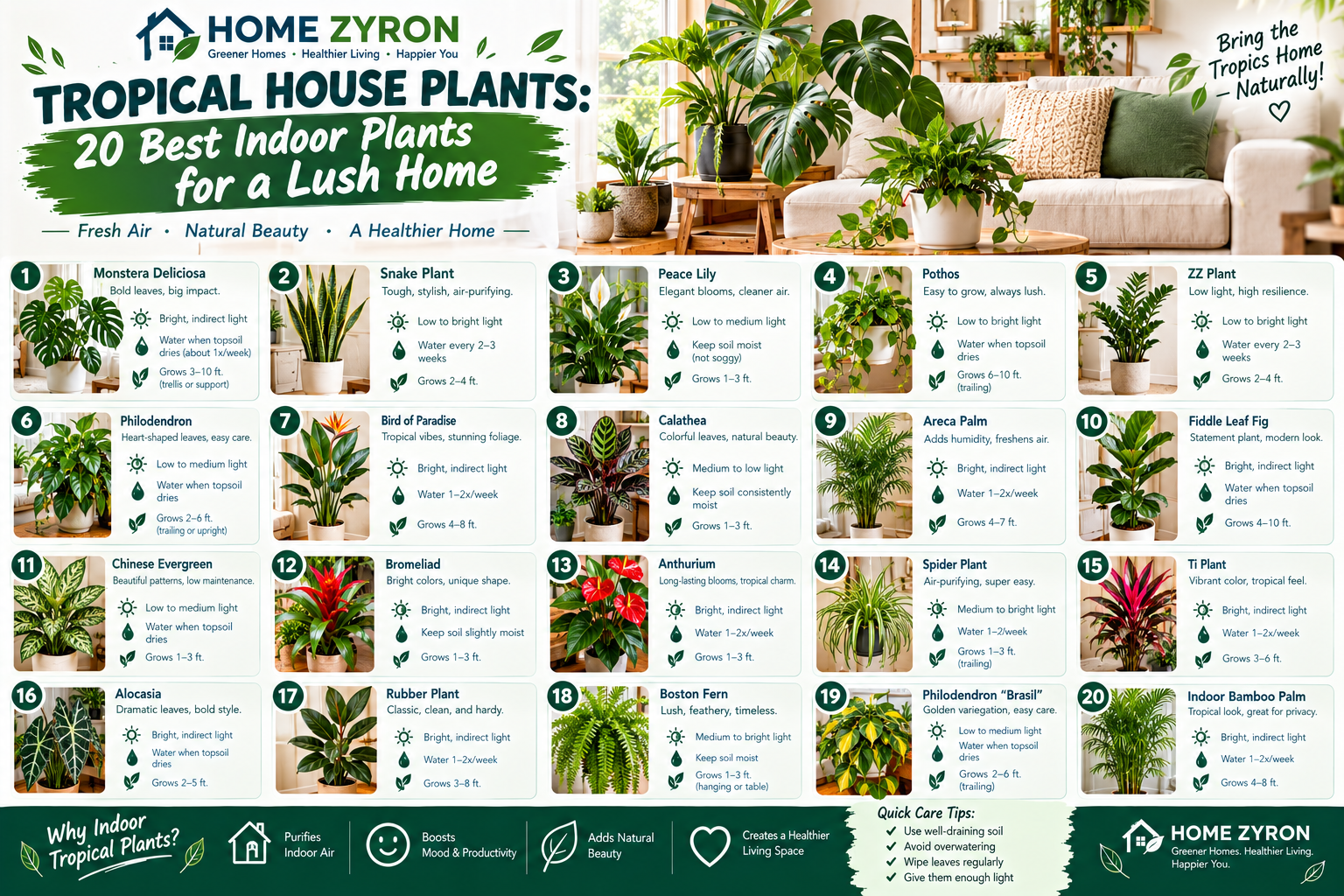
Quick Comparison: All 20 Plants at a Glance
Bold Architectural Statement Plants
Effortless Trailing and Climbing Plants
Low-Light Warriors
Colorful and Patterned Foliage
Flowering and Textural Tropicals
Gear That Actually Earns Its Shelf Space
Common Mistakes Beginners Make
Designing a Lush Room Without Clutter
Where Indoor Jungles Are Headed
Frequently Asked Questions
Final Thoughts
What “Tropical” Really Means for a Houseplant
Most of the plants on this list didn’t evolve on open, sunbaked plains. They grew on rainforest floors, wedged into tree bark as epiphytes, or tucked under a canopy so dense that direct sun rarely touched them. That single fact explains almost everything about why they make good houseplants: they’re already adapted to filtered, indirect light, stable warmth, and air that doesn’t swing wildly in temperature — which is basically what your living room offers, minus the humidity.
That last part, humidity, is the one variable most homes fall short on. Rainforests sit around 70–90% relative humidity. The average heated home in winter can drop to 20–30%, which is closer to desert conditions. This is why so many “why is my plant crispy” problems trace back to dry air rather than watering mistakes, even though watering gets blamed first.
It’s also worth being honest about a popular claim: the idea that houseplants dramatically purify indoor air. That belief traces back to a 1989 NASA Clean Air Study, which tested plants in sealed laboratory chambers, not real rooms with normal airflow. Later research found the effect in an actual house is far smaller than the original headlines suggested — you’d need dozens of plants per room to match what a cracked window or a basic air purifier does. I still keep my plants for the same reasons the original study didn’t measure: they lower my stress, make a room feel finished, and give me something to check on every morning. That’s a good enough reason on its own.
For deeper reference material as you build your collection, the Missouri Botanical Garden Plant Finder and the RHS houseplants hub are two of the more reliable, non-commercial sources I go back to when I want growing details that aren’t written to sell me plant food.
Quick Comparison: All 20 Plants at a Glance
Plant
Light
Watering
Humidity
Difficulty (1–5)
Pet-Safe
Monstera deliciosa
Bright, indirect
Weekly, let top 2″ dry
Medium
2
No
Bird of Paradise
Bright, some direct
Weekly
Medium–High
3
No
Fiddle Leaf Fig
Bright, indirect, consistent
Weekly, hates change
Medium
4
No
Rubber Plant
Bright, indirect
Every 1–2 weeks
Medium
2
No
Golden Pothos
Low to bright
Every 1–2 weeks
Low–Medium
1
No
Heartleaf Philodendron
Medium to bright
Weekly
Medium
1
No
Hoya
Bright, indirect
Every 2–3 weeks
Medium
2
Yes
String of Hearts
Bright, some direct
Every 2–3 weeks
Low
2
Yes
Snake Plant
Low to bright
Every 2–4 weeks
Low
1
No
ZZ Plant
Low to bright
Every 2–4 weeks
Low
1
No
Dracaena Marginata
Medium to bright
Every 1–2 weeks
Low–Medium
2
No
Chinese Evergreen
Low to medium
Weekly
Medium
2
No
Calathea Orbifolia
Medium, no direct sun
Keep evenly moist
High
4
Yes
Alocasia Amazonica
Bright, indirect
Evenly moist, less in winter
High
4
No
Croton
Bright, some direct
Weekly
Medium–High
3
No
Anthurium
Bright, indirect
Weekly, slight drying
High
3
No
Peace Lily
Low to medium
Weekly, droops when thirsty
Medium–High
2
No
Phalaenopsis Orchid
Bright, indirect
Every 1–2 weeks, soak method
High
3
Yes
Guzmania Bromeliad
Medium to bright
Keep central cup filled
High
2
Yes
Bird’s Nest Fern
Low to medium
Consistently moist
High
3
Yes
Before buying anything for pets or small children, cross-check the specific variety against the ASPCA’s toxic and non-toxic plant database — toxicity can vary between cultivars of the same species, and it’s the most current source I trust more than a random blog’s copy-pasted list.
Bold Architectural Statement Plants
These are the plants that do the visual heavy lifting in a room. One good specimen can anchor an entire corner.
Monstera deliciosa.
The plant everyone recognizes even if they don’t know its name — those iconic split leaves show up on everything from wallpaper to tote bags. What people don’t expect is how forgiving it actually is. Mine has survived two moves, a month of neglect during a work trip, and a fall off a shelf that snapped a stem, and it just kept growing back. It wants bright, indirect light and a stake or moss pole once it starts producing those signature splits, which typically only appear once the plant matures and gets enough light — a common disappointment for buyers who assume every leaf will look magazine-ready immediately. Learn more about the species on Wikipedia.
Bird of Paradise (Strelitzia reginae).
This is the plant to buy if you want a room to look like a hotel lobby. The broad, banana-like leaves catch light beautifully, but they also catch dust and tear in strong drafts, so keep it away from air vents. It wants more direct sun than most tropicals on this list and rewards a consistent watering schedule with genuinely fast growth — mine put out four new leaves in one summer once I moved it in front of an east-facing window.
Fiddle Leaf Fig (Ficus lyrata). I’ll be blunt: this is the plant with the worst reputation-to-difficulty ratio of anything on this list, and the reputation is earned. It drops leaves if you move it, if the light changes, if the room gets a draft, or seemingly just to make a point. That said, when it’s happy, nothing else gives you that glossy, sculptural silhouette. My advice after killing two: pick one spot, don’t rotate it constantly, and resist the urge to repot it the moment you bring it home.
Rubber Plant (Ficus elastica). The unsung alternative to the fiddle leaf fig — same glossy, dramatic leaves, dramatically less drama. It tolerates a wider light range, bounces back from missed waterings, and the burgundy-leafed varieties add color without needing a flowering plant’s fuss. If you want the fiddle leaf fig aesthetic without the anxiety, start here instead.
Effortless Trailing and Climbing Plants
These fill shelves, cascade from hanging baskets, and forgive almost everything.
Golden Pothos (Epipremnum aureum). The plant I recommend to literally everyone who says they “kill everything.” It tolerates low light, irregular watering, and rooms with zero humidity control. It also propagates in a cup of tap water on your windowsill with almost no effort, which is how most collections — including mine — actually start.
Heartleaf Philodendron. Often confused with pothos, but the leaves are thinner, heart-shaped, and slightly glossier, and new growth tends to come in paler before darkening. It’s marginally more shade-tolerant than pothos and grows faster in the right conditions, making it a favorite for people who want a trailing plant that fills a shelf quickly.
Hoya (wax plant). A slower grower with thick, waxy leaves and, if you’re patient and give it strong light, clusters of star-shaped flowers with a genuine honeyed scent. Hoyas actually prefer to dry out fully between waterings, which trips up people used to tropical plants that want consistent moisture — treat it more like a succulent than a rainforest plant and it thrives.
String of Hearts (Ceropegia woodii). Technically semi-succulent, but it’s earned a permanent place in tropical plant collections for its thin, trailing vines dotted with heart-shaped, marbled leaves. It wants brighter light than people assume and very infrequent watering — overwatering is the single most common way people lose this one.
Low-Light Warriors
If your apartment has one north-facing window and you still want greenery, start here.
Snake Plant (Dracaena trifasciata). Formerly classified as Sansevieria, and still sold under that name in most stores. Stiff, upright, sculptural leaves that tolerate genuinely low light, irregular watering, and dry air better than almost anything else on this list. I have one in a windowless bathroom that gets watered maybe once a month and it hasn’t complained once. Full species details are on Wikipedia.
ZZ Plant (Zamioculcas zamiifolia). Glossy, dark green, almost plastic-looking leaves that store water in thick underground rhizomes, which is why this plant survives weeks of neglect. It’s one of the only plants I’d trust in an office with fluorescent lighting and zero natural sun. The tradeoff is slow growth — don’t expect dramatic new leaves every month.
Dracaena Marginata. Thin, spiky, red-edged leaves on a trunk that often gets braided or twisted for sale, giving it a bonsai-like silhouette. It handles medium light and inconsistent watering well, though it’s genuinely sensitive to fluoride and chlorine in tap water, which shows up as brown leaf tips — letting water sit out overnight before using it solves this for most people.
Chinese Evergreen (Aglaonema). An underrated workhorse with mottled, silvery, or pink-flushed foliage depending on cultivar. It handles low light better than most patterned plants, which usually demand brighter conditions to keep their variegation vivid, making it a rare combination of colorful and genuinely easy.
Colorful and Patterned Foliage
These plants earn their keep on looks alone, but they demand more attention than the ones above.
Calathea Orbifolia. Enormous, round, silver-striped leaves that fold up at night like the plant is tucking itself in — the whole “prayer plant” family does this. It’s also the plant most likely to sulk over tap water, dry air, or direct sun, developing crispy brown edges within days. I didn’t have success with calatheas until I moved mine into my bathroom, where the humidity from daily showers made a visible difference within a couple of weeks.
Alocasia Amazonica (Elephant Ear). Dramatic, arrow-shaped leaves with pale veining that look almost hand-painted. It’s a plant of extremes: thriving with bright light and consistent moisture, and collapsing fast if either slips. Many alocasias also go dormant and drop leaves in winter, which panics new owners into thinking they’ve killed it — often it’s just resting and will regrow from the rhizome in spring.
Croton. The plant to buy if you want color without flowers — leaves come in combinations of red, orange, yellow, and green that rival any bloom. It needs more direct light than people expect; in low light, the color fades to plain green fairly quickly, which is the single most common complaint I hear about this plant.
Anthurium. Glossy, heart-shaped leaves and long-lasting, waxy red or pink blooms that aren’t actually flowers but modified leaves called spathes. It wants bright indirect light, a chunky, well-draining aroid mix, and consistent humidity, but rewards that effort with blooms that last for months rather than days.
Flowering and Textural Tropicals
Peace Lily (Spathiphyllum). One of the most dramatic communicators in the plant world — it wilts visibly and theatrically when thirsty, then perks back up within hours of watering, which makes it almost impossible to accidentally kill through neglect. The white “flowers” are actually spathes, similar to the anthurium’s, and appear most reliably with bright, indirect light.
Phalaenopsis Orchid. Not a plant most people associate with “easy,” but it’s genuinely more forgiving than its reputation suggests once you stop treating it like a soil-grown plant. It’s an epiphyte, so it wants a chunky bark mix, not potting soil, and a thorough soak every week or two rather than frequent light watering. Mine has re-bloomed three years running on a routine that takes about two minutes of attention weekly.
Guzmania Bromeliad. Grown for its long-lasting, brightly colored central bract rather than a traditional flower. Water goes into the central cup rather than the soil, mimicking how it collects rainwater in the wild. After it blooms, the mother plant naturally declines, but it produces “pups” at the base that can be separated and grown on — so the display isn’t a one-time purchase if you’re willing to propagate.
Bird’s Nest Fern (Asplenium nidus). Wide, ruffled, apple-green fronds that grow in a rosette resembling — unsurprisingly — a nest. It’s more tolerant of low light and indoor conditions than most ferns, which tend to be notoriously fussy, as long as humidity stays reasonably high and it’s never allowed to dry out completely.
Gear That Actually Earns Its Shelf Space
I’ve bought a lot of plant gadgets. Here’s the honest verdict on the four categories worth your money, and the ones that aren’t.
Soil moisture meters.
Verdict: worth it, but only the simple probe-style ones. I’ve tried three brands, and the cheap $10–15 analog probes performed identically to the “smart” Bluetooth versions that sync to an app and cost four times as much. What actually matters is depth — a meter only tells you the truth if you push it near the bottom of the pot, not just the top inch, since surface soil dries out long before the roots are actually thirsty.
Humidifiers vs. pebble trays vs. misting.
Verdict: humidifiers win, misting loses. Misting feels productive but raises humidity for maybe ten minutes before it evaporates — it does almost nothing for the plant and can actually encourage fungal spots on sensitive leaves like calathea. Pebble trays (a tray of water and stones under the pot) genuinely raise humidity in the immediate few inches around the plant, which helps but has a small radius. A small ultrasonic humidifier running a few hours a day raised the humidity in my plant corner from around 35% to a consistent 55%, which is the single change that fixed more crispy-leaf problems than anything else I tried.
Grow lights. Verdict: worth it if you have a genuinely dark room, skip it otherwise. A full-spectrum LED grow light on a timer turned my north-facing spare room from a “low-light plants only” zone into a space where I can grow calatheas and even a modest fiddle leaf fig. But if your room already gets a few hours of indirect daylight, most plants on this list don’t need supplemental light, and running one anyway is just an electricity bill with extra steps.
Self-watering pots. Verdict: mixed, plant-dependent. They work well for consistent-moisture lovers like peace lilies, ferns, and calatheas, where the reservoir keeps the wicking soil evenly damp. They’re a poor match for plants that want to dry out between waterings, like hoyas, snake plants, or string of hearts — I lost a hoya to root rot after two months in one before I understood this mismatch.
Common Mistakes Beginners Make
Watering on a calendar instead of checking the plant. “Every Sunday” works for some species and drowns others. Check the soil first.
Assuming bigger pots mean faster growth. Oversized pots hold excess moisture the roots can’t use fast enough, which is one of the most common causes of root rot in beginner collections.
Chasing “bright light” without actually measuring it. A spot that feels bright to your eyes can still be far too dim for a plant — light drops off dramatically just a few feet from a window.
Ignoring humidity until leaves are already crispy. By the time damage shows, it’s already happened; raising humidity won’t undo brown tips, though it prevents new ones.
Repotting immediately after buying a plant. Most nursery plants are stressed from transport already. Give it two to four weeks to settle before disturbing the roots.
Fertilizing dormant plants in winter. Most tropicals slow down significantly from roughly November through February and don’t need — or want — regular feeding during that window.
Designing a Lush Room Without Clutter
A “jungle” look isn’t about cramming in as many pots as possible — it’s about contrast and rhythm. Vary height with floor plants, shelf plants, and hanging plants in the same corner rather than lining everything up at eye level. Vary leaf shape and size deliberately: a broad monstera leaf next to fine, feathery fern fronds reads as intentional, while five plants with similar round leaves just look repetitive. Group odd numbers — three or five pots together photograph and read better than an even, symmetrical pair. And leave visible negative space around your best specimen plant; a single well-placed monstera in an otherwise open corner has more visual impact than the same plant buried among ten others.
Where Indoor Jungles Are Headed
A few shifts are worth watching if you’re building a long-term collection rather than a passing phase. Rare and variegated cultivars — think half-moon philodendrons or variegated monsteras — have moved from collector-only auction sites into mainstream nurseries, and prices are gradually normalizing as tissue-culture propagation makes them easier to mass-produce instead of relying on slow, unpredictable cuttings. Smart plant sensors that track light, moisture, and temperature and push alerts to your phone are getting genuinely more accurate and less gimmicky than the first generation from a few years ago. And biophilic design — the practice of intentionally integrating greenery into architecture rather than treating it as an afterthought — is showing up more in apartment renovations and office redesigns, not just luxury builds, as more people spend the bulk of their time indoors and actively seek the research-backed mood benefits of being around living plants.
Frequently Asked Questions
Do tropical houseplants really need high humidity to survive?
Most tolerate average home humidity (30–40%) fine and will simply grow a bit slower or show occasional crispy tips. A smaller group — calathea, alocasia, ferns, and anthuriums especially — genuinely struggle below 50% and benefit noticeably from a humidifier or grouping plants together.
Do houseplants actually clean the air in my home?
The effect is real but much smaller than popular claims suggest, since the original NASA research was conducted in sealed lab chambers, not ventilated rooms. Don’t buy plants expecting measurable air-quality improvements — buy them for the mood, aesthetic, and stress-reduction benefits, which are well documented on their own.
How often should I fertilize tropical plants? Roughly every four to six weeks during active growth (spring through early fall), diluted to half the strength the label suggests, and not at all during winter dormancy for most species.
Can any of these plants survive in a genuinely dark apartment? Snake plants and ZZ plants come closest to true low-light tolerance, but “low light” still means some ambient daylight — not a windowless room. In a truly dark space, a basic grow light will outperform any plant marketed as “low light.”
What’s the fastest way to deal with pests like spider mites or mealybugs? Isolate the affected plant immediately, wipe leaves down with diluted insecticidal soap or a neem oil solution, and repeat weekly for three to four weeks, since most treatments kill active pests but not eggs. Quarantining new plants for two weeks before introducing them to your collection prevents most infestations before they start.
Is it normal for tropical plants to drop a leaf or two after I bring them home? Yes — it’s called transplant shock, and it’s the plant adjusting to different light and humidity than the nursery greenhouse it came from. Give it a few weeks in a stable spot before assuming something is wrong.
Final Thoughts
The plants that ended up staying in my home long-term were never the ones I babied the most — they were the ones whose natural preferences happened to match the light and humidity I actually had, not the light and humidity I wished I had. That’s really the whole secret to a lush indoor space: match the plant to the room instead of trying to force the room to suit the plant. Start with two or three of the easy, forgiving species on this list, pay attention to how they respond over a few weeks, and let your confidence — and your collection — grow from there. The jungle doesn’t happen overnight, but it happens faster than you’d expect once you stop fighting the plants and start listening to what they’re already telling you.
About the Author
Written by a horticultural researcher and indoor-plant consultant with a background in botanical science and over a decade of hands-on experience growing tropical species in non-tropical climates. Their work focuses on translating rainforest ecology into practical, real-world care advice for apartment and home growers, and they regularly consult on plant selection for residential and office biophilic design projects. This guide reflects both published horticultural research and direct, personal trial-and-error experience across multiple plant collections.