Most homes have a room that gets used heavily for a few hours a day and sits idle the rest of the time. A home library, study, or reading room is a perfect example. You might use it for a couple of hours in the evening, and the rest of the time it’s just a quiet room full of books.
A Murphy bed turns that idle time into something useful. Fold the bed up, and you have a library. Fold it down, and you have a guest room. The pairing also works visually. Murphy beds are built into cabinetry, and libraries are built around cabinetry, so the two share a language. Done well, nobody walking in would guess a bed is hiding behind the bookshelves.
If you’ve been trying to decide between a guest room and a study, this is the idea that lets you stop choosing.
How a Murphy Bed Actually Works
The name comes from William Murphy, who patented a fold-away bed design in the early 1900s. You can read the background in this Wikipedia article on the Murphy bed. The idea hasn’t changed much, but the hardware has improved a lot.
A modern Murphy bed has three main parts:
The cabinet. This is the box that holds the bed when it’s folded up. In a library setup, it’s usually flanked by bookshelves or built into one.
The mattress platform. A frame that holds the mattress and pivots on a hinge point, either at the foot of the bed or along the side.
The lifting mechanism. Gas pistons or springs counterbalance the weight of the mattress, so you can lift and lower it with one hand. Cheap mechanisms feel stiff or slam. Good ones feel almost weightless.
There are two common orientations. A vertical bed folds up against the wall, headboard at the bottom, and works well in rooms with decent ceiling height. A horizontal bed folds sideways, with the long edge against the wall, and suits rooms with lower ceilings or wide walls. For libraries, vertical is usually more popular because it leaves room for shelves on both sides.
Library Murphy Bed Ideas
1. The Full-Wall Bookcase Bed
This is the classic. Floor-to-ceiling shelves run along one wall, and the bed is integrated into the center, with its front panel covered in shelving or matching doors. When the bed is up, the whole wall reads as one continuous library. It’s dramatic and looks custom, because it is.
2. Side-Cabinet Murphy Bed with Open Shelving
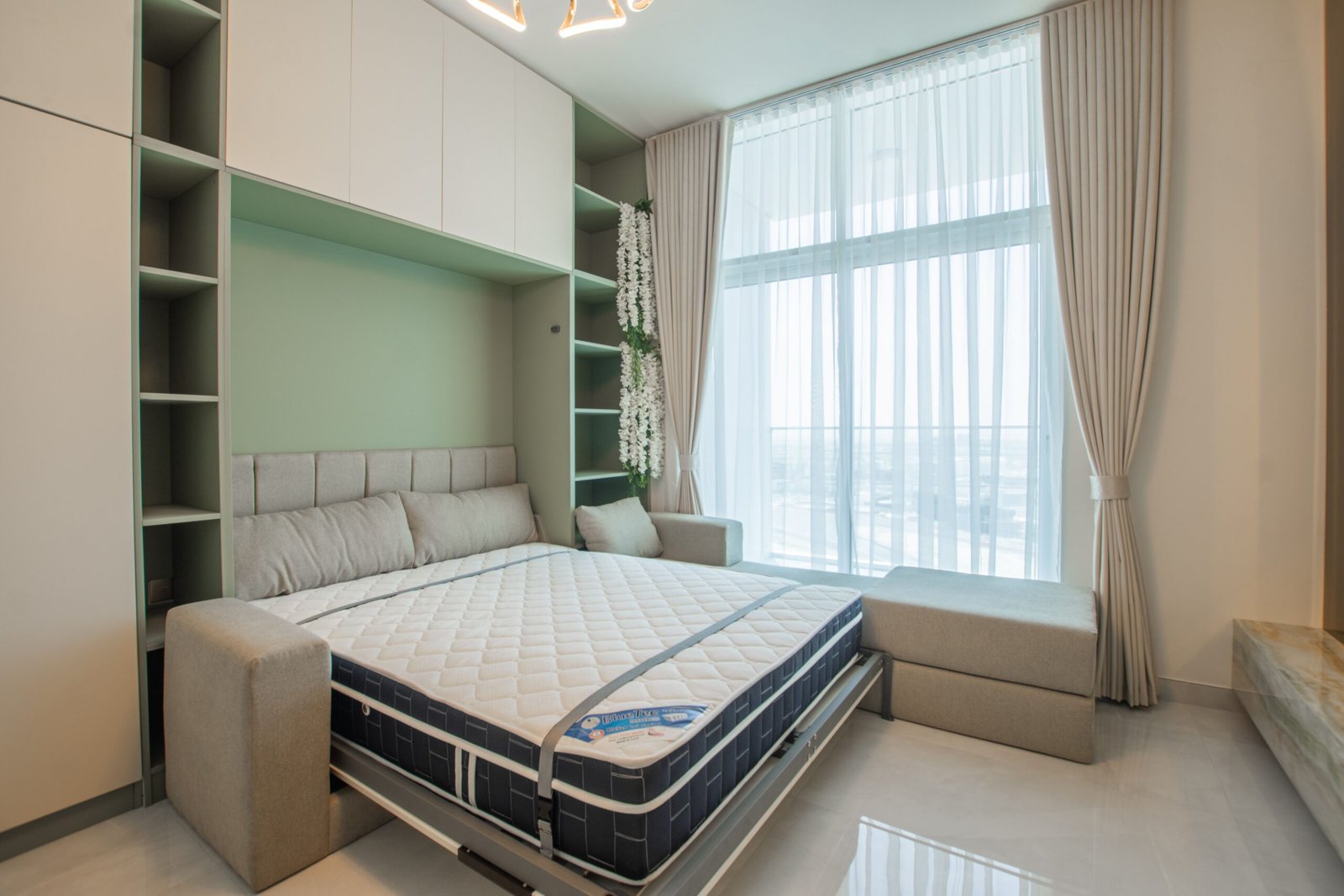
The bed sits in the middle, with tall open shelves on either side. The bed front is a simple paneled door or a painted flat panel. This is more affordable than the full-wall version and easier to build in phases.
3. Murphy Bed with a Built-In Desk
A desk folds down or stays fixed beneath the bed, so the room works as an office, a reading room, and a guest room. Some designs have the desk attached to the bed frame, and it folds down with a lamp and books still on it when you lift the bed. If you’re considering this, check the weight limits and the clearance carefully.
4. Window-Seat Style Library with Side Murphy Bed
Place the bed along one wall and build a cushioned reading nook with storage under the window. It’s a cozy layout for small rooms and gives you extra seating when guests visit.
5. Ladder Library with a Murphy Bed
In rooms with high ceilings, a rolling library ladder on a rail adds a classic touch. This works best with a vertical bed that doesn’t take up the entire wall, leaving the upper shelves reachable.
6. Dark, Moody Library Bed
Deep green, navy, or charcoal cabinetry with brass hardware gives the room a clubby, old-world look. Murphy beds disappear very well into dark finishes, which makes the effect convincing.
7. Light and Airy Scandinavian Style
Pale oak, white lacquer, and simple lines keep the room bright. This suits small rooms where heavy, dark cabinetry would feel crowded.
8. Murphy Bed with Hidden Storage Cabinets
Some designs add deep cabinets beneath or beside the bed for bedding, extra pillows, and out-of-season items. In a small home, this is a quiet superpower.
Benefits Worth Caring About
You get a real guest bed without losing a room. A good Murphy bed with a proper mattress is far more comfortable than a sofa bed or an air mattress.
Floor space comes back instantly. In a 10-by-12 room, a standing bed would eat roughly a third of the floor. A Murphy bed gives all of it back during the day.
It can add value to a small home. A flexible room that works as both a study and a bedroom is useful to buyers, though it won’t be treated the same as a legal bedroom everywhere.
The cabinetry doubles as storage. Library walls hold hundreds of books, display pieces, and baskets.
You can design the look you want. Unlike a standard bed, a library Murphy bed becomes part of the architecture.
Drawbacks to Know Before You Buy
Honest advice means telling you the downsides too.
It costs more than a standard bed. You’re paying for the cabinet, the hardware, and often custom carpentry.
Weight and wall strength matter. The bed has to be anchored properly to wall studs, and the books on the shelves add load. This isn’t a place to cut corners.
Daily use gets tiresome. If someone sleeps in it every night, the effort of folding it up each morning adds up. Murphy beds are best for guests or occasional use.
Bedding has to be managed. Some models let you leave light bedding in place, but most need you to strip and store it.
Ceiling height matters. Vertical beds need enough height for the mattress to swing up, and low ceilings can rule them out.
Cheap hardware causes frustration. Weak pistons or springs make the bed hard to lift or unsafe to lower.
Costs: What You’ll Really Pay
Prices vary by region, size, materials, and brand, so treat these as planning ranges and confirm with local quotes.
Option
Typical range (USD)
Notes
Ready-made Murphy bed cabinet
$1,500 – $4,500
Standard sizes and finishes
Murphy bed with side cabinets
$3,000 – $7,000
Includes matching shelving units
Hardware kit only (DIY build)
$300 – $900
Mechanism and hardware, you build the cabinet
Custom built-in library with bed
$6,000 – $15,000+
Full-wall carpentry, painted or stained finish
Mattress (Murphy-compatible)
$300 – $1,200
Thickness and flexibility matter
Installation labor
$300 – $1,500+
More for custom or tall units
A few things push the final number up or down:
Material. Solid wood costs more than veneer or MDF, though painted MDF is very common and looks excellent.
Size. Queen beds are the most popular, while king-size systems are significantly more expensive and need wider walls.
Finish. Spray-painted finishes cost more than basic laminate but look more refined.
Extras. Lighting, a built-in desk, and electrical outlets add to the cost.
Get at least three itemized quotes for custom work. A very low bid usually leaves something out, whether that’s hardware quality, finishing, or proper anchoring.
Custom, Kit, or Ready-Made?
Ready-made units from furniture and cabinet makers are the fastest and simplest option. You choose from standard sizes and finishes, and installation is straightforward. The downside is that they may not fit your room dimensions perfectly or blend seamlessly with existing bookshelves.
Hardware kits are popular with confident woodworkers. You buy the mechanism, which is the hardest and most safety-critical part, and build the cabinet yourself. A well-known source is Murphy Bed Hardware kits from Rockler, and you can also find options at Lowe’s and Home Depot.
Custom builds from a carpenter or cabinet shop give you the best-looking result. The bed becomes part of the library, with matching trim, paint, and shelves. Expect longer timelines and higher cost.
My view: if the bed will be used often and the library is a feature of the house, go custom. If it’s occasional guest use in a rental or a temporary space, a ready-made unit is far more sensible.
Planning Your Layout
Before you fall in love with a design, measure carefully.
Measure ceiling height. For a vertical bed, check the manufacturer’s minimum height requirement.
Check wall studs. The cabinet has to be anchored into solid framing, and you need to know where it is.
Leave floor clearance. A queen bed typically extends about 60 inches or more into the room when open. Make sure doors, desks, and furniture don’t block it.
Plan the lighting. Reading lights and electrical outlets are far easier to include during the build than to add later.
Think about door swings and windows. Windows near the bed area affect both privacy and light.
Sketch the room to scale on paper before you commit. It’s the single cheapest way to avoid expensive mistakes.
Choosing the Right Mattress
Not every mattress works in a Murphy bed. Most systems are designed around a mattress thickness of about 10 to 12 inches, and the manufacturer will specify this. A mattress that’s too thick may not fit when the bed is closed.
Memory foam and hybrid mattresses are the most common. Very heavy innerspring mattresses can strain the mechanism. Many Murphy beds also use straps to hold the mattress in place when folded, so bedding stays tidy.
Don’t buy a mattress before you’ve checked your bed’s specifications. It’s an easy error to make.
Installation: DIY or Pro?
A ready-made unit with clear instructions can be assembled by two handy people in a day, though some models require professional installation to keep the warranty valid. Hardware kits require real carpentry skill, since you’re building the box the mechanism lives in.
My strong advice is not to improvise the anchoring. A Murphy bed is a heavy piece of furniture that pivots through the air, so it has to be firmly secured to the wall studs. If you’re unsure, pay a professional for the installation, even if you build the rest yourself.
Follow the manufacturer’s instructions exactly, and test the bed with weight before you let anyone sleep in it.
Styling and Lighting Tips
A few small touches make the room feel intentional.
Match the bed front to the shelves. Use the same paint, trim, and hardware so the bed vanishes into the wall.
Add soft lighting. Picture lights, sconces, or LED strips inside the shelves make the room feel warm, and they make the books look better.
Choose a rug carefully. A low-pile rug works better than a thick one that catches the bed frame.
Keep a few shelves styled, not stuffed. Mixing books with art, plants, and objects gives the room a lived-in feel.
Include a reading chair. A good chair makes the room work as a library even when the bed is out.
Where the Category Is Heading
These are my expectations rather than certainties.
More integrated lighting and charging. Built-in lights, outlets, and USB ports will become standard in better units.
Combination furniture. Beds with fold-down desks, sofas, and storage will keep growing as homes shrink.
Quieter, smoother hardware. Soft-close mechanisms and better counterbalancing are becoming more common.
Sustainable materials. Expect more options in responsibly sourced wood and low-emission finishes.
Remote-working influence. As more people work from home, rooms that switch between office and guest room will stay in demand.
FAQs
Can a Murphy bed be built into a bookshelf? Yes. This is one of the most popular designs, with shelves on the sides or even on the front panel of the bed itself.
Are Murphy beds comfortable enough for guests? With a good mattress, yes. They’re usually more comfortable than sofa beds or air mattresses.
How much does a library Murphy bed cost? Ready-made units start in the low thousands, while custom built-ins can reach well beyond $10,000 depending on size and finish.
What size room do I need? A queen Murphy bed typically needs a room about 10 by 10 feet or larger, so there’s space for the bed when it’s open. Always check the manufacturer’s clearance specifications.
Can I leave the bedding on when I fold it up? Some models allow light bedding to stay in place with straps, but most work better when you strip and store it.
Are Murphy beds safe? Properly installed and anchored, yes. Choose reputable hardware and make sure the unit is fastened to wall studs.
Can I use a regular mattress? Usually not. You need a mattress that fits the thickness and weight limits of your specific system.
Will a Murphy bed damage my walls? It’s anchored into the wall, so there will be fastener holes if you remove it. The cabinet itself shouldn’t cause damage when installed correctly.
Conclusion
A library Murphy bed is one of the few space-saving ideas that actually improves a room instead of just compromising it. It lets a quiet, book-filled space do double duty without looking like a compromise, and when it’s designed well, the bed becomes a quiet surprise rather than an obvious piece of hardware.
If you take one thing from this guide, let it be this: start with how you’ll actually use the room. If guests are rare, keep it simple and affordable. The room is the heart of the house, invest in custom carpentry and quality hardware. In both cases, the real luxury isn’t the bed itself. It’s the freedom to use the same four walls for everything you need.
About the Author
The author is a home-improvement researcher and writer who studies residential design, space-saving furniture, and practical renovation decisions. Their work focuses on turning technical product information into clear guidance for homeowners, comparing real costs, tradeoffs, and long-term performance. They regularly review installation methods and manufacturer documentation to help readers avoid expensive mistakes.








1 Comment