




I’ve spent years remodeling bathrooms and living with the results—both the ones that work and the ones that become daily frustrations. One of the simplest upgrades that consistently changes how people feel in their showers is a well-chosen bench seat. It’s not just about accessibility or aging in place (though those matter). It’s about turning a standing chore into something more comfortable, safer, and oddly spa-like.
When I first added a built-in bench to my own primary bathroom years ago, I expected it to feel like a concession to practicality. Instead, it became the spot where I actually slow down—sitting to shave, rest a foot while washing, or just let the water run over tired shoulders. That personal shift is why I keep recommending them to clients and friends.
This guide covers the real benefits, the main types with honest comparisons of popular options, design ideas that look intentional rather than clinical, practical installation notes, and what to watch for. I’ve drawn from hands-on projects, product testing patterns I’ve followed, and current accessibility standards.
Table of Contents
- Why a Shower Bench Actually Improves Daily Life
- The Main Types of Shower Bench Seats
- Real Product Comparisons and Honest Verdicts
- Design Ideas That Feel Custom, Not Medical
- Materials, Dimensions, and Installation Essentials
- Accessibility and Future-Proofing Considerations
- Maintenance Realities and Longevity Tips
- Frequently Asked Questions
- Final Thoughts
- About the Author
Why a Shower Bench Actually Improves Daily Life
Most people stand through showers out of habit. Once you have a solid place to sit, the difference is immediate. Safety is the obvious win—falls in the bathroom remain one of the most common household injuries, especially for anyone with balance issues, joint pain, or recovering from surgery. A stable seat reduces that risk dramatically.
Beyond safety, comfort compounds. Sitting lets you take longer, more thorough showers without fatigue. Parents use them while bathing kids. People with limited mobility gain independence. Even able-bodied users discover practical perks: a place to prop a foot for easier leg shaving, a surface for bottles instead of a cluttered corner caddy, or a resting spot during long hair-washing sessions.
I’ve noticed another quieter benefit. In larger showers, a bench softens the empty expanse of tile and glass. It adds human scale. In smaller ones, the right style (especially fold-down) preserves standing room while still offering the option to sit. And from a resale perspective, thoughtfully designed benches signal a home built for real living rather than pure aesthetics.
Space efficiency is often underestimated. A corner bench uses otherwise dead square footage. A full-width bench can double as a towel ledge or plant perch for humidity-loving greenery. The key is matching the type to how the shower is actually used day to day.
The Main Types of Shower Bench Seats
Not every bench works in every shower. Here are the primary categories I evaluate on projects, with their strengths and trade-offs.
Built-in (tiled or solid) benches
These are framed into the shower structure—whether with lumber, concrete block, high-density foam boards like Kerdi or Wedi, then waterproofed and finished with tile, stone, or solid surface. Full-width versions run along one wall. Corner or triangular ones nest into the angle. Floating versions cantilever from the wall with no floor contact underneath.
Pros: Seamless look, high weight capacity when properly built (often well over 250–400 lbs), permanent feel, excellent for aging-in-place.
Cons: Requires planning during construction or a more involved remodel; once built, it’s fixed. Needs careful slope for drainage (about ¼ inch per foot toward the drain) and thorough waterproofing.
Best for primary baths or new construction where you want a spa aesthetic.
Fold-down or wall-mounted seats
These hinge from the wall and flip up flat when not needed. Many meet ADA guidelines for size and strength. Materials range from phenolic resin and plastic to teak with stainless hardware.
Pros: Zero permanent footprint, ideal for compact showers or multi-user households. Easy to retrofit in many cases. High weight ratings (250–400+ lbs common).
Cons: Installation must hit solid blocking or reinforced backing—never just drywall. Some models still carry a more utilitarian appearance unless you choose carefully.
Freestanding stools and chairs
Portable options in teak, plastic, aluminum, or bamboo-style synthetics. Some have backs and armrests; others are simple stools. Teak versions are popular for their natural water resistance and warmer look.
Pros: No installation, movable, can be removed for cleaning or guests. Stylish teak models avoid the medical look entirely.
Cons: Can shift on wet floors if feet lack good grips; take up floor space when present; weight capacity and stability vary widely.
Transfer benches
These straddle the tub or shower curb so a user can sit outside and slide across. Useful for tub-to-shower conversions or limited mobility.
Pros: Reduce the need to step over a high threshold.
Cons: Often bulkier and more institutional in appearance; can interfere with curtains or doors.
Floating and L-shaped variations exist within the built-in and wall-mounted categories. Floating ones open up the floor for easier cleaning and a more modern visual. L-shaped designs help with transfers for people with strength imbalances on one side.
Real Product Comparisons and Honest Verdicts
I’ve tracked reviews, specs, and user feedback across categories rather than relying on marketing claims. Here’s a practical side-by-side of representative options that come up repeatedly in testing and real-world use.
Teak freestanding benches (spa aesthetic)
Models like the EcoDecors Symmetry or Harmony, AquaTeak originals, and TeakCraft Hermod stand out. EcoDecors versions often feature raised sides that double as handholds, a lower shelf for bottles, and seating around 23–24 inches wide by 14 inches deep. Weight capacities typically land at 250–300 lbs. Seat height sits near 18–18.5 inches—comfortable for most adults.
Honest take: These look the best in a finished bathroom. Teak’s natural oils resist water better than most woods, but they still need periodic oiling or the finish dulls and the wood can roughen. Fully assembled options (like some TeakCraft) save frustration. Avoid cheap bamboo look-alikes—many show mold or degradation faster in constant humidity. Premium teak is worth it if aesthetics matter; otherwise a high-quality plastic or aluminum chair may last longer with less care.
Wall-mounted fold-downs (space-savers)
Moen Home Care and similar phenolic or teak-faced models. Many fold completely against the wall. Capacities often reach 400 lbs when installed correctly. Depths around 15–16 inches align with accessibility recommendations.
Honest take: Excellent for smaller showers or households where not everyone needs a seat every day. The critical failure point is always the wall backing. I’ve seen poorly installed units pull away over time. Spend the money on solid blocking during the remodel. Stylish teak versions exist, but plastic/phenolic are easier to wipe clean.
Standard shower chairs (medical/functional)
Wirecutter-style testing frequently highlights adjustable plastic models with armrests and backs, such as certain KingPavonini or similar heavy-duty chairs. Height adjustability (often 15–20 inches range), tool-free assembly, and capacities of 300–400 lbs are common. Some include cutouts for personal care.
Honest take: These prioritize function over looks. They’re the practical choice for temporary recovery or serious mobility needs. The best ones drain well and feel stable; cheaper ones flex or have slick seats. Pair any of them with a non-slip mat and grab bars.
Built-in custom
No single “product,” but foam systems (Schluter Kerdi-Board benches, Wedi) simplify framing and waterproofing compared with traditional lumber + cement board. Finished with matching tile or a quartz slab for a floating effect.
Honest take: Highest long-term satisfaction when done right. Cost varies widely ($500–1,500+ for the bench portion depending on tile and labor), but the seamless result justifies it in primary baths. Poor waterproofing is the number-one cause of future problems—never skip a continuous membrane.
Quick comparison summary
- Best overall aesthetics: Premium teak freestanding
- Best for tiny showers: Fold-down wall mount
- Best for serious accessibility: Properly installed fold-down or transfer bench + grab bars
- Best long-term value in a remodel: Built-in tiled or floating stone
- Avoid: Untreated softwoods, cheap bamboo without rigorous maintenance, and any seat mounted only to drywall
Always check current weight ratings, return policies, and warranty details on manufacturer or retailer sites such as those linked in Wirecutter reviews or specialty suppliers.
Design Ideas That Feel Custom, Not Medical
The best benches disappear into the overall design. Match the bench finish to the shower walls—same tile creates continuity. Contrast with a different material (warm teak against cool porcelain, or a quartz slab against mosaic) for intentional interest.
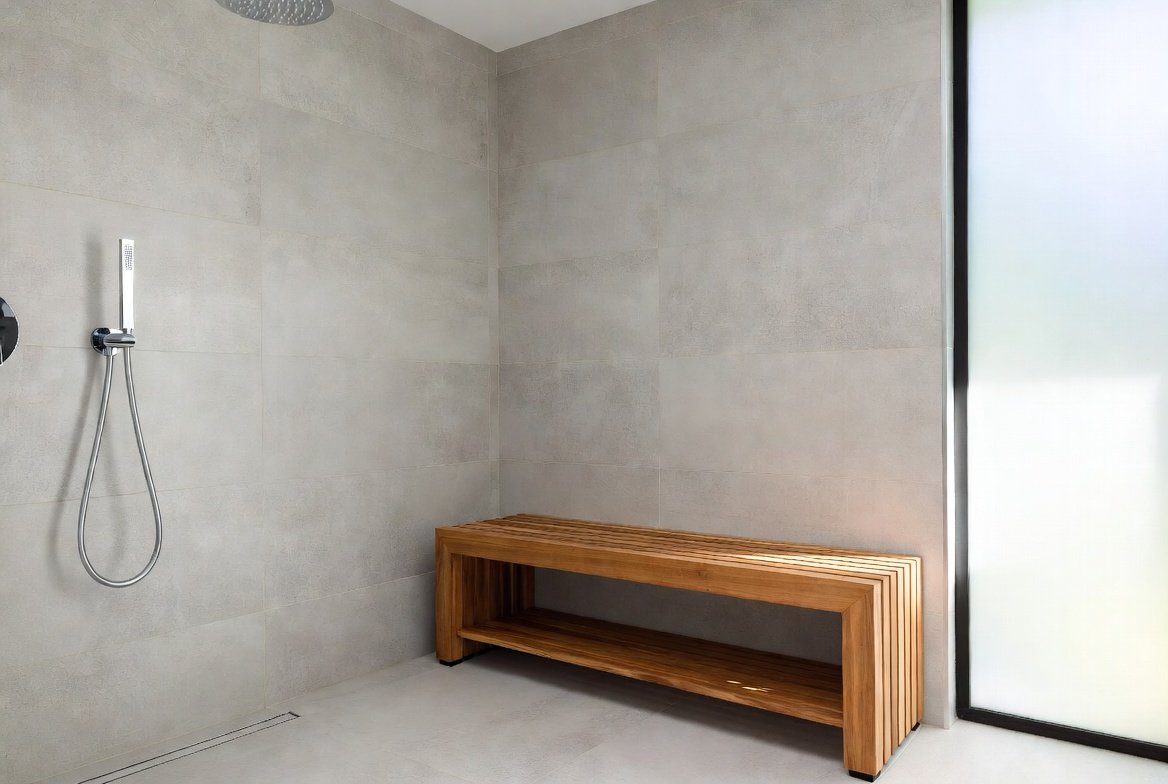
Floating benches with open space underneath make small showers feel larger and simplify floor cleaning. Full-width benches along the long wall of a 36×60-inch or larger enclosure create a true spa seat. Corner triangles preserve the most standing room in square stalls.
Add subtle details: a slight radius on the front edge for comfort, integrated niches nearby for bottles, or a recessed area under a floating bench for extra storage. In curbless or wet-room designs, the bench becomes part of the continuous floor plane.
I’ve seen successful pairings with linear drains that keep water moving past the bench without pooling. For neo-angle showers, a custom-cut wedge or corner seat follows the glass line cleanly. Lighting matters too—a soft sconce or recessed light aimed near the seat improves usability without glare.
Think about multi-function: the bench as a place to set a folded towel, a plant, or even a small stool for kids. The goal is a surface that invites use rather than shouting “accessibility feature.”
Materials, Dimensions, and Installation Essentials
Ideal seat height lands between 17 and 19 inches above the finished floor for most adults—close to standard chair height and aligned with accessibility guidance. Depth of 15–16 inches minimum supports comfortable sitting without forcing the user too far back against the wall; deeper is fine if space allows.
Slope the top surface gently toward the drain so water doesn’t sit. Frame for at least 250 lbs concentrated load (higher for accessibility-focused designs). Use pressure-treated or better yet foam/waterproof board systems for the structure. Apply continuous waterproofing membrane over every surface and joint before tiling or finishing.
For freestanding, prioritize non-slip feet and materials that handle constant wet-dry cycles. Teak remains the gold standard among woods; solid surface, porcelain, quartz, and high-quality plastics follow closely.
Installation tip from experience: Coordinate the bench with glass panels early. Leave clearance so doors or fixed panels don’t collide with the seat edge. Rough-in plumbing and drain location affect slope and bench placement—plan both together.
Accessibility and Future-Proofing Considerations
ADA guidelines (useful even for private homes aiming for aging-in-place) recommend seat heights of 17–19 inches, depths of 15–16 inches, and specific clearances in transfer or roll-in showers. Grab bars on the side and back walls (33–36 inches high) complete the system.
Even if you don’t need full compliance now, designing to these dimensions costs little extra and pays off later. Fold-down seats offer flexibility if needs change. Curbless entries pair especially well with benches for seamless access.
Maintenance Realities and Longevity Tips
Built-in tiled benches need occasional grout sealing and good ventilation to prevent mold in corners. Stone slabs require less frequent sealing than porous materials. Teak benefits from annual or semi-annual oiling depending on water exposure—skip it and the surface roughens. Plastic and aluminum wipe clean with mild soap; avoid abrasive cleaners that dull finishes.
Dry the seat after use when possible. Check wall-mounted hardware periodically for tightness. Properly built and maintained benches last decades; shortcuts in waterproofing or backing show up as leaks or looseness within a few years.
Frequently Asked Questions
Do I need a big shower to add a bench?
A corner seat works in many 36×36-inch stalls. Full-width benches feel best in 36×60-inch or larger footprints so standing room remains comfortable.
Can I retrofit a bench into an existing shower?
Fold-down and freestanding options are the easiest. Built-in usually means opening walls or floors for framing and waterproofing—more realistic during a full remodel.
What’s the weight capacity I should look for?
Residential minimum of 250 lbs is common; 300–400+ lbs is preferable, especially for accessibility. Capacity depends on both the seat and its mounting.
Will a bench make the shower feel smaller?
A poorly placed full-depth bench can. Corner, floating, or fold-up designs minimize that effect. Open space under a floating bench actually helps visual flow.
Are teak benches really worth the price?
For looks and natural durability, yes—if you maintain them. For pure function and low maintenance, high-quality synthetic or metal options often win long-term.
Final Thoughts
A shower bench is one of those upgrades that reveals its value only after you live with it. The right one disappears into the design while quietly making every shower safer and more pleasant. Whether you choose a seamless tiled built-in for a primary bath, a fold-down for a guest space, or a handsome teak stool that can move around, start with how the people in the household actually use the shower—and plan the structure and waterproofing as carefully as the finish.
I’ve never regretted adding one. The only regret is not specifying better drainage slope or stronger backing on a couple of early projects. Get those fundamentals right, match the style to the room, and the bench becomes a natural part of a better bathroom rather than an afterthought.
About the Author
Alex Rivera is a residential remodel specialist and independent researcher focused on practical bathroom design and aging-in-place solutions. With over 15 years of hands-on experience renovating homes across multiple climates, Alex has installed, tested, and lived with dozens of shower configurations. Their work emphasizes durable construction details, realistic product performance, and designs that serve real daily life rather than just photographs. When not on job sites or reviewing materials, Alex writes about thoughtful home improvements that balance aesthetics, safety, and longevity.