I didn’t think much about drink tables until I moved into a smaller apartment and realized my coffee table was three feet away from the armchair I actually sat in every night. I kept setting my glass on the floor, on a stack of books, once memorably on top of a candle. A friend who works in furniture retail took one look at my living room and said, “You don’t need a coffee table. You need a drink table.” She was right, and once I bought one, I understood why this tiny category of furniture has quietly become one of the most useful pieces in a well-planned room.
This guide covers everything I wish someone had told me before I started shopping: what a drink table actually is, the different styles you’ll run into, which materials hold up in real life, and how to pick one without wasting money on something that looks great in a catalog photo and wobbles the moment you set a glass on it.
Table of Contents
What Is a Drink Table, Exactly?
Where the Drink Table Comes From
Drink Table vs Side Table vs Coffee Table: The Real Differences
Types of Drink Tables
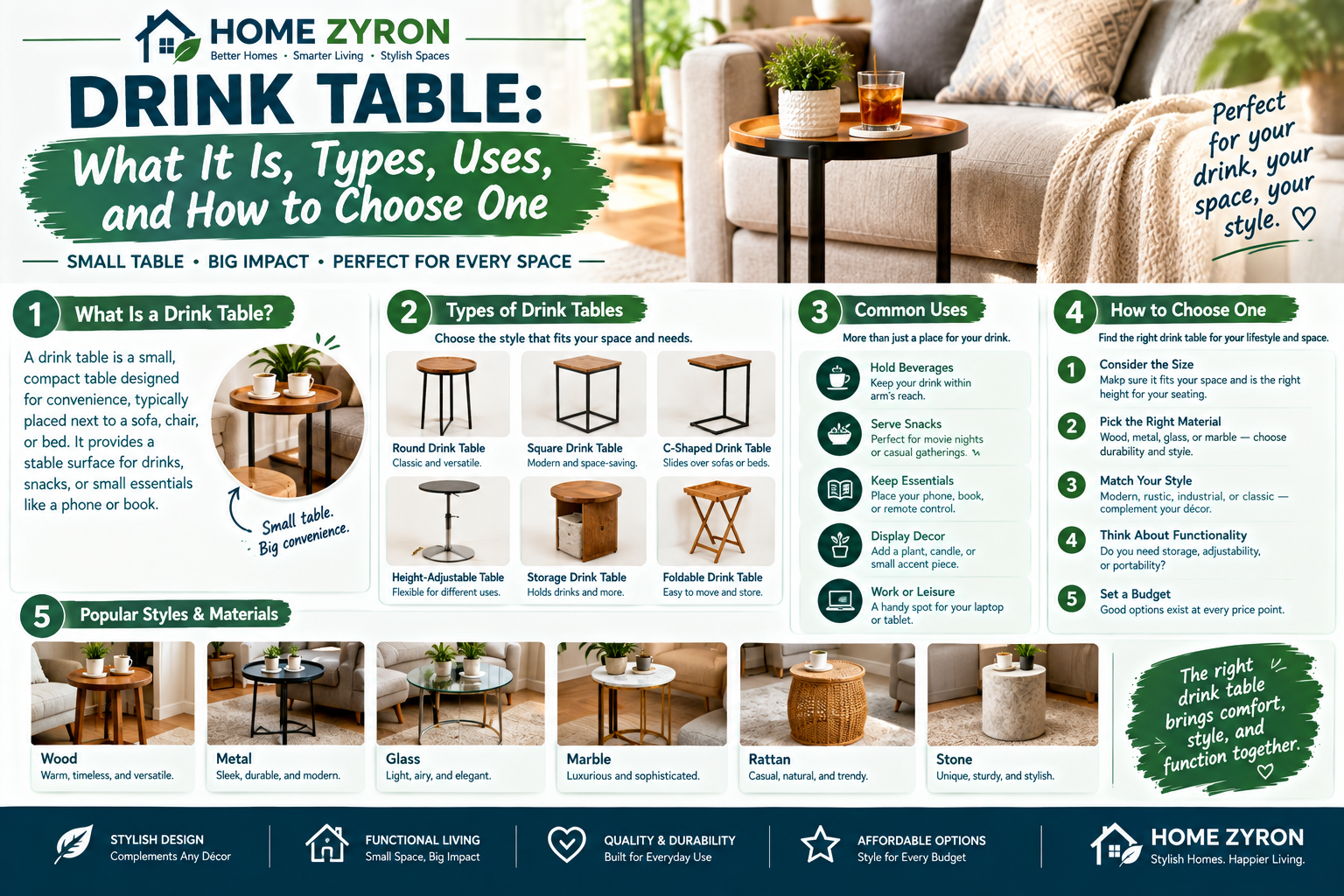
Materials Compared: Wood, Metal, Glass, Marble, and Rattan
Real-World Uses That Actually Make Sense
How to Choose the Right Drink Table
Popular Drink Table Options Compared
Mistakes People Make When Buying One
Where Drink Tables Are Headed
FAQs
Final Thoughts
About the Author
What Is a Drink Table, Exactly?
A drink table is a small, low, freestanding table designed to hold exactly what its name suggests — a drink, plus maybe a coaster, a phone, or a small plate. It’s not meant to be a workspace, a display shelf, or a storage unit. It’s meant to sit within arm’s reach of wherever a person is sitting, and then get out of the way when it’s not needed.
Technically, a drink table falls under a broader furniture category called <a href=”https://en.wikipedia.org/wiki/Occasional_furniture” target=”_blank” rel=”noopener”>occasional furniture</a> — pieces that are brought into use “as the occasion demands” rather than serving one fixed, permanent function. That’s really the defining trait. A dining table has one job. A drink table has whatever job the moment requires: holding a cocktail during a dinner party, propping up a laptop while you’re on the couch, or acting as a landing pad for keys and mail by the front door.
Most drink tables sit somewhere between 18 and 26 inches tall, with a tabletop small enough to fit one or two items — usually under 18 inches in diameter or width. That small footprint is the whole point. It lets the table slide into gaps that a coffee table or console table physically can’t reach.
Where the Drink Table Comes From
Small occasional tables have a longer history than most people assume. Georgian and Regency-era English furniture makers built <a href=”https://foundersantiques.co.uk/collections/antique-occasional-tables” target=”_blank” rel=”noopener”>antique occasional tables</a> specifically to be carried into a room “on occasion” — to hold a glass of wine or a tea service — and then moved aside once the moment passed. These pieces were deliberately lightweight and easy to reposition, which is exactly the same design logic behind the modern drink table sitting next to a sectional sofa today.
What’s changed is scale and specialization. The 18th-century occasional table did a bit of everything. Today’s drink table is a narrower, more purpose-built descendant, shaped by smaller apartments, open-plan living rooms, and a renewed interest in furniture that looks intentional rather than filler. Interior press outlets have been calling it one of the more interesting “small furniture” trends of the past few years, largely because it solves a real spatial problem rather than just adding decoration.
Drink Table vs Side Table vs Coffee Table: The Real Differences
People use these terms interchangeably, and honestly, in casual conversation it doesn’t matter much. But if you’re shopping, knowing the distinction saves you from buying the wrong scale of furniture.
Feature
Drink Table
Side Table
Coffee Table
Typical height
18–26 in
22–28 in
16–18 in
Typical top size
10–16 in
18–24 in
36–50 in long
Primary job
One drink, one small object
Lamp, books, decor
Central surface, shared use
Placement
Pulled up to a single seat
Fixed beside a chair or sofa arm
Center of a seating group
Mobility
Usually light enough to move often
Occasionally moved
Rarely moved
A is generally meant to stay put next to a specific piece of furniture. A drink table is meant to travel — you pick it up, set it where you’re sitting, and move it again later. A coffee table, meanwhile, is a shared surface for a whole seating group, which is exactly the job a drink table refuses to do. If your living room already has a coffee table that’s too far from your favorite chair, a drink table fixes that gap without you having to rearrange anything.
Types of Drink Tables
Once you start looking, you’ll notice drink tables come in a handful of recognizable shapes, each solving a slightly different problem.
1. The C-Table
This is the one most people picture. It has a base shaped like the letter C, which lets it slide partially underneath a sofa, armchair, or even a bed, so the tabletop hovers right next to you without the base taking up floor space in front of the seat. I own one in blackened steel with a smoked glass top, and it’s genuinely the most-used piece of furniture in my apartment — it slides under my reading chair during the day and pulls out for drinks the moment guests arrive.
C-tables are popular precisely because the cantilevered design solves a spacing problem that a standard four-legged table can’t: you can’t push a normal table’s base under upholstered furniture without it hitting the frame.
2. Pedestal and Tripod Drink Tables
These have a single central column or three splayed legs supporting a small round or square top. They’re the most traditional-looking option, and they don’t slide under anything, but their narrow footprint means they barely register visually in a room. Tripod tables have roots in 18th-century tea service furniture, and that heritage still shows in how many of them are designed today — turned wood legs, carved detailing, a slightly formal air.
3. Tray Tables
Essentially a small folding table with a removable or fixed tray top, often with handles. These are the most portable option in the category, and the best choice if you genuinely need to carry the table (and whatever’s on it) from the kitchen to the patio. They fold flat for storage, which matters if you’re working with limited space or you only need extra surfaces occasionally, like during parties.
4. Nesting Drink Tables
A set of two or three tables in graduated sizes that stack together when not in use. You can split them up to serve multiple people, or nest them back into one compact footprint. I think this is the most underrated option for anyone who entertains semi-regularly but lives in a smaller space — you get the flexibility of three tables with the storage footprint of one.
5. Bar Carts
Not technically a drink table, but worth mentioning because people often shop for one when they actually want the other. A bar cart is larger, has multiple tiers, and is built for storing and serving drinks rather than simply holding one glass. If your goal is a rolling home bar, get a cart. If your goal is somewhere to rest a glass next to your chair, a cart is overkill — go with an actual drink table instead.
6. Outdoor Drink Tables
Built from weather-resistant materials like teak, powder-coated aluminum, or all-weather wicker, these are scaled and finished for patios, decks, and poolside seating. The key difference isn’t really the shape — it’s the hardware. Look for stainless steel fasteners and finishes explicitly rated for outdoor or “all-weather” use, because a table that merely looks rugged can rust or warp within a season if it wasn’t actually engineered for exposure.
7. Smart or Tech-Integrated Tables
A newer, smaller niche: drink tables built with wireless charging pads embedded in the top, or small built-in USB ports. I’m mixed on these — the charging pad is genuinely handy, but I’ve seen too many where the electronics fail long before the table itself wears out, and then you’re left with a slightly overpriced regular table. If you go this route, buy from a brand with a real warranty on the electrical component, not just the furniture.
Materials Compared: Wood, Metal, Glass, Marble, and Rattan
Material
Durability
Weight
Best For
Watch Out For
Solid wood
High
Medium-heavy
Living rooms, long-term ownership
Can scratch or water-ring without a sealed finish
Engineered wood/veneer
Medium
Light-medium
Budget-friendly rooms
Chips at edges, doesn’t take refinishing well
Metal (steel, iron)
Very high
Medium
C-tables, modern spaces
Can feel cold visually without a warm top material
Glass top
Medium
Light-medium
Small rooms, visual openness
Shows fingerprints and dust constantly
Marble/stone
High (but brittle)
Heavy
Statement pieces
Chips at corners, etches with acidic spills like wine or citrus
Rattan/wicker
Medium
Very light
Outdoor or casual indoor spaces
Indoor-rated rattan degrades quickly outside
If I’m being honest about my own experience: glass tops look fantastic in photos and get visibly grimy within about three days of real use, especially if you’ve got pets or kids. Marble is stunning but genuinely risky around red wine — I learned this the hard way with a etched ring that never fully buffed out. Solid wood with a matte polyurethane finish has been the least fussy option in my own home, and it’s what I’d recommend to anyone who wants to stop thinking about the table after they buy it.
Real-World Uses That Actually Make Sense
Beside a reading chair that’s too far from the coffee table. This is the single most common reason people end up buying one, myself included.
As overflow seating surfaces during parties. Nesting tables split apart and scattered around a room solve the “everyone’s standing around holding a plate” problem better than any single large table.
Next to a bathtub. A small, water-resistant drink table (metal or sealed wood, never raw wood or unfinished veneer) holds a glass of wine or a candle within reach.
In a home office, as a landing spot for coffee that keeps it off the actual desk and away from your laptop.
On a patio or balcony, paired with a single outdoor chair where a full-size outdoor coffee table wouldn’t fit.
As a nightstand substitute in a small bedroom — a C-table slides under the bed frame and pulls out flush with the mattress edge, which is a trick a lot of studio apartment dwellers use.
How to Choose the Right Drink Table
Before you buy, run through this checklist. I skipped most of these steps on my first purchase and ended up returning a table that was two inches too tall for my sofa arm.
Measure your seat height first. A drink table’s surface should sit roughly level with, or slightly below, the arm of your chair or sofa — generally within an inch or two. Too tall, and you’re reaching up; too short, and you’re bending down.
Check under-furniture clearance if you want a C-table. Measure the gap between your floor and the underside of your sofa or chair frame. Many C-table bases need at least 3–4 inches of clearance to slide under comfortably.
Decide if it needs to move often. If yes, prioritize weight and grip — a light metal or hollow-core wood table is easier to reposition than solid stone.
Think about what’s actually going on top. A wine glass and a candle need a stable, level, heat- and stain-resistant surface. A laptop needs a slightly larger, sturdier top with enough weight capacity that it won’t tip.
Match the base style to your existing furniture, not just the top. A sleek glass top on a heavy Victorian-style base looks like two different tables got married. Keep the leg or base style consistent with your room’s dominant style.
Budget for the material, not just the size. A small table isn’t automatically cheap — a solid marble drink table can cost more than a much larger laminate coffee table because of the material itself.
Popular Drink Table Options Compared
Here’s an honest breakdown of how the major style categories generally stack up against each other when you’re shopping online. I’m comparing by design language and typical price tier rather than any one specific SKU, since inventory changes constantly.
Style Category
Typical Price Range
Design Strength
Honest Drawback
Mainstream retailer C-tables (metal frame, wood or glass top)
Budget to mid-range
Reliable, widely available, easy to match to modern rooms
Base welds and finishes vary a lot in quality between brands at the low end
Better hardware, more refined finishes, sturdier welds
Noticeably pricier for what’s still a small piece of furniture
Vintage or antique tripod/pedestal tables
Highly variable
Genuine character, often solid wood construction that’s already survived decades
Requires more careful shopping — condition and stability vary piece to piece
Budget flat-pack nesting sets
Budget
Cheapest way to get multiple surfaces at once
Engineered wood tops chip easily and legs can wobble if assembled imperfectly
Outdoor-rated aluminum or teak drink tables
Mid-range
Genuinely weatherproof, low maintenance
Limited style variety compared to indoor options
My honest verdict after buying from a few different tiers over the years: mid-range C-tables from mainstream retailers hit the best value-to-durability ratio for most people. The jump in quality from budget to mid-range is significant — better welds, sturdier glass, less wobble. The jump from mid-range to designer boutique pricing is mostly about finish quality and brand name, which matters less if the table’s daily job is just holding a coffee mug.
Mistakes People Make When Buying One
Buying based on photos alone, without checking dimensions against their own seating. A table that looks proportionate in a wide-angle product photo can be comically small or oversized in your actual room.
Choosing glass or glossy marble for a household with kids or pets, then being surprised at how quickly it shows wear.
Ignoring weight capacity. Some decorative drink tables are rated for light objects only — a laptop or a heavy book can genuinely be too much for a delicate design.
Skipping the “does it match my other furniture’s undertone” check. Warm wood next to cool-toned gray furniture can look mismatched even when both pieces are individually attractive.
Assuming all C-tables slide under all sofas. Low-profile modern sofas with skirted bases often block C-table bases entirely — always check clearance first.
Where Drink Tables Are Headed
I think the next phase for this category is multi-functionality without added bulk. We’re already seeing tables with modular trays that lift off for serving, or bases that convert between a fixed side table and a mobile C-table depending on how you position them. Sustainable materials are creeping in too — reclaimed wood tops and recycled aluminum bases are becoming more common as buyers pay closer attention to how furniture is sourced, not just how it looks.
I’d also bet on more integrated tech, but done better than the current generation. Wireless charging will likely become a standard option rather than a novelty add-on within the next few years, especially as more people use their living rooms as informal workspaces. The trick will be brands building it in without making the table feel like a gadget instead of furniture.
FAQs
Is a drink table the same as a side table? Not quite. A drink table is smaller, more mobile, and meant to hold one or two items near a single seat. A side table is typically larger, fixed in place, and does more general-purpose duty, like holding a lamp.
What height should a drink table be? Aim for roughly level with, or an inch or two below, the arm of the chair or sofa it’ll sit beside. Most fall between 18 and 26 inches tall.
Can a drink table replace a coffee table? For one or two people, yes — especially in a small apartment. For a full seating group where multiple people need a shared surface, a coffee table still does that job better.
What’s the most durable material for everyday use? Solid wood with a sealed finish, or powder-coated metal, tend to hold up best against daily wear, spills, and moving around.
Are C-tables sturdy enough for a laptop? Most are, but check the weight rating first. Cheaper models with thin metal bases can wobble under a heavier laptop, especially if you’re typing on it directly.
Do I need a matching pair for two chairs? Not necessarily. A lot of designers now intentionally mismatch drink tables across a room for a more collected, less showroom look — just keep a shared material or color thread running between them.
Final Thoughts
A drink table is one of those pieces of furniture you don’t think you need until you’ve lived without one for too long, constantly setting your coffee mug on the arm of a chair or the floor. It’s small, it’s inexpensive relative to almost everything else in a living room, and it solves a genuinely specific problem: getting a stable surface exactly where your hand naturally reaches, without committing to a big piece of furniture or a permanent layout change.
If I were starting from scratch again, I’d measure my seating first, pick a material based on how I actually live rather than how a showroom photo looks, and resist the urge to buy the trendiest option before checking whether it actually fits under my sofa. Get those basics right, and a drink table quietly becomes one of the most-used pieces in the room — which, for something this small, is a pretty good return on investment.
About the Author
This guide was researched and written by a furniture and interior design writer who specializes in small-space living and practical home furnishing decisions. Drawing on years of hands-on furniture testing, material research, and direct conversations with retailers and independent furniture makers, the author focuses on cutting through marketing language to give readers grounded, real-world buying advice rather than showroom talking points. Their work centers on helping readers make furniture decisions based on how a piece will actually perform in daily life — not just how it photographs.




1 Comment