Most people choose a roof the way they choose paint: by looking at it. That’s understandable, because the roofline defines how a house looks from the street. But the shape of your roof also affects how your home handles wind, how much attic space you get, how much you’ll pay for repairs, and how comfortable the upstairs feels in July.
Hip and gable roofs are the two most common shapes on residential homes. They look different, they behave differently, and they cost differently. Neither is automatically better. The right answer depends on where you live, what you’re building, and what you want from the space under the roof.
This guide breaks down both honestly, so you can make the choice with your eyes open.
What Is a Gable Roof?
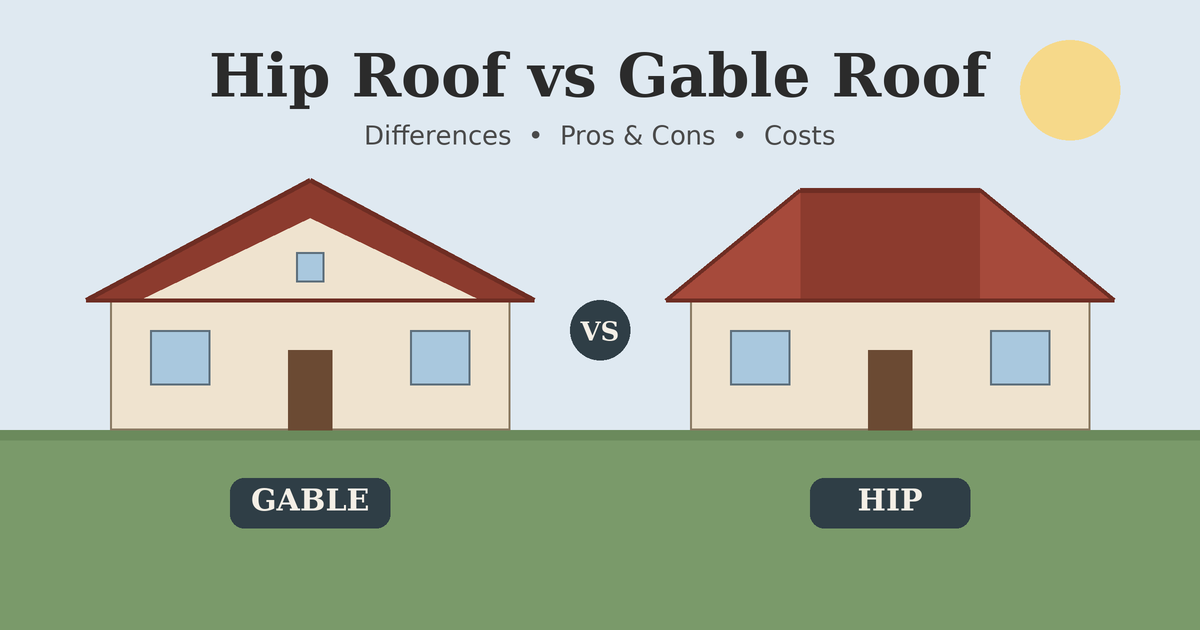
A gable roof has two sloping sides that meet at a ridge in the middle. The triangular section of wall at each end of the house, called the gable, is what gives the roof its name. If you picture a child’s drawing of a house, you’re picturing a gable roof.
Its simplicity is its biggest strength. Two planes, one ridge, and relatively few joints mean fewer places for things to go wrong, and fewer hours of labor to build it.
Variations include the side gable, where the ridge runs parallel to the street, the front gable, where the gable end faces the street, and the cross gable, where two gable sections intersect to form an L or T shape.
What Is a Hip Roof?
A hip roof slopes on all four sides. The sloping sides meet at the top in a ridge, which is usually shorter than a gable ridge, and the corners where two slopes meet form diagonal lines called hips. There are no vertical gable walls.
This gives the house a more compact, grounded look, with eaves running around the entire perimeter. Variations include the pyramid hip, which comes to a single point on a square house, the half-hip, which has short gable-like sections at the ends, and the cross hip, which is common on more complex floor plans.
The Key Differences at a Glance
Feature
Gable Roof
Hip Roof
Number of slopes
2
4
Vertical end walls
Yes (gable ends)
No
Construction complexity
Simpler
More complex
Typical cost
Lower
Higher
Wind resistance
Good in mild conditions, weaker at gable ends
Generally stronger
Attic space
More usable
Less usable
Ventilation options
Straightforward
Slightly more limited
Eave shade
Only on the long sides
All around
Leak risk
Fewer joints, lower risk
More joints, slightly higher risk
If you only remember one thing from this table, remember this: gable roofs win on simplicity and cost, and hip roofs win on stability and wind performance.
Wind and Storm Performance
This is the area where the two designs differ most, and it’s the reason many homeowners in storm-prone regions lean toward hip roofs.
A hip roof’s four sloping sides create a low, aerodynamic shape, and the slopes brace each other. Wind has no flat wall to push against, and the roof structure is inherently stronger because the rafters meet at the corners and form a rigid unit. Research from organizations like the Insurance Institute for Business & Home Safety and guidance from FEMA has consistently pointed toward hip roofs performing better than gable roofs in high-wind events like hurricanes.
Gable roofs are vulnerable at the gable ends. The flat triangular wall acts like a sail, and in strong winds it can push inward or the overhang can lift. This doesn’t mean a gable roof will fail in a storm, because a properly braced gable end with good connections can perform well. But it does mean the bracing and fastening details matter much more with a gable.
If you live in a hurricane or high-wind region, a hip roof is usually the safer starting point. If you live in a calm area, the wind advantage matters less, though it’s still a real benefit.
Cost Comparison
Prices vary by region, roof size, pitch, and material, so treat these as planning ranges rather than quotes.
Cost factor
Gable Roof
Hip Roof
Framing and labor
Lower
Higher, due to more cuts and angles
Roofing materials
Lower
Higher, due to more surface area and waste
Typical total cost difference
Baseline
Often noticeably higher than gable
Repair costs
Usually simpler
Can be higher due to complexity
Long-term insurance impact
Varies
Sometimes lower premiums in wind-prone areas
Hip roofs generally cost more because they require more rafters, more cutting, and more precise framing. There’s also more material waste, since the angles produce more offcuts. Roofers often charge more for the added labor, and the difference can be significant on a large or complicated house.
That said, the lower upfront cost of a gable roof doesn’t always mean lower lifetime cost. In regions with severe storms, a hip roof may reduce storm damage and, in some cases, insurance premiums. It’s worth asking your insurance provider if a roof shape affects your rates, since some insurers consider wind resistance in their pricing.
If you’re also planning a re-roof, our guide to shingling a roof from industry resources like the Asphalt Roofing Manufacturers Association is a useful place to start for understanding material and installation costs.
Attic Space and Ventilation
Here the advantage tips toward gable.
A gable roof usually creates a large, open attic with plenty of headroom. That’s valuable if you want storage, a future bedroom, or a loft. Gable ends also allow for simple, effective ventilation, since louvers or vents can be placed in the end walls to let air flow through.
A hip roof typically has less usable attic space, because the sloping sides on all four edges reduce the area where you can stand upright. Ventilation is still achievable, but it usually relies on ridge vents, soffit vents, and sometimes roof-mounted vents rather than gable-end vents. Done properly, it works well, but it needs more planning.
For homeowners who want to convert the attic into living space later, gable roofs offer more room to work with. For those who see the attic as simple storage or just insulation space, the difference may not matter much.
Appearance and Architectural Style
Neither shape is more attractive in an absolute sense, but they suit different architectural styles.
Gable roofs suit cottages, colonial homes, Cape Cods, Tudors, farmhouses, and many traditional designs. The triangular gable end also gives you a spot to add decorative details like windows, vents, trim, or a small porch roof.
Hip roofs suit ranch homes, bungalows, Craftsman-style houses, and many contemporary designs. The continuous eave gives the house a calm, balanced appearance and provides more shade around the walls.
Cross gables and cross hips can add visual interest to larger homes, though they also add complexity and cost.
If you’re matching an existing neighborhood or building in a historic district, check local guidelines. Some areas have rules about roof shapes.
Maintenance and Leak Risk
Every roof joint is a place where water can find a way in. Valleys, hips, and ridges all need proper flashing and sealing.
A simple gable roof has fewer of these intersections, which means fewer potential leak points. Maintenance tends to be straightforward, with fewer areas where debris and water collect.
A hip roof has more ridges and hips, which means more places where shingles and flashing must be installed correctly. When installed well, a hip roof is very reliable. But if the workmanship is poor, those extra seams can become trouble spots.
Both types benefit from regular inspections, clean gutters, and prompt repair of any damaged shingles or flashing. Complex roofs of either type, with multiple valleys and dormers, simply have more areas to watch.
Snow, Rain, and Climate Considerations
Snow: Both shapes shed snow well when pitched steeply enough. Gable roofs tend to dump snow off the two long sides in a concentrated way, which is something to remember if you have walkways or entrances below. Hip roofs spread snow around the perimeter. In areas with heavy snow loads, structural design and pitch matter more than the shape itself.
Heavy rain: Both handle rain well. The longer eaves often found on hip roofs give extra protection to walls and foundations, while gable roofs can have shorter overhangs at the gable ends, leaving the wall more exposed unless the overhang is designed to cover it.
Hot climates: Hip roofs provide shade around all four sides of the house, which can help reduce heat gain. Gable roofs shade only two sides with eaves, though the large attic can be vented to release heat.
Hurricane or tornado zones: As noted earlier, hip roofs are generally preferred, particularly with proper tie-downs and connections.
Energy Efficiency
Roof shape alone doesn’t determine energy efficiency. Insulation, ventilation, roof color, and air sealing matter far more.
That said, a few shape-related points are worth knowing. A gable roof’s open attic is easier to insulate and ventilate, which can help keep heat from building up in summer. A hip roof’s larger eaves provide shading, while its reduced attic volume can be a minor benefit in winter, since there’s less space to heat or cool.
In practice, a well-insulated and properly ventilated roof of either type will outperform a poorly insulated one of the other. Put your energy into the details of insulation and air sealing, and the shape becomes a smaller factor.
Pros and Cons Summary
Gable roof pros:
Lower construction cost
Simple design and easy repairs
Excellent attic space
Easy ventilation
Fewer joints to leak
Good water and snow runoff
Gable roof cons:
More vulnerable to wind at gable ends
Less eave shade on the end walls
Can look plain without added detail
Hip roof pros:
Strong performance in high winds
Overhanging eaves on all sides
Stable, balanced appearance
Good for storm-prone and windy regions
Hip roof cons:
Higher construction and repair costs
More complex framing
Less usable attic space
More seams to flash and maintain
How to Choose
Run through these questions.
How windy is your area? In hurricane or high-wind zones, lean toward a hip roof.
What’s your budget? If initial cost is a major factor, a gable roof usually wins.
Do you want usable attic space? A gable roof is the better choice.
What’s your home’s style? Match the roof to the architecture.
Are there local rules or HOA guidelines? Check before you commit.
Will insurance premiums differ? Ask your provider.
How complicated is your floor plan? Simple rectangles suit either, but complex shapes can make hip roofs expensive.
If you’re unsure, talk to a local roofer or builder who knows the weather patterns in your area. A good one will tell you what has worked in your region, and that experience is worth more than any general guideline.
Where Roof Design Is Heading
These are my expectations rather than certainties.
Wind-resilient design will keep gaining attention. As storms become a bigger concern for insurers and homeowners, hip and hybrid designs may become more popular in vulnerable regions.
Better connections and bracing. Stronger fastening systems are making gable roofs safer in high-wind areas.
Solar-friendly planning. Gable roofs often offer large, flat surfaces for solar panels, and more homeowners are designing roofs with solar in mind from the start.
Hybrid designs. Combinations such as half-hip roofs, which combine the attic space of a gable with some of the stability of a hip, are likely to keep growing.
Smarter materials. Impact-resistant shingles, cool roof coatings, and improved underlayments will matter increasingly, regardless of shape.
FAQs
Which is better, a hip roof or a gable roof? Neither is better in every situation. Hip roofs are generally stronger in high winds, while gable roofs are cheaper and offer more attic space.
Are hip roofs more expensive than gable roofs? Usually, yes. They require more framing, more labor, and more material, though the exact difference depends on your region and house design.
Which roof is better for hurricanes? Hip roofs generally perform better in high-wind events, though proper construction and connections are important for either type.
Do hip roofs leak more? Not necessarily. They have more seams, so workmanship matters, but a well-installed hip roof is very reliable.
Can I convert a gable roof to a hip roof? Often it’s possible, but it’s a major structural project that requires an engineer or experienced contractor. Cost can be significant.
Which roof is better for solar panels? Gable roofs often provide large, uninterrupted surfaces, which can simplify solar installation. Hip roofs can also work, but the layout may be more fragmented.
Which roof gives more attic space? Gable roofs, in most cases, because the vertical end walls create more headroom.
Does roof shape affect home insurance? In some regions, yes. Some insurers factor in wind resistance, so it’s worth asking your provider.
Conclusion
The hip versus gable debate isn’t really about which shape is better. It’s about which set of tradeoffs suits your home, your budget, and your weather.
If you live somewhere with strong storms and want maximum stability, a hip roof is a sensible investment, even with the higher upfront cost. If you want a simpler build, more attic space, and a lower price, a gable roof is a proven, reliable choice, as long as the bracing and connections are done properly.
Whichever you choose, remember that execution matters more than shape. A well-built roof of either type will outlast a poorly built one of the other, so choose a good contractor, insist on quality materials and flashing, and don’t skimp on the details you’ll never see. The best roof is the one you don’t have to think about for decades.
About the Author
The author is a home-improvement researcher and writer who studies residential building products, roofing systems, and practical renovation decisions. Their work focuses on turning technical product information into clear guidance for homeowners, comparing real costs, tradeoffs, and long-term performance. They regularly review installation methods and manufacturer documentation to help readers avoid expensive mistakes.