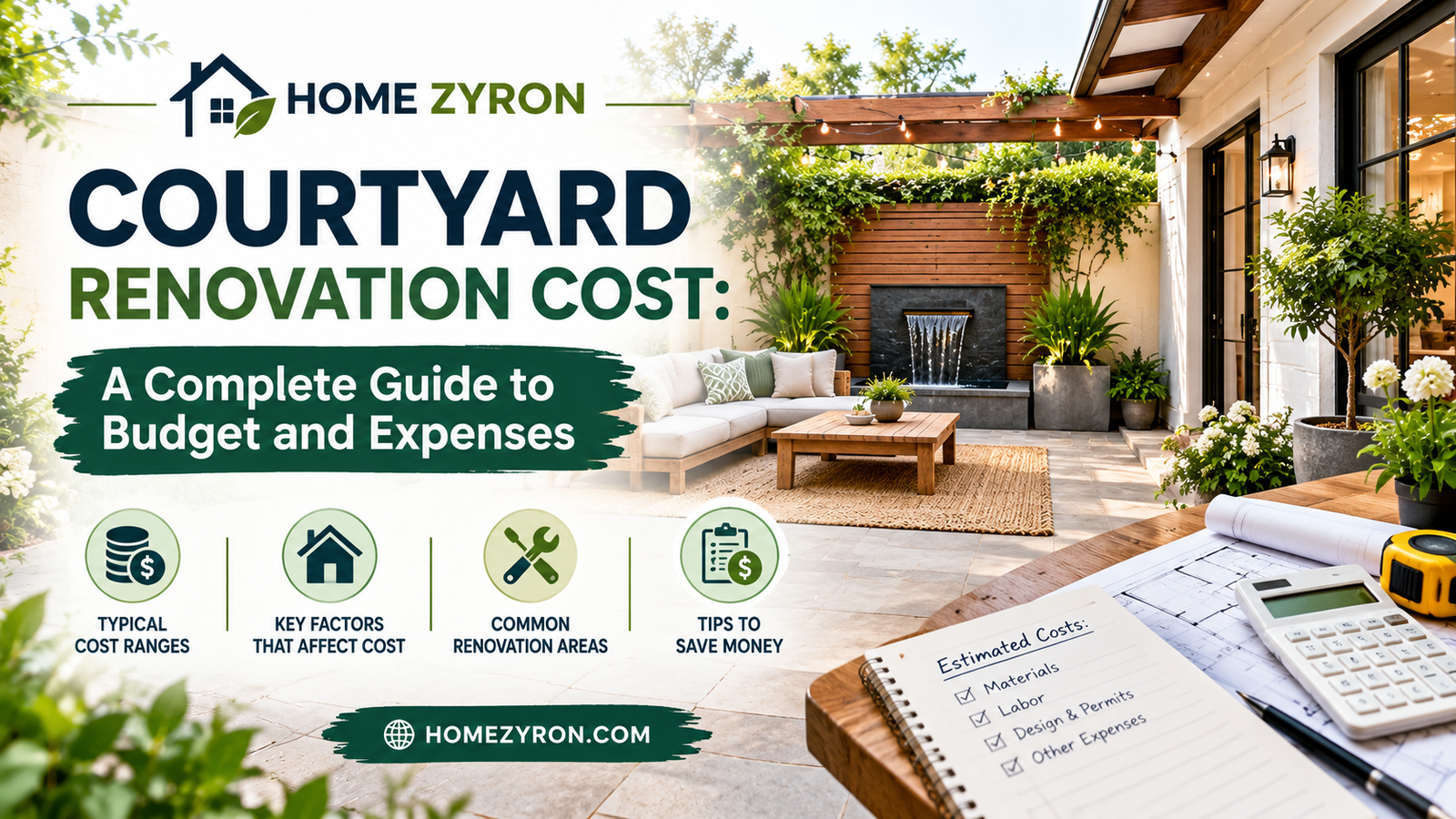
I still remember the first courtyard I renovated for a client in a dense urban neighborhood. It was a 280-square-foot space hemmed in by three walls and a narrow side gate. What looked simple on paper—pull up the cracked concrete, lay new pavers, add some plants—turned into a three-week exercise in logistics, drainage fixes, and careful material choices. That project taught me more about real costs than any spreadsheet ever could. Courtyards aren’t just small yards. They’re enclosed, high-visibility spaces where every square foot and every access challenge shows up on the invoice.
This guide pulls from recent 2026 pricing data, contractor quotes I’ve reviewed, and projects I’ve overseen or advised on. It’s written for homeowners who want clear numbers, honest trade-offs, and practical ways to stay on budget without ending up with something that looks cheap in five years.
Table of Contents
What Actually Drives Courtyard Renovation Costs
Average Costs by Courtyard Size
Surface Materials: The Biggest Cost Lever
Detailed Budget Breakdown by Element
Labor, Access, and Hidden Site Costs
Real-World Project Examples
Tool and Material Comparisons with Honest Verdicts
Ways to Control Costs Without Sacrificing Quality
Future Trends Affecting 2026–2028 Pricing
Frequently Asked Questions
Final Thoughts
Author Bio
What Actually Drives Courtyard Renovation Costs
Courtyards differ from open backyards in three important ways. First, almost the entire surface is hardscape. Soft planting usually lives only at the edges or in containers. Second, access is often restricted—wheelbarrows through a gate or even through the house instead of a skid-steer. Third, water has nowhere natural to go. Poor drainage can damage foundations, so grading and drains become non-negotiable.
Hardscape typically consumes 40–55% of the total budget. The single biggest decision is the floor material. Everything else—plants, lighting, a small water feature or fire bowl—rides on top of that choice. Regional labor rates, existing conditions (old concrete vs. gravel), and whether you need permits for electrical or gas lines also move the number significantly.
National 2026 averages put a typical courtyard renovation around $9,500 in the US, with a broad range of $2,500 to $60,000 depending on size and ambition. UK figures sit roughly 15–25% lower in equivalent terms for comparable work.
Average Costs by Courtyard Size
These ranges assume a balanced project: new or refinished surface, perimeter planting, basic lighting, and one modest feature (water bowl or fire pit). Premium finishes or full outdoor-kitchen setups push higher.
Courtyard Size
Typical US Range
What It Usually Covers
Small (under 250 sq ft)
$2,500–$12,000
Resurface + edge plants + one feature
Medium (250–600 sq ft)
$8,000–$25,000
New paving, planting, lighting, simple structure
Large (600–1,200 sq ft)
$18,000–$45,000
Designed remodel, water or fire feature, better materials
XL (1,200+ sq ft)
$35,000–$60,000+
Full design-build with structures and built-ins
A 200-square-foot courtyard with mid-grade concrete pavers, decent base work, and simple planting often lands between $4,500 and $8,000 all-in. Jump to porcelain or natural stone and the same footprint can exceed $12,000.
Surface Materials: The Biggest Cost Lever
Because the floor is what you see and walk on every day, material choice dominates both cost and long-term satisfaction. Installed prices (materials + labor + proper base) in 2026 look like this:
Surface Material
Installed Cost per Sq Ft
Pros
Cons
Best For
Pea gravel
$4–$8
Cheap, drains well
Migrates, weeds, unstable for furniture
Temporary or very budget projects
Decomposed granite
$5–$10
Compactable, Mediterranean feel
Tracks indoors, needs top-ups
Dry climates, informal look
Stamped concrete
$12–$18
Smooth, level, decorative options
Cracks over time, hard to repair
Budget permanent surface
Concrete pavers
$15–$25
Best overall value, repairable
Joints need occasional refresh
Most homeowners
Clay/brick pavers
$18–$30
Warm color, classic look
Higher cost, fewer styles
Traditional or period homes
Flagstone (dry-laid)
$18–$35
Natural, unique patterns
Labor-intensive, uneven
Cottage or rustic style
Travertine
$20–$30
Stays cooler underfoot
Needs sealing
Warm climates, pool-adjacent
Porcelain pavers
$22–$35
Low maintenance, modern
Can chip on edges, colder feel
Contemporary designs
Bluestone
$25–$40
Premium Northeast classic
Heavy, expensive outside region
High-end formal spaces
Concrete pavers remain the sweet spot for most projects I see. They give a clean, finished look, allow individual replacement if one cracks, and hold up for decades when the base is done right. Natural stone looks spectacular but the labor premium and irregular shapes inflate the bill. Gravel works for a quick refresh, yet I’ve rarely seen a client stay happy with it beyond three or four years once furniture and foot traffic arrive.
Detailed Budget Breakdown by Element
Here’s a realistic line-item view for a mid-sized 300-square-foot courtyard using quality concrete pavers:
Demolition and haul-away of existing surface: $800–$2,500 (concrete costs more than gravel)
Excavation, grading, and 6–8 inch compacted base: $1,200–$2,800
Pavers, edge restraints, and polymeric joint sand: $3,000–$5,500
Total mid-range: roughly $10,000–$20,000. Swap in natural stone and add a gas line for a fire feature and you’re quickly into the mid-twenties.
Drainage deserves special mention. In enclosed courtyards I almost always specify at least one catch basin or linear drain. Skipping it to save $800–$1,500 is the most common regret I hear two years later when water starts pooling against the house foundation.
Labor, Access, and Hidden Site Costs
Labor usually accounts for 40–60% of the total. Restricted access can add 15–30% because everything moves by hand. In one project the crew had to carry every bag of base material through the living room; the labor line alone jumped by nearly $2,000.
Other frequent surprises:
Tree root removal or utility locating
Permit fees for gas or electrical work ($150–$1,200 depending on city)
Soil export and dump fees
Night or weekend work premiums if noise ordinances apply
Always ask contractors for an itemized proposal that separates demo, base, surface, and softscape. A lump-sum bid that looks attractively low often hides thin base work that fails within a few seasons.
Real-World Project Examples
Example 1 – Small urban courtyard (180 sq ft) Old cracked concrete, narrow side access. Client chose concrete pavers in a simple running-bond pattern, steel edging, three large planters, and four path lights. Final cost: $7,800. Timeline: 9 working days. The biggest win was proper slope toward a new trench drain that protected the foundation.
Example 2 – Medium family courtyard (420 sq ft) Existing gravel that constantly tracked inside. We installed 60 mm concrete pavers with a soldier-course border, built two raised planting beds, added a modest gas fire bowl, and layered in low-voltage lighting. Total: $19,400. The fire bowl and gas line accounted for about $3,200 of that. Three years later the surface still looks new; the only maintenance has been refreshing joint sand once.
Example 3 – Premium redesign (650 sq ft) Porcelain large-format pavers, custom seat wall, pondless water feature, motorized retractable shade, full irrigation, and designer planting. Budget landed at $48,000. Access was excellent, which kept labor reasonable relative to materials. This is the range where design fees ($2,000–$5,000) become worthwhile.
Tool and Material Comparisons with Honest Verdicts
When clients ask me what to buy or rent, I give them the same advice I use myself.
Base preparation tools A plate compactor is non-negotiable for any permanent surface. Renting a good one runs $80–$120 per day. Skipping compaction to save money is the single most common cause of later settlement. Hand tampers work only for tiny jobs under 100 square feet.
Edge restraints Plastic is cheapest but can flex over time. Aluminum or steel lasts longer and looks cleaner. I prefer steel for most residential work—the modest premium pays for itself in longevity.
Jointing materials Polymeric sand is worth the extra cost over regular sand. It hardens and resists weeds and washout far better. Re-applying every 5–7 years is still cheaper than constant weeding.
Lighting Low-voltage LED path and up-lights have dropped in price and improved dramatically. A basic 8-fixture system with transformer often costs less than $2,000 installed and transforms the space at night. Solar lights look tempting but rarely deliver consistent output after the first season.
Honest verdict on DIY vs. pro: If the courtyard is under 150 square feet, dead flat, and you’re comfortable with excavation and compaction, a motivated homeowner can handle gravel or simple concrete pavers and save 30–40%. Anything larger, sloped, or involving gas/electrical should go to a professional. The cost of fixing a failed base or improper drainage almost always exceeds the original labor savings.
Ways to Control Costs Without Sacrificing Quality
Keep the existing surface if it’s structurally sound. Power-washing, re-jointing, and sealing can refresh pavers for $400–$1,500 instead of a full tear-out.
Choose concrete pavers over natural stone for the field and use stone only as an accent border.
Limit the number of features. One well-executed water bowl or fire feature reads better than three mediocre ones.
Phase the work. Install the hardscape this year and the lighting or planting next season.
Use larger-format pavers where possible—fewer joints mean faster installation and a cleaner look.
Source plants from local nurseries that grow regionally adapted stock; they establish faster and cost less long-term.
Future Trends Affecting 2026–2028 Pricing
Material costs for concrete products have stabilized after the post-pandemic spikes, but labor remains tight in many metro areas. Expect 3–6% annual increases in most markets. Porcelain and large-format concrete pavers continue gaining share because of their clean aesthetic and lower maintenance. Permeable paving systems are also rising in popularity where local codes encourage stormwater management—sometimes unlocking rebates that offset part of the higher material cost.
Smart lighting and app-controlled irrigation are moving from luxury to expected. Budget an extra $500–$1,500 if you want those capabilities; the long-term water and energy savings usually justify it.
Frequently Asked Questions
How long does a typical courtyard renovation take? Most projects run 1–3 weeks of active work once materials arrive. Restricted access or complex drainage can stretch that to 4–6 weeks.
Do I need a permit? Surface replacement alone usually does not. Adding gas lines, electrical, or structures over a certain height often does. Check with your local building department early.
What is the best surface for a small courtyard? Concrete pavers for most people. They balance cost, durability, and appearance. In very hot climates travertine or light-colored porcelain stays cooler underfoot.
Can I renovate a courtyard myself? Yes for simple gravel or small paver jobs if you have the tools and patience. Hire out anything involving significant excavation, drainage, or utilities.
How much should I set aside for contingency? 10–15% is prudent. Courtyards have a habit of revealing surprises once the old surface comes up.
Final Thoughts
A courtyard is one of the highest-impact outdoor spaces you can improve. Because it’s enclosed and close to the house, every design decision is amplified. Spend the money where it counts—proper base, good drainage, and a surface that will still look intentional a decade from now. The difference between a $9,000 job that ages poorly and a $14,000 job that still feels fresh is almost always in the unseen layers and the quality of the installation, not the brand name on the pavers.
I’ve watched clients use their renovated courtyards daily for morning coffee, evening conversations, and quiet reading. When the budget is spent thoughtfully, the space becomes a genuine extension of the home rather than an afterthought. Measure carefully, get itemized quotes, and prioritize the foundation work. The rest tends to fall into place.
Author Bio
Alex Rivera is a landscape designer and outdoor living specialist with over 14 years of hands-on experience renovating urban and suburban courtyards across the United States. He has managed more than 200 hardscape projects, consulted for residential clients and small design-build firms, and regularly contributes practical cost and materials analysis to industry publications. His work focuses on durable, climate-appropriate solutions that balance beauty with real-world budgets and long-term performance.


1 Comment