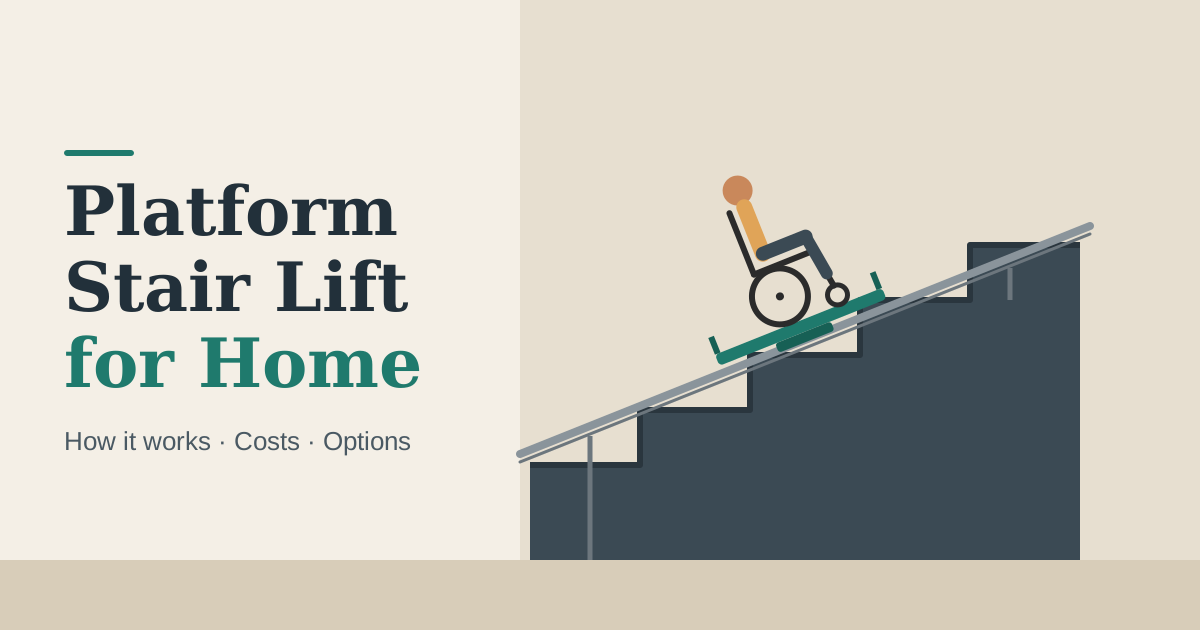
Most people picture a stair lift as a chair on a rail. A platform stair lift swaps the chair for a flat, fold-down platform. A person in a wheelchair or on a mobility scooter rolls on, and the whole thing travels up the staircase. The trade-offs only make sense once you see the difference.
The industry calls these inclined platform lifts (IPLs). An inclined lift folds up against the wall when not in use, which keeps the stairs usable for everyone else. That fold-away trait is why people choose them over a ramp. A code-compliant ramp for a full flight of stairs can run the length of a living room, and an IPL doesn’t. silvercross
I think of it as a stair lift that takes the wheelchair along with the person. Nobody has to transfer into a seat or leave the chair at the bottom, so there’s no stranded wheelchair and no awkward hand-off. For someone who relies on a specific chair for posture or pressure relief, that matters a great deal.
How it works, step by step
The hardware varies by brand, but the logic is consistent.
A guide rail is mounted to the stair wall, to support posts, or to both. Rail placement depends on platform size and stair angle.
A motorized carriage moves along that rail, usually on a rack-and-pinion drive. The Garaventa X3’s spec sheet describes an extruded aluminum guide rail with a folding platform moved by an integrated rack and pinion drive, plus an overspeed safety system. savaria
The platform unfolds at the bottom landing. Side ramps lower so the wheelchair can roll on.
Safety arms and ramps reposition. Savaria’s planning guide notes that before the lift leaves the floor, the safety arms must be down and the platform ramps must be up. The ramps double as a barrier that keeps the wheelchair in place. lifewaymobility
The rider holds a control to travel. These are “constant pressure” controls, so the lift stops the moment you let go. Savaria’s Delta lists constant pressure operation and a speed of 0.075–0.1 m/s depending on the stair angle. savaria
Obstruction sensors stop the carriage if something blocks its path.
That speed is slow, around a quarter of a mile per hour at the high end. It feels deliberate. Some first-time users read that as a flaw, but it’s partly why the ride is stable and easy to control.
Many models run on battery power. The Delta uses a 24-volt DC battery system with a charger on standard household AC. That means the lift keeps working during a power outage, which counts for a lot if the lift is someone’s only route to a bedroom or bathroom. savaria
Who benefits most (and who doesn’t)
Strong fits:
Full-time wheelchair or scooter users living in a multi-level home
Families who want to age in place without moving or building an addition
Homes where a vertical lift or elevator has no room or budget
Households where other people still use the stairs daily, since the lift folds away
Weaker fits:
Someone who can walk but struggles with stairs. A standard chair-style stair lift costs far less and is simpler.
Very narrow staircases. The platform needs real width, and the rail and folded platform eat into it.
Anyone who needs to go up a very long distance repeatedly. A home elevator may serve better.
The best-fit question is simple: does the rider need to stay in the wheelchair? If yes, a platform lift deserves serious consideration. If no, price a chair-style lift first.
Real costs, and why the numbers disagree
Cost research for this category is frustrating because published figures conflict. Here is what several sources report:
Source
Reported range
RetirementLiving (installed)
$12,000–$35,000 for inclined platform lifts
RetirementLiving (hardware only)
about $8,500 on average, with installation pushing the total past $23,000
The spread is huge: a low of $4,000 and a high of $35,000 for what looks like the same product. In my reading, three things explain it:
Straight versus curved stairs. A straight run uses standardized rails. Curves, turns, and intermediate landings need custom fabrication, which Silvercross notes means a curved platform costs more because the rail is custom fabricated. silvercross
Hardware versus installed price. Some figures include labor and some don’t. Installation commonly runs 15% to 25% of the total project cost. retirementliving
Scope of work. Reinforcing a wall, adding a dedicated electrical outlet, or rebuilding a landing can add real money.
My practical rule: treat anything under about $10,000 installed as a best-case scenario for a straight, simple staircase, and budget toward the higher end if your stairs curve or turn. Get at least two written quotes that spell out what is included. A quote that says “lift only” and one that says “lift, install, wall reinforcement, electrical, and first-year service” are not comparable.
Used lifts can cut costs, but they carry a caveat. You’d need to confirm the platform size and construction suit both your wheelchair and your staircase. A used rail cut for someone else’s staircase usually can’t be reshaped. retirementliving
[Screenshot suggestion: side-by-side of two installer quotes with the line items highlighted]
Model comparison
I can’t give you a “best” model without knowing your stairs, but I can show how the well-known options differ on paper. These are spec-sheet comparisons, not hands-on tests.
The split between the two Savaria models is the useful part. As one dealer puts it, the Delta is designed for a single level of straight stairs, while the Omega handles multiple levels, turning stairs, curved stairs, or stairs with intermediate landings. Choosing between them mostly comes down to your staircase geometry. theelevatorman
My honest verdicts:
Delta: the sensible default for a plain straight staircase. Fewer custom parts usually means a lower price and an easier install.
Omega: the right tool if your stairs bend. Expect a longer lead time and a higher quote.
X3: worth a look for indoor straight stairs, but check capacity against the combined weight of rider plus chair. A powered wheelchair alone can weigh a lot.
Alternatives worth pricing
A platform lift isn’t always the best answer. Before you sign, price these too.
Vertical platform lifts suit short rises well. One provider describes them as best for short vertical distances up to 14 feet, such as porch access or split-level interiors. If you have outdoor steps and the room to spare, a vertical lift can be the cleaner choice. porchlightathome
If you’re still deciding on stairs generally, you might also like my piece on open staircase design, since the look of your stairs affects how a rail will sit on them.
Your staircase decides everything
Before calling anyone, I’d measure and note these:
Clear width from wall to rail. Platform lifts need more than chair lifts, and Savaria’s planning guide lists stair width requirements by platform size.
Wall construction. Solid walls versus wood studs changes how the rail mounts. The X3 spec says rails mount directly to solid walls, but wood stud walls need an added board secured behind the upper rail. savaria
Landings at top and bottom. You need turning room for the chair at both ends. Silvercross also stresses space requirements as a key question.
Stair angle and length. These affect both speed and price.
Outdoor exposure. Outdoor installs may work in moderate climates without extreme cold, but ask the dealer about your specific conditions. silvercross
Photograph the stairs from both ends and keep the tape measure in the shot. An installer can often pre-qualify a job from photos.
In the US, residential inclined platform lifts fall under ASME A18.1, the safety standard for platform lifts and stairway chairlifts, which includes a section on private residence inclined platforms. Ask any dealer to confirm in writing that the exact model complies. arcat
One note for commercial or shared buildings: under the 2010 ADA Standards, platform lifts can’t be attendant-operated and must allow unassisted entry and exit. That doesn’t govern a private home, but it explains why independent controls are a good feature either way. ascension-lift
On maintenance, ASME A18.1 calls for routine maintenance and inspections. Ask what a service plan costs before you buy. A cheap lift with an expensive service contract may not be cheap at all. ascension-lift
Mistakes I’d help you avoid
Buying on the lowest quote. Compare line items, not totals.
Ignoring the wheelchair’s real weight. Add rider and chair, then check against capacity with margin.
Skipping the folded-platform test. Ask how much stair width remains when it’s stowed. If other family members use the stairs daily, this matters.
Forgetting power-outage behavior. Ask whether it has a battery backup.
Not asking about funding. Rules vary widely by location and situation. Paying for Senior Care’s platform lift guide is a reasonable starting point, though check that any program details are current.
Where the category is heading
This is my opinion, not a forecast I can prove. Three directions look likely to me:
Smarter diagnostics. Remote fault reporting and app-based service alerts are already common in elevators and spreading to residential equipment.
Slimmer designs. Narrower folded profiles would help the most common complaint, lost stair width.
Aging-in-place demand. As more households try to stay in their homes longer, residential accessibility equipment will keep moving from specialty product to mainstream renovation line item.
I’d treat claims of rapid price drops with caution. Custom-fabricated rail and skilled installation labor don’t get cheaper quickly.
FAQs
How much does a platform stair lift cost? Published figures range from about $4,000 to $35,000 installed. The big drivers are stair shape, installation scope, and brand. Straight stairs land at the lower end.
Can a platform stair lift go on curved stairs? Yes, but it needs a custom rail. Models like the Savaria Omega are built for turns, curves, and landings, and cost more.
Does it work in a power outage? Battery-driven models like the Delta use a 24V DC battery system, so they can keep operating. Confirm with your specific model.
Does it have a seat? Some do. Certain inclined platform lifts include a fold-out seat for people using a cane or walker. silvercross
Can it be used outdoors? Some can, depending on the climate and model. Savaria lists the Delta for indoor and outdoor use, with limits set by local climate.
How long does installation take? It depends on stair complexity and any prep work. Ask your installer for a written timeline.
Platform lift or home elevator? A platform lift is usually cheaper and needs less structural change. An elevator suits longer travel and heavier daily use, at higher cost.
Conclusion
A platform stair lift is a narrow, practical tool. It solves one problem: getting a wheelchair or scooter user up a staircase that can’t accept a ramp or elevator, without removing the stairs for everyone else. When that’s your problem, it’s often the most sensible fix. When it isn’t, a chair lift or a vertical lift is probably cheaper and simpler.
If you take only three things away: measure your stairs first, compare itemized quotes rather than totals, and ask about service costs before signing. Do those and you’ll be ahead of most buyers.






1 Comment