




A homeowner told me last year that she’d “decided against Pergo and gone with vinyl instead,” and I had to stop her before she placed the order. She didn’t realize Pergo makes vinyl flooring. Not “vinyl-look laminate” actual, 100% waterproof luxury vinyl, sold under the Pergo name, sitting right next to their traditional laminate in the same catalog.
That mix-up isn’t her fault. It’s the single biggest source of confusion in this entire comparison, and almost no other guide addresses it head-on. So before we get into wear layers and AC ratings, let’s clear up what you’re actually choosing between.
Table of Contents
- The Confusion Nobody Clears Up: What “Pergo” Actually Means Today
- Laminate vs. Vinyl: The Fundamental Construction Difference
- Durability Face-Off: AC Ratings vs. Mil Thickness
- Waterproofing: The Difference That Actually Matters
- SPC vs. WPC: The Vinyl Core Decision Most People Skip
- What It Actually Costs in 2026
- Installation: Tools and Process Compared
- Brand Comparison: Honest Verdicts
- Where Each One Wins: Room-by-Room Recommendations
- Lifespan and Resale Value
- Where the Industry Is Heading
- FAQs
- Final Thoughts
- About the Author
The Confusion Nobody Clears Up: What “Pergo” Actually Means Today
Pergo is a Swedish company that invented modern laminate flooring in the late 1970s, and the brand became so dominant that “Pergo” turned into shorthand for laminate flooring in general the same way “Kleenex” became shorthand for tissues. That’s the source of almost every “Pergo vs. vinyl” question people type into a search bar: they’re really asking “laminate vs. vinyl,” using an old brand name as the stand-in.
But the company itself has moved on. Now operating under Unilin and Mohawk Industries, Pergo currently sells three genuinely different product lines:
- Pergo laminate — the original product, still a wood-fiber core with a photographic layer, typically sold through big-box retailers.
- Pergo Extreme — a rigid-core luxury vinyl product, sold through independent flooring retailers rather than big-box stores, built with a waterproof composite core and a thick urethane-coated wear layer.
- Pergo engineered hardwood — a smaller product line with a real wood veneer over an engineered core.
So a genuinely accurate comparison has to acknowledge that “Pergo” isn’t automatically laminate anymore. For the rest of this guide, when I say “Pergo,” I mean the classic laminate product, since that’s what 90% of people mean when they ask the question — but I’ll flag Pergo Extreme specifically wherever the vinyl side of the brand changes the answer.
Laminate vs. Vinyl: The Fundamental Construction Difference
Once you strip away branding, these are two structurally different products that happen to compete for the same square footage in your house.
| Laminate (e.g., Pergo laminate) | Vinyl (LVP/LVT, including Pergo Extreme) | |
|---|---|---|
| Core material | High-density fiberboard (HDF), a compressed wood product | PVC-based composite — either stone plastic composite (SPC) or wood plastic composite (WPC) |
| Surface layer | Photographic image layer under a clear melamine/aluminum oxide wear layer | Printed vinyl design layer under a urethane-coated wear layer |
| Water behavior | Core can swell and warp if water reaches it; layer itself resists surface spills only | Fully waterproof core; water sits on the surface and in seams without damaging the plank |
| Feel underfoot | Hard, rigid, slightly hollow-sounding without underlayment | Slightly cushioned, especially WPC; quieter underfoot |
| Realism | Aluminum oxide coating gives a crisp, glass-like clarity to the wood image, often reads as more “photographic” | Embossed-in-register texture aligns grain and texture physically, often feels more tactile |
| Repairability | Individual planks can be replaced if click-lock; cannot be refinished/sanded | Individual planks can be replaced if click-lock; cannot be refinished/sanded |
The one-sentence version I give clients: laminate is a wood product wearing a photograph, and vinyl is a plastic product wearing a photograph. Everything else about how they perform in your home flows from that difference.
Durability Face-Off: AC Ratings vs. Mil Thickness
This is where the two products genuinely can’t be compared on the same scale, which is exactly why so many buyers get confused mid-showroom.
Laminate uses the AC rating system, which measures the durability of the aluminum oxide wear surface:
| AC Rating | Use Case |
|---|---|
| AC1–AC2 | Light residential, low-traffic rooms |
| AC3 | Moderate residential traffic |
| AC4 | Heavy residential and light commercial |
| AC5 | Heavy commercial |
For any main living area in 2026, I tell people not to go below AC4 — the price difference between AC3 and AC4 is usually small, and the scratch-resistance gap is not.
Vinyl uses wear layer thickness, measured in mils (one mil = one-thousandth of an inch):
| Wear Layer | Use Case |
|---|---|
| 6–12 mil | Builder-grade, light residential |
| 12–20 mil | Standard residential, moderate traffic |
| 20–30 mil | Premium residential, pets, heavy traffic |
Here’s the honest verdict on the actual durability contest: laminate’s aluminum oxide surface is genuinely harder and more scratch-resistant than any vinyl wear layer, mil for mil. If your main threat is a large dog’s claws or dragged furniture on a dry floor, laminate wins outright. But vinyl’s core is far more forgiving of dents from dropped objects because the whole plank has a little give, where laminate’s rigid core tends to show impact dents laminate can’t hide. Different failure mode, not a simple “one is tougher” answer.
Waterproofing: The Difference That Actually Matters
If there’s one factor that should decide this comparison for most rooms, it’s this one, and it isn’t close.
Laminate’s fiberboard core is wood. Even the water-resistant laminate lines — Pergo’s Outlast+ line is the best-known example — are engineered to survive a spill that gets wiped up within a reasonable window, not standing water. Leave a puddle on laminate overnight and there’s a real chance of swelling at the seams that never fully reverses.
Vinyl’s core, whether SPC or WPC, is genuinely waterproof at the plank level. You could submerge a vinyl plank in a bucket for a week and it would come out unchanged. That’s the entire premise behind Pergo Extreme’s marketing around flood protection.
The nuance almost nobody mentions: vinyl being waterproof doesn’t mean your floor is waterproof. Water can still travel through the seams between planks and sit on top of your subfloor, where it can encourage mold growth you won’t see until it’s a real problem. Waterproof planks with an unsealed subfloor in a genuinely wet area — a laundry room with a supply line leak, for instance — can still cause hidden damage. Vinyl is the right call for moisture-prone rooms, but it’s not a substitute for fixing an actual water source.
SPC vs. WPC: The Vinyl Core Decision Most People Skip
If you’ve settled on vinyl, there’s a second decision hiding inside that choice that most buyers never get asked about.
| SPC (Stone Plastic Composite) | WPC (Wood Plastic Composite) | |
|---|---|---|
| Core density | Very high — limestone-based, dense and solid | Lower density — foamed core, thicker but lighter |
| Feel underfoot | Firmer, closer to standing on tile | Softer, more cushioned, warmer |
| Dimensional stability | Excellent — resists temperature-driven expansion | Good, but slightly more prone to movement in temperature swings |
| Subfloor forgiveness | Very good at hiding minor subfloor imperfections | Good, slightly less rigid |
| Best for | Commercial spaces, sunrooms, high-traffic areas, anywhere floor hardness isn’t a concern | Bedrooms, living rooms, anywhere you’re standing for long stretches (kitchens included) |
My honest take: SPC is the better all-around choice for busy households and anywhere durability is the priority, but I’d steer someone who cooks a lot toward WPC for the kitchen specifically — the extra cushioning genuinely reduces fatigue standing at a stove or sink for long stretches, and it’s a difference you feel within the first week, not an abstract spec.
What It Actually Costs in 2026
Pricing has landed in a place where laminate and vinyl overlap heavily in the mid-range, which surprises people who assume laminate is automatically cheaper.
| Product Tier | Installed Cost per Sq Ft | Notes |
|---|---|---|
| Budget laminate (AC3) | $3 – $6 | Entry-level big-box laminate |
| Mid-range laminate (AC4) | $5 – $9 | Better wear layer, more realistic textures |
| Premium laminate (AC4/AC5, water-resistant) | $7 – $14 | Includes lines like Pergo Outlast+ |
| Budget SPC vinyl (6–12 mil) | $2 – $4 | Fine for rentals, low-traffic spaces |
| Mid-range vinyl (12–20 mil) | $4 – $7 | The sweet spot for most residential rooms |
| Premium vinyl (20+ mil, incl. Pergo Extreme) | $6 – $10+ | Commercial-grade wear layer, best realism |
For a 500-square-foot project, that puts most mid-range choices in the same $2,000–$4,000 ballpark regardless of which material you pick — which means the deciding factor for most people should genuinely be performance in the specific room, not price.
Installation: Tools and Process Compared
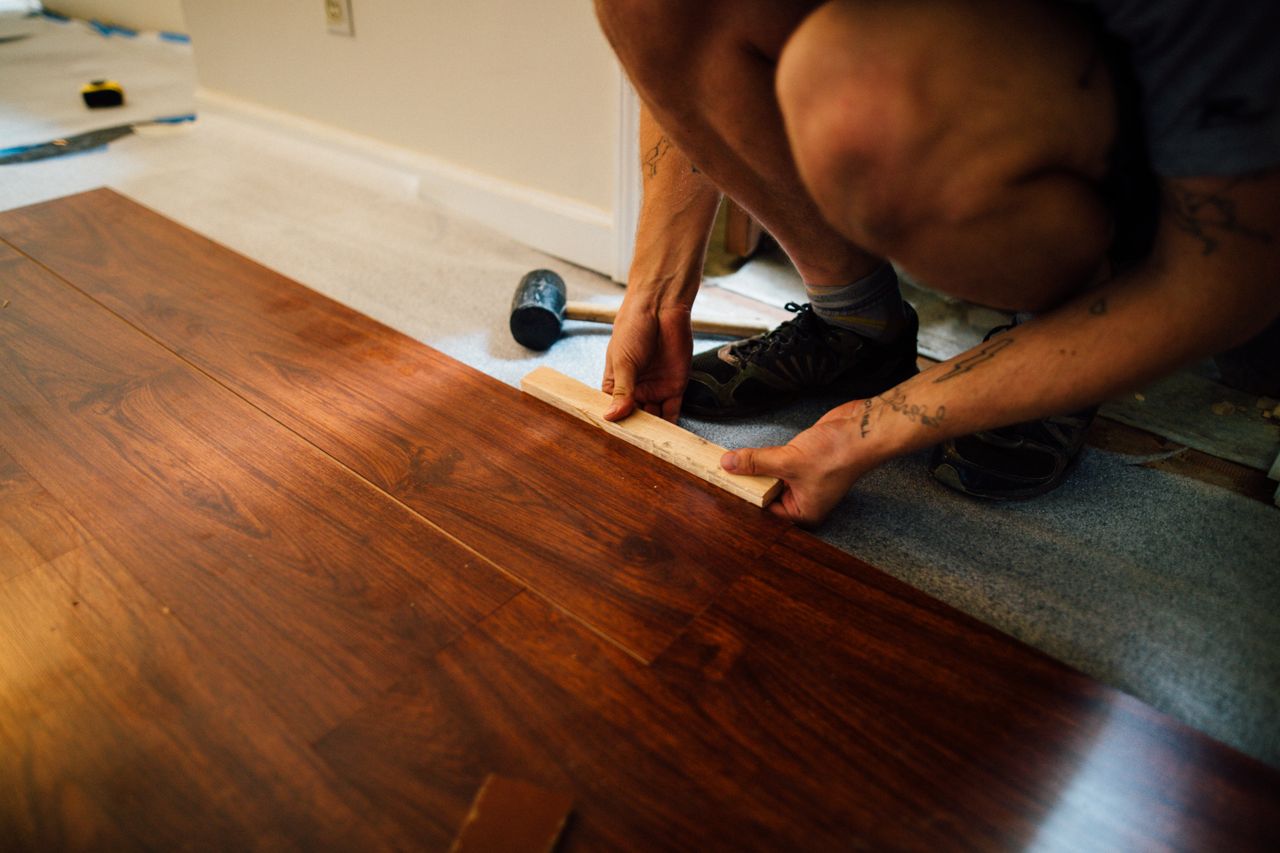
Both materials install as floating floors with click-lock edges in most residential product lines, but the process and tools differ enough to matter if you’re doing this yourself.
| Tool/Step | Laminate | Vinyl (rigid core) |
|---|---|---|
| Subfloor tolerance | Needs to be flat within about 3/16″ over 10 feet — gaps show and joints can fail on an uneven floor | More forgiving; SPC/WPC’s rigidity hides minor dips and high spots reasonably well |
| Cutting tool | Circular saw or laminate-specific cutter (guillotine-style shear); table saw for detail cuts | Utility knife and straightedge for most cuts; a vinyl-specific plank cutter speeds up large jobs |
| Underlayment | Usually required separately unless pre-attached; foam or cork pad reduces the “hollow” sound | Frequently pre-attached (especially WPC); separate underlayment less critical |
| Tapping block & pull bar | Essential — laminate’s tighter locking mechanism is less forgiving of a poor fit | Still recommended, though rigid-core locking systems are generally more forgiving |
| Expansion gap | Required around the perimeter, typically 1/4″–3/8″ | Also required, though generally slightly more tolerant of variation |
| DIY difficulty | Moderate — precise cuts and subfloor flatness matter more | Slightly easier — more forgiving of small floor irregularities and cutting imprecision |
My honest verdict for a first-time DIYer: vinyl is the more forgiving material to install yourself. The rigid core hides subfloor imperfections better, the cuts are more forgiving with a basic utility knife, and the locking systems on most SPC products tolerate a slightly imperfect fit better than laminate does. Laminate rewards a genuinely flat subfloor and precise cutting — worth it for the scratch resistance, but not the easier weekend project.
Brand Comparison: Honest Verdicts
| Brand | Product Type | Strengths | Honest Downside | Best For |
|---|---|---|---|---|
| Pergo (laminate) | Laminate | Strong AC4 options, widely available, good realism-to-price ratio | Big-box distribution means quality control varies by batch | Budget-to-mid laminate buyers who want a trusted name |
| Pergo Extreme | Rigid vinyl | Genuinely strong wear layer (often 20 mil), backed by a lifetime waterproof warranty | Only sold through independent dealers, not big-box stores — harder to comparison shop | Buyers who specifically want Pergo’s engineering in a waterproof product |
| Shaw Floorte | Vinyl | Strong mid-to-premium vinyl line, good realism, wide distribution | Pricing sits at the higher end of the vinyl spectrum | Buyers wanting a recognizable, dependable premium vinyl brand |
| Mohawk (various lines) | Both | Owns Pergo and produces its own separate laminate/vinyl lines; broad range across price points | Overlapping product lines across brands can make comparison shopping confusing | Buyers who want flexibility across a wide price range from one manufacturer |
| COREtec | Vinyl (WPC/SPC) | Pioneered a lot of the rigid-core vinyl category; strong reputation for comfort and quality | Premium pricing reflects the brand’s positioning | Buyers prioritizing comfort underfoot and long-term durability |
| LifeProof | Vinyl | Strong value at mid-range pricing, widely available through big-box retail | Fewer premium/ultra-thick wear layer options than specialty brands | Budget-to-mid buyers wanting reliable vinyl without a specialty retailer |
Where Each One Wins: Room-by-Room Recommendations
- Kitchens: Vinyl, generally WPC for the cushioning. Spills are inevitable, and laminate’s core vulnerability is a real risk here regardless of how “water-resistant” the marketing claims.
- Bathrooms and laundry rooms: Vinyl, no real debate. This is the category laminate simply shouldn’t compete in, water-resistant lines included.
- Basements: Vinyl, specifically SPC for its dimensional stability against the temperature and humidity swings basements are prone to.
- Bedrooms: Either works well; laminate’s slightly harder surface holds up well to furniture legs, and moisture risk is low.
- Living rooms with pets: Laminate (AC4/AC5) if scratching is the primary concern; vinyl if accidents or spills are more likely than claw damage.
- High-traffic entryways: Laminate’s aluminum oxide surface generally outperforms vinyl here for pure scratch resistance from grit and dirt tracked in from outside.
Lifespan and Resale Value
Laminate, kept dry, genuinely tends to outlast vinyl — a well-maintained AC4/AC5 laminate floor can reasonably last 15–30 years, while most vinyl products are more realistically rated for 10–20 years before the wear layer thins enough to show its age. Neither material can be sanded and refinished the way solid hardwood can, so once a plank’s surface layer wears through, that plank’s finished life is over rather than restorable.
On resale, hardwood still tends to be perceived as the most desirable flooring by buyers and appraisers, with quality laminate generally perceived as more premium than vinyl in listing photos and walkthroughs — though this gap has narrowed significantly as premium vinyl’s realism has improved. Neither laminate nor vinyl typically adds resale value the way real hardwood does; they’re better understood as practical, cost-effective choices than as value-adding upgrades.
Where the Industry Is Heading
The line between “laminate” and “vinyl” is blurring at the high end. Hybrid products combining a rigid, dimensionally stable core with laminate-style aluminum oxide wear layers are starting to show up, aiming to capture vinyl’s waterproofing with laminate’s scratch resistance in a single product.
Wear layer and AC rating inflation is becoming standard marketing, similar to what happened with thread counts in bedding — expect “premium” tiers to keep pushing mil thickness and AC ratings higher as a straightforward way to signal quality, even as the practical difference between, say, 20 mil and 28 mil narrows for typical residential use.
Recycled content is becoming a real spec, not just a marketing line, particularly in vinyl cores, as manufacturers respond to both cost pressure on virgin PVC and growing buyer interest in lower-impact materials.
Attached underlayment is becoming close to universal on mid-range and premium vinyl, reflecting how much buyers care about the “hollow” sound that used to be one of vinyl’s most common complaints against real hardwood.
FAQs
Is Pergo laminate or vinyl? Both, depending on the product line. Classic Pergo laminate is a wood-fiber-core laminate; Pergo Extreme is a separate, fully waterproof rigid-core vinyl product sold through independent retailers rather than big-box stores.
Which is more waterproof, laminate or vinyl? Vinyl, without real competition. Even water-resistant laminate lines are only designed to survive quickly-cleaned spills, not standing water, while vinyl’s core is genuinely waterproof.
Which scratches less, laminate or vinyl? Laminate, generally. Its aluminum oxide wear layer is harder than any vinyl wear layer at a comparable price point, though vinyl tends to hide dents from dropped objects better.
Is vinyl or laminate better for resale value? Neither adds meaningful resale value compared to real hardwood, but quality laminate is often perceived as slightly more premium than vinyl in buyer walkthroughs — a gap that’s shrinking as premium vinyl realism improves.
Can I install vinyl or laminate over an uneven subfloor? Vinyl is meaningfully more forgiving, especially rigid-core SPC and WPC products. Laminate generally needs a subfloor flat within about 3/16 inch over 10 feet to avoid gaps and joint issues.
Is SPC or WPC better for a kitchen? WPC, for most people — the added cushioning reduces fatigue from standing, which matters more in a kitchen than almost anywhere else in the house.
Do I need underlayment for vinyl flooring? Often not separately, since many mid-range and premium vinyl products come with an attached foam or cork pad. Check the specific product spec before buying a separate underlayment you may not need.
Final Thoughts
If you take one thing away from this guide, let it be that “Pergo vs. vinyl” was never really a fair fight, because Pergo makes both. The actual decision in front of you is laminate versus vinyl as construction categories, and that decision comes down to a genuinely simple question: how much water does this room realistically see? Get that answer right, and the rest — AC ratings, mil thickness, SPC versus WPC — is just fine-tuning a choice you’ve already made correctly.
The floors that disappoint people almost never fail because someone picked “the wrong material” in some abstract sense. They fail because a water-vulnerable product went into a water-exposed room, or because a budget wear layer went into a high-traffic hallway that needed a heavier one. Match the product to the room’s real conditions, not to a brand name doing double duty for a whole category, and either one will serve you well for a long time.
About the Author
Marcus Ferreira is a flooring materials researcher and residential construction consultant specializing in resilient and laminate flooring systems. His work focuses on translating manufacturer specifications wear layer ratings, core composition, and moisture performance data — into practical guidance for homeowners and contractors navigating an increasingly crowded flooring market. He has evaluated flooring products across residential and light-commercial installations for over a decade, with a particular focus on how material choices perform under real-world moisture, traffic, and climate conditions rather than in showroom demonstrations.