




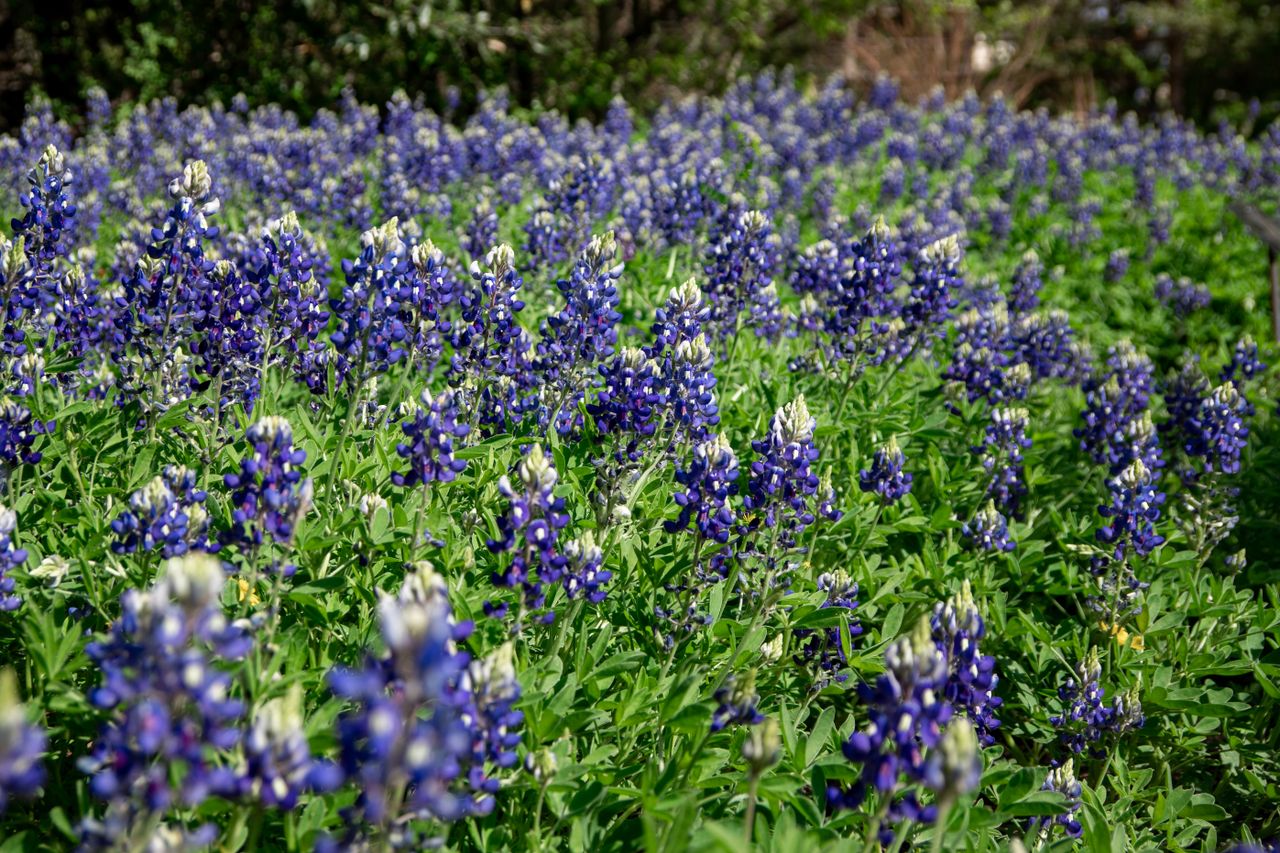
Every Texan has a version of the same photo: a toddler plopped down in a field of blue flowers, squinting into the sun, probably crying, definitely wearing something the parents coordinated in advance. I have three of these photos of myself, spanning three different decades of bad haircuts, and I didn’t think much about why until I started digging into the actual history behind the flower. If you’ve ever wondered why this specific flower, out of everything Texas could have picked, ended up as the object of a statewide spring ritual, here’s the actual story.
Table of Contents
- What Is the Texas State Flower, Exactly?
- The 1901 Fight: Cotton, Cactus, or Bluebonnet?
- The 70-Year Sequel: How 1971 Settled It (Sort Of)
- Where the Name “Bluebonnet” Actually Comes From
- The Comanche Legend of the Bluebonnet
- Comparing the Six Native Texas Bluebonnet Species
- How the Bluebonnet Took Over the Highways
- The Bluebonnet Capital Turf War
- Why Bluebonnet Season Became a Texas Ritual
- Growing Bluebonnets of Your Own
- Common Bluebonnet Myths, Debunked
- Where Bluebonnet Culture Is Headed
- FAQs
- Final Thoughts
- About the Author
What Is the Texas State Flower, Exactly?
Here’s the first surprise: there isn’t technically one Texas state flower. There are six, all in the genus Lupinus, all commonly called bluebonnets. When people picture “the” bluebonnet, they’re almost always picturing Lupinus texensis, the showiest and most widespread of the group, but the law itself doesn’t single that species out anymore. It covers the whole family.
Texas, it turns out, takes its wildflowers seriously enough to litigate them.
The 1901 Fight: Cotton, Cactus, or Bluebonnet?
When the 27th Texas Legislature sat down to pick a state flower in the spring of 1901, it wasn’t a rubber-stamp vote. Two other contenders had real momentum going in. One faction pushed hard for the cotton boll, arguing that cotton was the economic backbone of the state at the time. A young legislator from Uvalde made an equally passionate case for the prickly pear cactus, praising its toughness and its surprisingly orchid-like blooms a pitch persuasive enough that he reportedly picked up the nickname “Cactus Jack.” That legislator was John Nance Garner, who would go on to become Vice President of the United States, which means the bluebonnet’s biggest legislative rival later held one of the highest offices in the country.
The bluebonnet won anyway, thanks largely to the National Society of Colonial Dames of America in Texas. Rather than just making a floor speech, the group brought the argument into the room physically — decorating the legislative chamber with paintings of bluebonnets and setting small pots of live blooming bluebonnets on individual legislators’ desks. On March 7, 1901, Governor Joseph D. Sayers signed the bill, and the bluebonnet became Texas’s first official state symbol of any kind.
There was just one catch, and it’s the kind of detail only a botanist would flag at the time: the 1901 law named one specific species, Lupinus subcarnosus, sometimes called the sandyland bluebonnet. It’s a real bluebonnet, but by most accounts it’s the least showy of the bunch — lower-growing, sparser, with a more sprawling habit than the lush blue carpets most people picture.
The 70-Year Sequel: How 1971 Settled It (Sort Of)
For the next seventy years, Texas essentially had an officially designated state flower that wasn’t the one anybody was actually planting, photographing, or scattering along highways. That role fell to Lupinus texensis — taller, denser, and far more visually striking — which had become the de facto face of “bluebonnet” in popular culture despite having no legal standing.
The Texas Legislature finally addressed the mismatch on March 8, 1971, amending the original statute to add Lupinus texensis by name, plus a catch-all clause covering “any other variety of bluebonnet not heretofore recorded.” That single clause is why the state flower now legally encompasses all six native Texas Lupinus species, present and future, rather than locking the law to one specific plant. It’s a remarkably tidy legislative fix for what had been a genuinely awkward 70-year gap between the letter of the law and the flower on the postcards.
Where the Name “Bluebonnet” Actually Comes From
The name has nothing to do with hats worn by settlers heading west, despite that being a common assumption. It refers specifically to the shape of the flower’s upper petal, which resembles the sunbonnets pioneer women commonly wore to shield their faces from the Texas sun. Look closely at an individual bloom on the flower spike, and the resemblance is genuinely there — a rounded, hooded shape sitting above the rest of the petals.
There’s a smaller, lesser-known detail botanists appreciate more than casual observers: the white patch on the upper petal isn’t just decorative. On a fresh, unpollinated flower, that patch is white or pale, acting as a visual cue for pollinating bees. It’s a small mechanism, but it’s part of why a healthy bluebonnet field shows such a visible gradient of white-tipped and rosy-tipped blooms mixed together rather than uniform blue.
The Comanche Legend of the Bluebonnet
Long before the legislative fights, Comanche oral tradition told its own story about the flower’s origin. Versions vary, but the core of the story describes a prolonged, brutal drought that had left a community starving, and a tribal shaman declaring that only a sacrifice of something deeply valued would end it. A young girl, sometimes described as an orphan and referred to as “She-Who-Is-Alone,” offered up her most treasured possession — a doll made from cornhusk and dressed with a blue feather — and burned it as an offering. According to the legend, the rains returned soon after, and the next spring, fields where the ashes had scattered were covered in flowers the same blue as the doll’s feather.
The story has been retold many times, including in a well-known illustrated children’s book, and versions of it differ across sources, but the throughline — sacrifice, drought, and a blue flower appearing as a sign of renewal — stays consistent. It’s worth knowing not because it’s the “official” origin story (the flower obviously predates any human narrative about it), but because it shows the bluebonnet carried cultural weight in Texas long before a single legislator ever debated it.
Comparing the Six Native Texas Bluebonnet Species
This is the part most articles skip entirely, and it’s genuinely interesting once you know what to look for.
| Species | Common Name | Where It Grows | Bloom Time | Distinguishing Feature |
|---|---|---|---|---|
| Lupinus texensis | Texas bluebonnet | Central Texas, Hill Country, widespread | March–April | Tallest, densest blooms; the “iconic” roadside bluebonnet |
| Lupinus subcarnosus | Sandyland bluebonnet | South Texas, sandy soils | Slightly earlier than texensis, ~March | Lower-growing, sparser habit; the original 1901 legal species |
| Lupinus havardii | Big Bend bluebonnet | Far West Texas, Big Bend region | February–April | Tallest of all six, spikes can reach 2–3+ feet |
| Lupinus plattensis | Nebraska/sand dune bluebonnet | Texas Panhandle, sand dune areas | Spring | Adapted to sandy, dune-like soils in the state’s north |
| Lupinus concinnus | Bajada lupine | West Texas desert regions | Spring, weather-dependent | Small, low-growing, pink-purple tinged blooms |
| Lupinus perennis | Sundial lupine | East Texas, into the eastern US | Late spring | Leaves radiate in a distinctive “sundial” arrangement; least “bluebonnet-looking” of the group |
If you’ve only ever seen bluebonnets in Hill Country photos, you’ve almost certainly only seen one of these six — Lupinus texensis. The others are real, legally protected under the same statute, and worth looking for if you travel across the state during bloom season.
How the Bluebonnet Took Over the Highways
The bluebonnet’s ubiquity along Texas roads isn’t accidental, and it predates the person most commonly credited with it. Back in the early 1930s, the state highway engineer at the time, Gibb Gilchrist, directed maintenance crews to identify wildflowers growing on private land adjacent to highways and, where possible, get landowner permission to collect seed for replanting along the right-of-way. The Texas Highway Department formally established its Wildflower Program in 1932, and by the mid-1930s, mowing crews were instructed to delay cutting roadside grass until after wildflowers had gone to seed a policy that’s still followed today and is a big part of why the blooms return year after year without constant replanting.
Lady Bird Johnson gets credit for the beautification movement, and it’s well earned, but her role built on that existing state program rather than starting it from scratch. She grew up seeing Texas roadside wildflowers and later said they inspired her national beautification work, which culminated in the federal Highway Beautification Act of 1965. In 1982, she co-founded what’s now the Lady Bird Johnson Wildflower Center in Austin, and federal legislation in 1987 permanently earmarked a portion of highway landscaping funds nationwide specifically for wildflower plantings — a policy that traces directly back to Texas roadside practice. Today, the Texas Department of Transportation sows an estimated 30,000 pounds of wildflower seed annually along state highways, bluebonnets included.
The Bluebonnet Capital Turf War
This is the part I genuinely didn’t expect to find, and it might be my favorite piece of Texas trivia now. Multiple Texas towns hold competing, simultaneously “official” bluebonnet titles, and the state legislature is directly responsible for the overlap.
| Location | Official Title | Year Designated |
|---|---|---|
| Ennis | Official Bluebonnet City of Texas | 1997 |
| Ennis | Official State Bluebonnet Trail of Texas | 1997 |
| Chappell Hill | Official Bluebonnet Festival of Texas | 1997 |
| Burnet & Llano counties | Bluebonnet Co-Capitals of Texas | 1981 |
Burnet had been informally calling itself the “Bluebonnet Capital of Texas” for years before the legislature waded in and designated Burnet and neighboring Llano County joint “Bluebonnet Co-Capitals” in 1981 — a compromise that, depending on who you ask locally, either settled the matter or just formalized the rivalry. Then in 1997, a separate resolution handed Ennis both the Bluebonnet City and Bluebonnet Trail titles, while Chappell Hill’s decades-old event (which started in 1964 as a small antique show and was renamed the Bluebonnet Festival in 1983) got named the state’s official festival in that same bill. Four different towns, three different resolutions, twenty years apart, and every single title is still technically valid today. Texas, it turns out, is entirely capable of designating more than one capital of the same flower without anyone finding that strange.
Why Bluebonnet Season Became a Texas Ritual
Beyond the legislation, there’s a simpler explanation for why bluebonnet season turned into such a widely shared cultural moment: it’s genuinely brief and genuinely reliable. The bloom window runs roughly from mid-March through April, which creates urgency — you don’t get a second chance if you miss it — and the highway program means fields show up in nearly every part of the state rather than being confined to one region, so almost everyone has a bluebonnet field within a short drive.
The field-photo tradition specifically seems to have grown organically alongside the highway program rather than being planned by anyone. Once roadside fields became common and accessible in the 1930s and beyond, pulling over for a quick family photo became an easy, free, low-effort spring tradition — and it’s one of the few Texas customs that spans rural and urban families alike, since even highly urbanized areas like Houston and Dallas have highway medians and overpasses that bloom every spring.
Growing Bluebonnets of Your Own
If you want bluebonnets in your own yard rather than just visiting a field, a few things matter more than people expect:
Plant in fall, not spring. Bluebonnets are winter annuals — seed sown in September or October germinates, overwinters as a low rosette, then blooms the following March or April. Spring-planted seed almost never catches up in time.
Scarify the seed coat. Bluebonnet seeds have a hard outer coat that resists water absorption in nature; nicking or lightly sanding the coat before planting dramatically improves germination rates compared to sowing untreated seed.
Skip the fertilizer. As a legume, bluebonnet fixes its own nitrogen through root nodules and actually performs worse in rich, heavily amended soil. Poor, well-drained soil with full sun is closer to its ideal.
Don’t mow too early. If you want the planting to reseed itself for next year, resist cutting the area back until the seed pods have matured and turned brown and dry — cutting green pods removes next year’s seed bank along with this year’s spent flowers.
Expect patience in year one. A newly seeded bluebonnet planting is often thin and unimpressive the first spring. Established, self-sustaining stands tend to fill in and thicken over two to three seasons as the seed bank in the soil builds up.
Common Bluebonnet Myths, Debunked
“It’s illegal to pick bluebonnets in Texas.” This one is everywhere and it’s false. There’s no state law against picking bluebonnets. The real risks of wading into a roadside field are practical, not legal — traffic, private property lines, snakes, and trampling other people’s photo setups.
“Bluebonnets are safe to let pets or kids eat.” Like many lupines, bluebonnets contain alkaloid compounds that can cause illness if ingested in quantity, particularly for grazing livestock. They’re not typically an emergency-level hazard from casual contact, but eating them isn’t advisable.
“Bluebonnets only grow in the Hill Country.” The Hill Country produces some of the most photographed fields, but thanks to the highway seeding program and the diversity of native species, bluebonnets show up from the Panhandle to the Gulf Coast to Far West Texas.
Where Bluebonnet Culture Is Headed
A few real trends worth watching rather than just nostalgia for the postcard version:
Climate variability is shifting bloom timing. Drought years and unusually warm winters have made bloom windows noticeably less predictable in recent seasons, which is pushing tourism boards and highway departments toward more real-time public bloom-tracking rather than fixed festival-date planning.
Native-plant landscaping demand is rising alongside the bluebonnet’s popularity, and unlike some regional favorites, bluebonnets are a genuine ecological asset rather than a compromise — they’re straightforwardly native, pollinator-friendly, and low-water, which is helping drive a broader home-gardening trend toward roadside-style native wildflower plantings instead of traditional turf lawns.
The small-town title system shows no sign of consolidating. If anything, more Texas communities have picked up niche “capital of” designations for various symbols since the 1980s, and bluebonnet-adjacent titles remain a low-stakes, popular way for small towns to draw spring tourism.
FAQs
Is it actually illegal to pick bluebonnets in Texas? No. This is a widely repeated myth. There’s no Texas law prohibiting picking bluebonnets, though picking them along a highway shoulder carries obvious traffic and trespassing risks.
What’s the difference between the Texas state flower and “the bluebonnet” people usually picture? The law covers all six native Texas Lupinus species. The one most people picture — tall, dense, vivid blue fields — is specifically Lupinus texensis.
When do bluebonnets bloom in Texas? Generally mid-March through April, though the exact window shifts year to year with rainfall and temperature, and some species like the Big Bend bluebonnet can start blooming as early as February.
Are bluebonnets poisonous? They contain alkaloid compounds that can cause illness if eaten in quantity, similar to many other lupine species, though casual contact isn’t a hazard.
Which Texas town is really the “Bluebonnet Capital”? Depends which title you mean. Burnet and Llano counties hold the “Bluebonnet Co-Capitals” designation from 1981, Ennis holds the official Bluebonnet City and Trail titles from 1997, and Chappell Hill holds the official state Bluebonnet Festival title from that same year. All four are simultaneously valid.
Why does Texas plant so many wildflowers along its highways specifically? It traces back to a 1930s state highway beautification policy that predates Lady Bird Johnson’s national advocacy, later reinforced by her Highway Beautification Act of 1965 and federal wildflower funding rules passed in 1987.
Final Thoughts
What struck me most, working through the actual paper trail behind this flower, is how much of Texas’s identity got built on something this specific and this small. A hooded blue wildflower became the subject of a real floor debate against a future Vice President, got legally mismatched with its own popular image for seventy years, inspired a national highway beautification movement, and somehow ended up with four different towns holding overlapping “official” titles to it without anyone bothering to sort out the redundancy. That’s not really a flower story. It’s a pretty accurate snapshot of how Texas does things in general enthusiastically, a little chaotically, and without much interest in picking just one winner.
Next spring, when you pull over for that field photo, you’ll at least know there’s a decent chance you’re looking at the “wrong” species, standing in a town that isn’t actually the official capital of anything, next to a highway that only has that field because of a policy nearly a century old.
About the Author
Caroline Hastings is a Texas-based writer and researcher focused on state history, folklore, and the origins of regional cultural symbols. Her work traces how official state designations flowers, foods, songs, and titles — actually made their way through legislative history, often uncovering a messier and more interesting story than the commonly repeated version. She has researched state symbol archives and local historical society records across Texas, with a particular interest in how small-town title disputes like the bluebonnet capital designations reflect broader patterns in state civic identity. She writes to separate the well-worn postcard version of Texas history from what the actual legislative and historical record shows.