
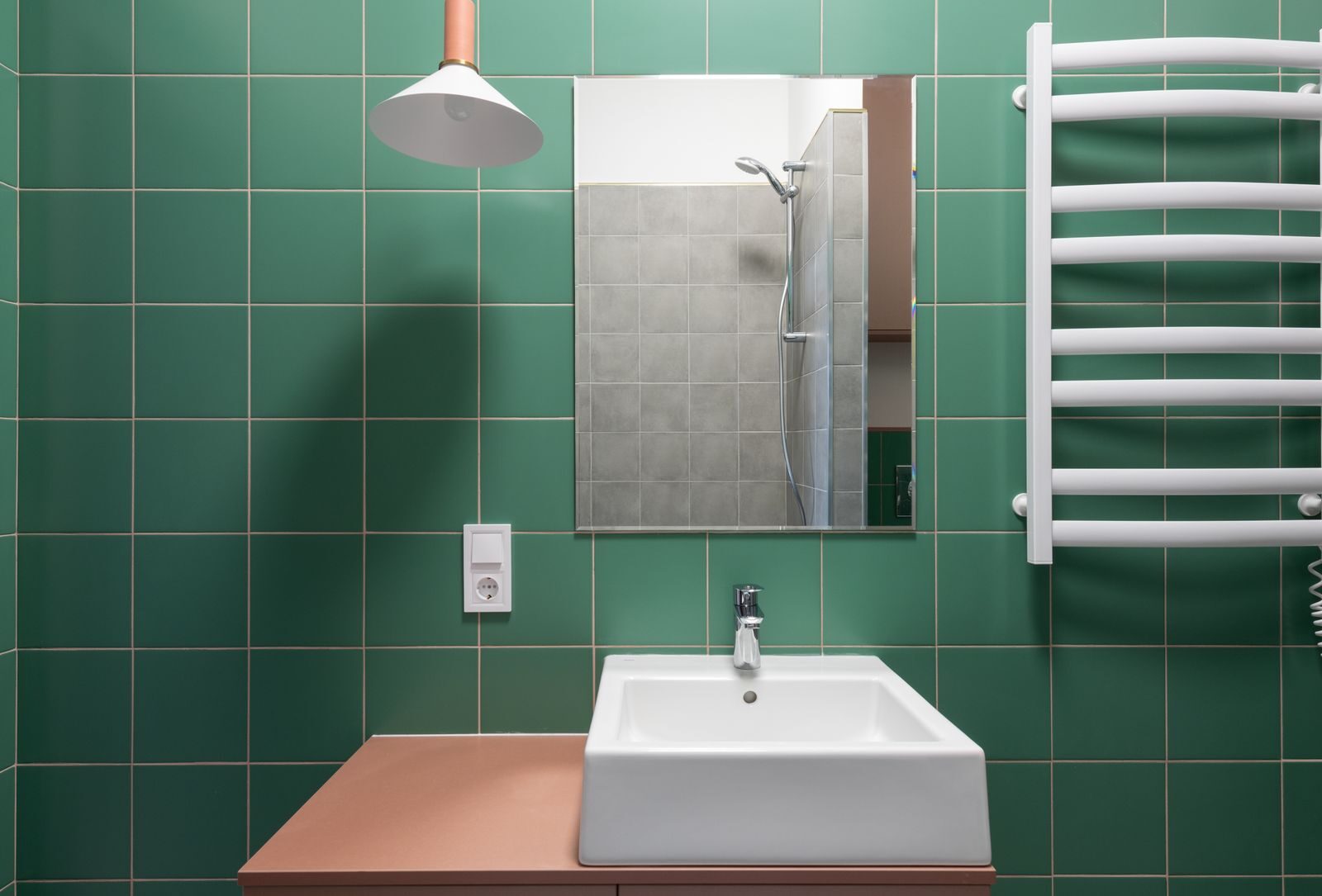
I redid my own bathroom three times before I landed on a green I could live with. The first attempt was a mint that looked like a dentist’s office under LED light. The second was a “sage” that turned grey and depressing the moment the sun went down. The third a deep, slightly dusty bottle green in a matte zellige finish is the one that’s still on my wall four years later, and it’s the one I get asked about by literally every contractor and friend who walks into that room. That’s the thing nobody tells you about green tiles:
The color on the sample chip and the color on your wall, under your lighting, next to your fixtures, are often two completely different colors. So this guide isn’t going to be a mood board dump. It’s going to walk through the actual decisions — material, shade, finish, layout, grout, lighting, cost — that determine whether your green bathroom looks like a design magazine or a swamp.
Table of Contents
- Why Green Is the Bathroom Color Everyone’s Suddenly Obsessed With
- Choosing Your Shade of Green (This Matters More Than the Tile)
- Tile Material Comparison: Ceramic vs Porcelain vs Glass vs Zellige vs Natural Stone
- Tile Shapes and Layouts That Actually Work in a Bathroom
- Design Styles: Matching Green Tile to a Look
- Real Bathrooms I’ve Worked On or Studied Closely
- The Buying Guide: What to Check Before You Order
- Real Cost Breakdown (Per Square Foot, US Market)
- Grout, Lighting, and the Mistakes That Ruin Green Bathrooms
- Maintenance: What Green Tile Actually Demands
- Where Green Tile Is Headed Next
- FAQs
- Final Thoughts
- About the Author
1. Why Green Is the Bathroom Color Everyone’s Suddenly Obsessed With
For about a decade, bathroom were stuck in a loop of white subway tile and grey everything. Safe, resellable, forgettable. Green broke that loop, and not because of a passing trend cycle it’s because green is one of the only saturated colors that reads as calming rather than loud.
Designers will tell you it’s “biophilic,” meaning it mimics nature and lowers stress responses, and there’s real research behind that claim environments with green tones measurably reduce cortisol compared to stark white or grey spaces. But honestly, the simpler explanation is that green tile photographs beautifully and looks expensive even when it isn’t. A $4-per-square-foot ceramic in the right green can look like a $40 stone tile if the shade and finish are right.
There’s also a practical angle: green hides water spots and soap scum better than white or black, especially in matte and textured finishes. That’s not marketing — that’s just how light scatters on a mid-tone, slightly desaturated color.
2. Choosing Your Shade of Green (This Matters More Than the Tile)
People obsess over brand and material and then pick the wrong undertone, and that’s the mistake that actually shows up in photos. Here’s how I break down the major green families:
Sage and eucalyptus — grey-green, low saturation. Reads as calm and Scandinavian. The risk: in north-facing bathrooms with cool LED bulbs, sage can shift to a flat, slightly institutional grey. Pair it with warm brass or unlacquered fixtures to keep it from going cold.
Emerald and jewel green — high saturation, often glossy. This is the “statement wall” green. It needs either a lot of natural light or warm, dimmable lighting, or it goes dark and cave-like. Works exceptionally well on a single accent wall or shower niche, less well on all four walls of a small windowless powder room.
Forest and bottle green — deep, almost black-green. This is what I used in my own bathroom. It’s forgiving of bad lighting because it’s already dark, and it pairs beautifully with brass, black matte fixtures, and warm wood vanities. The trade-off: in a small bathroom with no window, it can feel like a cocoon — some people love that, some find it claustrophobic.
Olive and avocado — yes, avocado green is back, but reinterpreted as a muted, sophisticated olive rather than the shiny 1970s version. This one is divisive. It photographs incredibly on Instagram but is genuinely hard to match with countertop and floor colors, so I’d only recommend it to someone who’s also picking everything else from scratch.
Mint and seafoam — light, cool, high-value. Beautiful in a bright, south-facing bathroom with plenty of window light. In artificial light it can look clinical, almost medical, which is exactly the dentist-office effect I mentioned earlier. Use warm-temperature bulbs (2700K, not 4000K+) if you go this route.
My honest take: if you can only get a tile sample and look at it in one lighting condition before committing, get the darker, more desaturated greens (forest, olive, deep sage). They’re far more forgiving than bright mints and emeralds, which can flip dramatically between daylight and evening lighting.
3. Tile Material Comparison: Ceramic vs Porcelain vs Glass vs Zellige vs Natural Stone
This is where most buying guides get vague. Let me actually compare these side by side, because the material changes everything — durability, cost, installation difficulty, and how the color itself behaves.
| Material | Price Range (per sq ft) | Water Resistance | Color Consistency | Best For | Honest Verdict |
|---|---|---|---|---|---|
| Ceramic | $2–$10 | Good (glazed) | High | Walls, budget projects | The safest entry point. Glazed ceramic in green holds color beautifully and is forgiving for first-time DIYers. Not as durable underfoot as porcelain. |
| Porcelain | $3–$15 | Excellent | Very high | Floors and walls, wet areas | Denser, less porous, handles freeze-thaw and heavy traffic. If you want green floor tile in a shower pan, this is almost always the right call. |
| Glass | $7–$30 | Excellent | High but reflective | Accent walls, shower niches, backsplash | Glass green tile has incredible depth — light passes through it rather than just bouncing off, which is why emerald glass mosaics look almost gem-like. Downside: grout lines show every imperfection, and it scratches more easily than people expect. |
| Zellige (handmade Moroccan) | $15–$40 | Good, needs sealing | Intentionally inconsistent | Feature walls, showers, vintage/Mediterranean looks | This is what I used at home. Each tile has slight pooling, dimples, and tonal variation — that’s the entire appeal. If you want a perfectly uniform green wall, do NOT buy zellige; the variation will frustrate you. If you want something that looks handcrafted and alive under changing light, nothing else compares. |
| Natural stone (marble, quartzite, slate) | $10–$50+ | Variable, needs sealing | Low (natural veining) | Luxury bathrooms, statement floors | Green marble (like Verde Guatemala or Rainforest Green) is stunning but genuinely high-maintenance — it etches with acidic cleaners and needs resealing. I’d only recommend this to someone who already owns natural stone elsewhere and knows the upkeep. |
| Cement/Encaustic tile | $8–$20 | Moderate, needs sealing | Medium | Floors, patterned looks | Great for green-and-white pattern floors (a very popular look right now). Softer than porcelain, so it dents and stains if not sealed properly. |
If I had to pick one for a first-time green tile project with a normal budget, I’d say glazed porcelain for the floor and zellige or ceramic for a shower wall accent. That combination gives you durability where you need it and character where it matters visually.
4. Tile Shapes and Layouts That Actually Work in a Bathroom
The shape changes how saturated a color reads, which is something people underestimate.
- Subway tile (3×6 or 4×8) in green is the safest, most timeless choice. A herringbone layout instead of the standard brick pattern instantly makes it look more current and less like a 2014 renovation.
- Hexagon tile in small format (under 2 inches) on a floor with white grout creates a honeycomb effect that reads as more pattern than pure color — useful if you love green but worry about full saturation overwhelming a small room.
- Fish-scale / scallop tile is having a real moment for shower accent walls. It catches light in a way flat tile can’t, and in glossy emerald it looks genuinely luxurious. It’s also one of the trickiest shapes to install — budget extra labor time.
- Large-format tile (12×24 and up) in green works best in bigger bathrooms. Large format in small saturated colors can make a small room feel boxed in because there are fewer grout lines to break up the visual field — counterintuitively, sometimes more grout lines (smaller tile) makes a strong color easier to live with in a tiny space.
- Zellige in classic 4×4 is the standard for that handmade Moroccan look — anything bigger than that loses the appealing “pillowy” texture.
5. Design Styles: Matching Green Tile to a Look
Mediterranean / Moroccan — zellige or talavera-inspired tile, brass fixtures, white grout, terracotta or wood accents. Deep green or teal-green works best.
Art Deco revival — glossy hexagon or fan-shaped tile in emerald, paired with black and brass hardware, geometric mirror frames. This style wants saturation and shine — don’t go matte here.
Modern minimalist / Scandinavian — large-format matte porcelain in sage or eucalyptus green, paired with white oak vanities and minimal hardware. Grout should match the tile closely so the wall reads as one calm plane.
Cottage / vintage Americana — small subway or penny tile in mint or seafoam, white grout, chrome fixtures, beadboard. This is the look people associate with “1950s bathroom,” reinterpreted with better materials.
Biophilic / wellness spa — natural stone or stone-look porcelain in forest or olive, paired with wood, woven textures, and plenty of plants that can survive humidity (pothos and ferns, realistically, since most “bathroom plants” lists overestimate how much light a windowless bathroom gets).
6. Real Bathroom I’ve Worked On or Studied Closely
A few projects that taught me something specific:
A client in a 1920s bungalow wanted full emerald glass tile on all four shower walls. We tested a sample panel for two weeks before committing — smart move, because the bathroom had only a small frosted window, and at night under warm bulbs the emerald looked nearly black. We ended up doing emerald glass only on the back wall and white subway on the other three, and it solved the cave problem while keeping the wow factor.
A small powder room I consulted on used dark forest green ceramic floor-to-ceiling with a single brass sconce and no overhead light at all — just the sconce and a vanity light. It sounds risky on paper, but powder rooms are used briefly and don’t need bright, even lighting the way a shower does, so a moody, jewel-box effect actually works there in a way it wouldn’t in a primary bath.
A renovation I reviewed for a friend used olive green cement tile on the floor in a checkerboard pattern with cream tile, and matte white subway on the walls. This is a great formula if you’re nervous about committing to green everywhere — it gives you the trend without painting yourself into a corner if you sell the house in five years.
7. The Buying Guide: What to Check Before You Order
- Order a sample, not just a chip. A 4×4 actual tile sample tells you far more than a paint-style swatch. Tape it to the wall and look at it morning, midday, and night.
- Check the lot/dye number. Glazed and natural tiles vary between production batches. If your project needs more than one box, confirm they’re from the same lot, or order slightly more from the start — reordering later often means a visible color mismatch.
- Calculate 10-15% extra for cuts, breakage, and future repairs. This is standard trade advice and it’s annoying how often people skip it and then can’t match a broken tile two years later.
- Confirm PEI rating for floors. This is the durability/wear rating (1 through 5). Bathroom floors should be PEI 3 or higher; anything rated for walls only (PEI 1-2) will wear and scratch on a floor.
- Ask about the finish’s slip rating (often listed as a DCOF or R-rating) for any floor or shower-pan tile. Glossy glass and polished stone look incredible but can be dangerously slick when wet — this is the single most overlooked safety issue in bathroom tile shopping.
- Decide on grout color before you order tile, not after. Grout can shift a tile’s entire personality — white grout on green zellige looks crisp and Mediterranean; green-matched grout on the same tile looks like a single calm plane of color.
- Measure your actual wall/floor area and add for waste, then check the supplier’s return policy on unopened boxes — many tile retailers won’t accept opened boxes back, so don’t open everything at once if you’re unsure of final quantity.
8. Real Cost Breakdown (Per Square Foot, US Market)
| Item | Budget Tier | Mid-Range | High-End |
|---|---|---|---|
| Tile material | $2–$5 (ceramic) | $6–$15 (porcelain, glass mosaic) | $20–$50+ (zellige, natural stone, designer glass) |
| Installation labor | $5–$8 | $8–$15 | $15–$25+ (herringbone, fish-scale, handmade tile needs skilled setters) |
| Waterproofing/substrate prep | $2–$4 | $4–$7 | $7–$12 |
| Grout and sealant | $0.50–$1.50 | $1.50–$3 | $3–$6 (epoxy grout, specialty sealers) |
| Total installed cost (approx.) | $10–$18/sq ft | $18–$35/sq ft | $35–$80+/sq ft |
For a typical 40 square foot shower surround, that puts you somewhere between $400 on the low end and well over $2,500 on the high end — and the material itself is often a smaller share of the total than people expect. Labor, especially for handmade or oddly-shaped tile, frequently costs more than the tile.
9. Grout, Lighting, and the Mistakes That Ruin Green Bathrooms
The single biggest mistake I see is choosing the tile under store lighting (usually cool, even, fluorescent-adjacent) and never testing it under the bathroom’s actual bulbs. A second close mistake is grout that fights the tile — bright white grout on a deep, moody green can look chalky and cheap, breaking up the tile’s intended cohesion into a busy grid.
A third mistake: matching green tile to green paint on an adjacent wall. It rarely works because tile has glaze and reflectivity that paint doesn’t, so the two greens “argue” instead of blending, even when they’re technically the same hex code. If you want a cohesive green room, let the tile be the green statement and keep adjacent walls in white, cream, or a warm neutral.
And a smaller, sneaky one: people forget that green grows more intense in larger quantities. A green that looks perfectly balanced on a small sample looks two shades more saturated once it covers an entire wall — a phenomenon designers sometimes call “color magnification.” When in doubt, go one shade lighter or more muted than you think you want.
<a name=”maintenance”></a>
10. Maintenance: What Green Tile Actually Demands
Glazed ceramic and porcelain are genuinely low-maintenance — a non-abrasive cleaner and a squeegee after showers is enough. Zellige and natural stone need periodic resealing (roughly once a year for a shower, less for a floor) because they’re more porous, and you should avoid acidic cleaners like straight vinegar on natural stone, since it etches the surface over time.
Glass tile shows water spots more visibly than matte ceramic, simply because of how reflective it is — if you’re someone who’s bothered by visible mineral deposits, a matte or honed finish will hide far more daily wear than a glossy one.
Grout, regardless of tile material, is usually the actual maintenance burden — not the tile itself. Sanded grout in a shower should be sealed annually; many newer “epoxy” grouts skip this step entirely and resist staining much better, at a higher upfront cost.
11. Where Green Tile Is Headed Next
A few shifts I’m watching closely: the move toward more textured, three-dimensional green tile — fluted, ribbed, and wavy surfaces that play with shadow rather than relying purely on color saturation. I’m also seeing a quiet move away from full glossy emerald walls toward mixed-finish installations, where a matte green field tile is paired with a glossy green trim or niche, giving depth without the all-over high-shine look that can feel dated quickly.
There’s also a real shift toward “tonal” bathrooms — green tile paired with green-toned (not white) grout, green-toned fixtures, and stone countertops with green undertones, creating a monochromatic, almost architectural look rather than a single accent color against a neutral backdrop. I’d bet this becomes the dominant high-end look over the next few years, replacing the current “green accent wall against all-white” formula that’s become extremely common.
12. FAQs
Does green tile make a small bathroom feel smaller? Not necessarily — darker, more saturated greens can actually make a small windowless bathroom feel intentional and cozy rather than cramped, especially with good lighting. What does shrink a small room is high-contrast grout breaking the wall into a busy grid. Tone-matched grout helps a lot.
What grout color goes best with green tile? For light greens (mint, sage), a soft white or warm grey grout keeps things crisp without going stark. For deep greens (forest, emerald), a charcoal or tone-matched green grout creates a cohesive, intentional look. Bright white grout on dark green can look chalky and dated within a few years.
Is green tile a passing trend or here to stay? Green has cycled through design history for decades — avocado in the 70s, sage in the 90s, and now this current wave leans on more sophisticated, nature-inspired shades. I think the deeper, muted greens (forest, olive, sage) have real staying power because they function almost like a neutral; the brighter, glossier greens (emerald, mint) are more clearly tied to this specific design moment.
Can I mix green tile with other colors like terracotta or navy? Yes — green pairs particularly well with warm terracotta, navy, and warm wood tones because they all sit on complementary or adjacent points of the color wheel relative to green. Avoid pairing cool mint green with cool grey-blue; that combination tends to feel clinical rather than warm.
Do I need special cleaning products for green tile specifically? No different from any other tile color — the cleaning requirements come from the material (glazed ceramic vs. natural stone vs. glass), not the color itself.
13. Final Thoughts
Green tiles isn’t a single decision it’s about six decisions stacked on top of each other: shade, material, finish, shape, grout, and lighting. Get five of those right and one wrong, and the bathroom still won’t feel finished. I learned that the hard way, twice, before getting it right the third time.
If there’s one piece of advice I’d actually want someone to remember from this whole guide, it’s this: live with a real sample in your real bathroom, under your real lighting, for at least a few days before you order anything. Every other decision — material, shape, grout — is reversible-ish with enough money and patience. The wrong shade of green, multiplied across forty square feet of wall, is the mistake that’s hardest to undo gracefully. Get that one right, and almost everything else falls into place around it.
About the Author
Written by a residential design researcher and renovation consultant with over a decade of hands-on experience evaluating tile materials, finishes, and installation outcomes across both budget and high-end residential projects. Their work focuses on translating material science and design trend data into practical, livable guidance for homeowners — combining direct renovation experience with ongoing research into surface materials, color behavior under varying light conditions, and long-term maintenance outcomes. They’ve personally specified, sourced, and lived with more tile samples than they’d like to admit.