




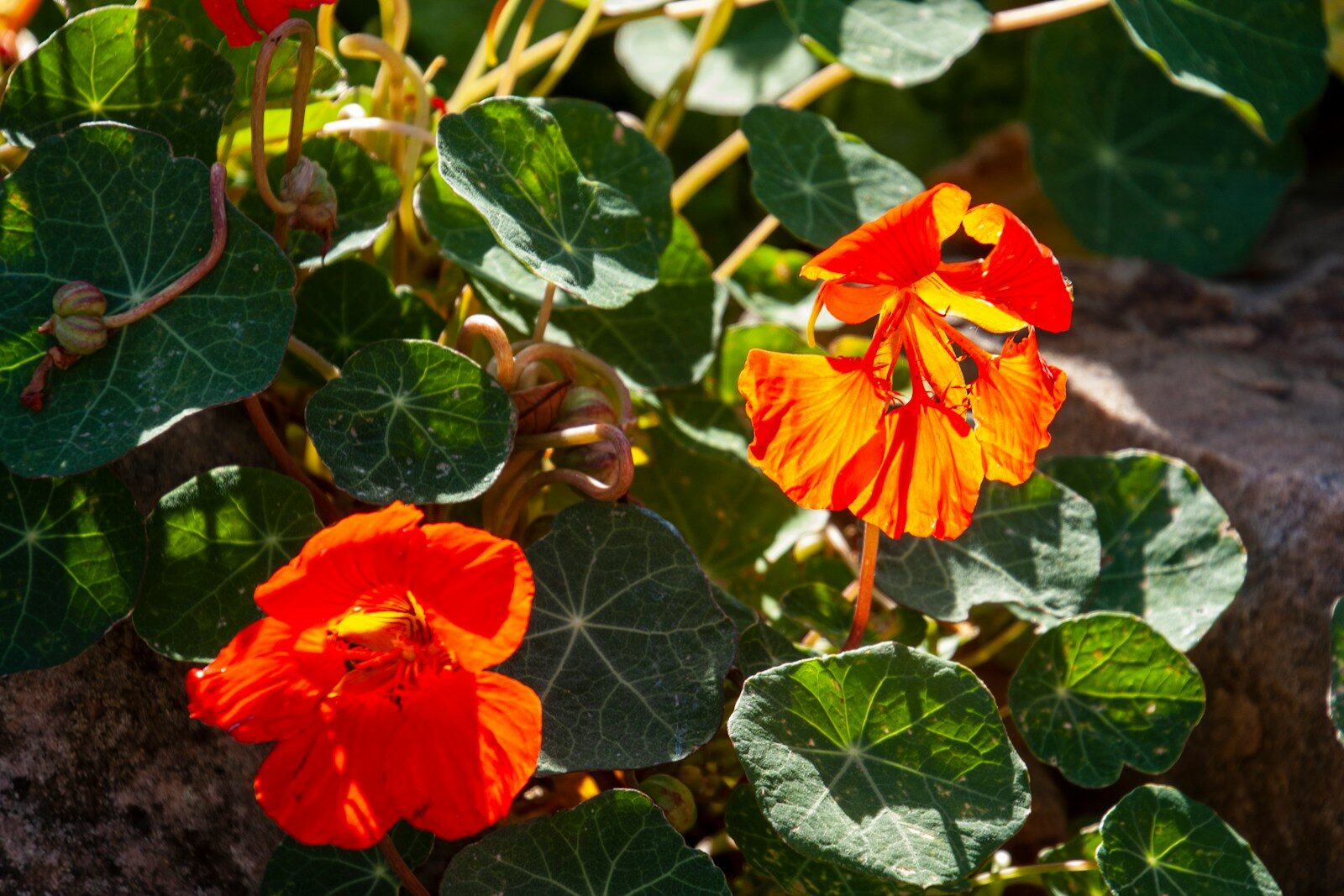
I planted my first Nasturtium almost by accident. A neighbor had tossed a handful of seeds near the garden fence one spring, and by midsummer there was this spectacular cascade of tangerine and crimson spilling across the soil like something from a painting. I didn’t know you could eat the flowers. I didn’t know they were keeping aphids off my tomatoes. Didn’t know they’d self-seed and come back the following year without any help from me.
That accidental first encounter turned into a lasting relationship. Nasturtiums are the kind of plant that makes you feel like a talented gardener without actually demanding much from you — and then, the more you learn about them, the more you realize they’ve been quietly doing things in your garden that you never gave them credit for.
This is the article I wish I’d had from the beginning: the growing science, the culinary truth, the medicinal history, and the companion-planting logic that make nasturtiums one of the most genuinely useful flowers you can grow.
The Plant Behind the Name
Most people know nasturtiums as those cheerful orange and yellow flowers that pop up in summer without much fuss. But the name itself has an interesting quirk worth understanding.
Botanically speaking, Nasturtium is actually the genus name for watercress. The garden flower most of us call Nasturtium belongs to the genus Tropaeolum — specifically Tropaeolum majus for the climbing or trailing types and Tropaeolum minus for the compact, bushy varieties. The common name “nasturtium” stuck over centuries of informal use, and it’s not going anywhere. But knowing the Tropaeolum distinction matters when you’re searching for seeds or reading cultivation research.
The name Tropaeolum comes from the Greek word for trophy (tropaeum), given by the Swedish botanist Carl Linnaeus because the round, shield-shaped leaves and helmet-like flowers reminded him of Roman war trophies displayed on poles after battle. There’s a pleasing boldness to that image — and it fits a plant that thrives where others give up.
Nasturtiums are native to the tropical and subtropical regions of the Andes in South and Central America. The ancient Incas cultivated them for both food and medicine long before European explorers arrived. Spanish conquistadors brought seeds back to Europe in the 16th century, though it took another century before Europeans fully embraced the plant’s culinary and medicinal value. By the Victorian era, nasturtiums were a garden staple across England and Europe, symbolic of romance and courage in the elaborate floral language of the time.
Why Nasturtiums Are Worth Growing — Even If You Don’t Care About Flowers
Before getting into the how, it’s worth dwelling on the why, because nasturtiums genuinely earn their garden space across multiple categories simultaneously.
They’re fully edible — every part. The flowers, leaves, stems, and seed pods are all edible, and each brings something distinct. The flowers have a mildly peppery sweetness that adds both flavor and color to salads. The leaves carry more heat — sharper and more pronounced than the blooms, closer to arugula or watercress. The green seed pods are traditionally pickled in vinegar and used as a caper substitute. This isn’t a gimmick — restaurants across Europe and North America have been featuring nasturtium components on upscale menus for years.
They do real work as companion plants. Nasturtiums attract, repel, and confuse a surprising range of insects. They draw aphids away from vulnerable crops, serving as sacrificial trap plants. They attract hoverflies, lacewings, and ladybugs — all natural predators of common garden pests. Their strong scent confuses and deters whiteflies, squash bugs, cucumber beetles, and cabbage moths. For organic gardeners, this makes them one of the most valuable non-food plants in the bed.
They bloom from midsummer to the first frost. In a garden that can look tired by August, nasturtiums keep producing color well into autumn. And they do it without demanding fertilizer, without complicated care routines, and in soil that would make other plants sulk.
Varieties Worth Knowing
The nasturtium family has more diversity than most people realize. Selecting the right type for your space shapes everything from the look of your garden to the amount of harvesting room you have.
Trailing and climbing varieties (Tropaeolum majus) are the vigorous, sprawling types that can reach six to ten feet given something to climb — a trellis, a fence, or a wigwam of garden canes. They make spectacular ground cover, spill beautifully from raised beds, and work wonderfully as natural privacy screens in a container on a balcony. ‘Empress of India’ is a classic, with deep scarlet flowers against dark blue-green leaves. ‘Tall Mixed’ produces a full spectrum of warm colors and is one of the most reliable for cutting gardens.
Dwarf and bush varieties (Tropaeolum minus) stay compact — roughly twelve inches tall and wide — and are better suited to containers, window boxes, and border edging. ‘Alaska’ is a standout for its cream-marbled variegated foliage; even when not in bloom, it’s ornamentally interesting. ‘Jewel Mix’ produces semi-double blooms in saturated colors. ‘Peach Melba’ offers soft yellow petals with a striking orange-red center, which photographs beautifully and works well as a garnish.
Specialty varieties worth tracking down:
- Tropaeolum peregrinum (Canary Creeper) — a climbing nasturtium with fringed yellow flowers and deeply lobed leaves. More delicate-looking than the majus types, but genuinely lovely trained over an arch.
- ‘Black Velvet’ — one of the darkest red nasturtiums available, almost mahogany in the right light. Less vigorous than standard varieties but visually stunning in containers.
- ‘Milkmaid’ — a cream-white variety, rare in that it steps away from the typical warm palette entirely. Useful for white garden designs.
When and How to Sow Nasturtium Seeds
This is where nasturtiums make gardening feel effortless. The seeds are large, wrinkled, and easy to handle — no tweezers, no careful spacing with a ruler. Children can plant them successfully.
Direct sowing is almost always the better approach. Nasturtiums have long taproots and resent being transplanted once established. Starting them in pots and moving them later introduces stress that shows up as stunted growth or delayed flowering. In most climates, direct sow in the garden one to two weeks after the last frost, once soil temperatures have reached at least 55°F (13°C).
Sow seeds roughly half an inch deep and about ten to twelve inches apart. If you’re growing trailing varieties on a trellis, you can push spacing to fifteen inches. For ground cover, twelve inches apart gives each plant room to fill without overcrowding.
If your growing season is short and you want earlier blooms, you can start seeds indoors two to three weeks before the last frost in biodegradable pots that can be transplanted whole. Root disturbance is minimal this way, and the plants establish without shock.
Germination typically takes ten to fourteen days at soil temperatures of 65–70°F. In my experience, if you haven’t seen any movement by day sixteen, the seeds were either too old or the soil was too cold. Nasturtium seeds do lose viability over time — seeds more than two years old germinate inconsistently.
One technique I’ve found genuinely useful: nick the seed coat lightly with a nail file or soak seeds in water for a few hours before sowing. Nasturtium seeds have a relatively hard outer coat, and this simple step can cut germination time by two to three days.
The Counterintuitive Soil Rule
Here’s the piece of advice that trips up more gardeners than any other: Nasturtiums flower best in poor soil.
This feels wrong, especially if you’ve spent years improving your garden beds with compost and fertilizer. But it’s true, and the reason is straightforward. When soil is rich in nitrogen, nasturtiums respond by producing abundant, vigorous leaf growth at the direct expense of flowers. The plant focuses its energy on vegetative growth when nutrients are plentiful.
In lean, well-drained soil with low fertility, the plant shifts its energy toward reproduction — i.e., flowering and setting seed. The result is a mass of blooms rather than a mass of leaves.
This doesn’t mean planting in pure sand. Good drainage is essential, and a moderately fertile soil is fine. But hold back on the compost top-dress and skip the nitrogen-heavy fertilizer entirely. If your soil is naturally rich from years of amendments, you might find nasturtiums flowering modestly and leafing generously — which is fine if you’re growing for culinary leaves, but frustrating if you want a floral display.
Soil pH doesn’t need to be obsessed over. They’re tolerant across a wide range, performing well from about 6.0 to 8.0.
Light, Water, and the Art of Minimal Intervention
Light: Nasturtiums need full sun — at least 6 to 8 hours of direct sunlight daily. In hot climates (regularly above 90°F in summer), some afternoon shade actually helps, preventing the flowers from bleaching and slowing the plant’s tendency to go leggy in intense heat. In the UK, Northern Europe, or cool-summer regions, full sun is always the right call.
Water: Once established, nasturtiums are drought-tolerant and actually prefer slightly dry conditions. Water deeply but infrequently — the goal is to let the top couple of inches dry between waterings rather than keeping soil constantly moist. Consistent overwatering leads to root rot, yellowing leaves, and minimal flowering. During establishment (the first two to three weeks after germination), water more regularly to help roots develop; after that, step back.
Always water at the base of the plant, not from above. Wet foliage creates conditions for fungal problems, particularly in humid climates.
Temperature: Nasturtiums are frost-sensitive annuals in most climates. They grow best between 55°F and 75°F (13–24°C). A light frost will blacken the foliage and end the season. In USDA zones 9–11 (or equivalent warm climates), they can be grown as short-lived perennials and may self-seed prolifically enough to feel permanent.
Companion Planting With Nasturtiums: How It Actually Works
The companion planting benefits of nasturtiums are real, but they work best when you understand the mechanism rather than treating it as garden magic.
As a trap crop for aphids: Aphids are strongly attracted to nasturtiums, particularly the soft new growth. The strategy here is intentional — you’re offering aphids an alternative to your vegetables. Plant nasturtiums near brassicas, roses, or fruit trees, and aphids will often colonize the nasturtiums first. Once you see aphid colonies on your nasturtiums, you can either leave them (they’ll attract ladybugs and lacewings that naturally keep the population in check) or remove and dispose of heavily infested stems.
Pest confusing and repelling: The volatile oils in nasturtium leaves — including compounds like myristicin and limonene — produce a scent that genuinely interferes with the host-finding behavior of certain insects. This olfactory noise disrupts whiteflies, squash bugs, and cabbage moths, and tends to drive them elsewhere. For a vegetable bed, this makes nasturtiums worth planting on the windward side, where their scent disperses across neighboring crops.
Pollinator attraction: The long, nectar-filled spurs on nasturtium flowers are particularly attractive to bumblebees and hummingbirds. Planting nasturtiums near fruiting vegetables — tomatoes, cucumbers, squash, beans — increases pollinator traffic and can meaningfully improve fruit set.
Best companions: Cucumbers, zucchini, squash, tomatoes, radishes, kale, broccoli, cauliflower, beans, and fruit trees all benefit. Nasturtiums also reportedly enhance the flavor of radishes planted nearby, according to permaculture tradition.
What to avoid: Don’t plant nasturtiums directly next to fennel (which inhibits many plants), and be cautious about planting them right next to very dense shade-producing crops where they’ll struggle for light.
The Edible Parts: A Practical Culinary Guide
Flowers: Pick in the morning after the dew has dried. Rinse gently and shake dry. Use fresh — they wilt quickly once cut. The flavor is mildly peppery with a honeyed sweetness. Use as a salad garnish, float in summer soups, press into compound butter, or freeze into ice cubes for drinks. The colors range from pale cream through to deep crimson, and a mixed bowl of nasturtium flowers on a table is genuinely beautiful.
Leaves: Smaller, younger leaves are milder and work well in salads, such as arugula. Larger, mature leaves carry significant heat and are better used sparingly — torn into a sandwich, folded into an omelette, or blended into a peppery nasturtium pesto. Yes, nasturtium pesto is real, and it’s excellent — substitute the leaves for basil, pine nuts, garlic, parmesan, and olive oil.
Seed pods: Harvest while still green and plump, before they harden. They have a strong, peppery bite when raw. Pickling them in white wine vinegar with a few peppercorns and garlic cloves for three to four days produces a caper substitute that, honestly, holds up very well in pasta dishes, salads, and on charcuterie boards. This is a preservation trick that deserves far more mainstream attention than it gets.
A word on quantity: Nasturtiums are not a vegetable to eat in large volumes at every meal — they contain compounds, including oxalic acid, that can cause mild digestive discomfort in very large quantities. As a regular culinary accent, a garnish, a flavoring — they’re excellent. As a bulk salad green eaten by the bowlful every day, they’re better in moderation.
Medicinal and Health Benefits: The Science Behind the Tradition
The Incas weren’t wrong. Modern phytochemical research has confirmed several properties that traditional medicine has attributed to nasturtiums for centuries.
Antimicrobial activity: Nasturtiums contain glucosinolates that break down into isothiocyanates — compounds with documented antibacterial and antifungal properties. This is the same class of compounds responsible for the health benefits of broccoli and other brassicas. The volatile oils in the plant (myristicin, α-terpinolene, limonene) contribute additional antioxidant and anti-inflammatory activity.
Vitamin C content: Nasturtiums are a genuinely rich source of vitamin C — more concentrated than many common salad vegetables. The Incas used nasturtium teas for respiratory ailments; European herbalists used them to treat urinary tract infections. Both uses have some logic given the plant’s immune-supporting and mild antimicrobial properties.
Respiratory support: Traditional herbalism used nasturtium preparations (teas and tinctures from fresh leaves) as expectorants for chest infections and colds. The isothiocyanate compounds have a warming, decongestant-like effect that supports this use.
Wound care: Infusions of fresh nasturtium leaves were applied topically as poultices for minor cuts and abrasions by both Incan practitioners and European herbalists. The antimicrobial properties make this historically sensible, though for anything beyond the most minor injuries, modern wound care is clearly preferable.
None of this means nasturtiums are medicine in the clinical sense. But eating them regularly, adding them to your salads, and cooking them as a genuine food — not just as decoration — offers real nutritional value that most ornamental flowers simply don’t.
Overwintering, Self-Seeding, and Managing Comeback Season
In temperate climates, nasturtiums are annuals that die at the first hard frost. But they self-seed prolifically, and if you let a few seed pods mature and fall, you’ll often find volunteers emerging the following spring without any intervention from you.
If you want to save seed intentionally, wait until the seed pods have turned from green to tan-white and feel dry and papery. Collect them into a paper bag, allow them to dry fully for a week or two, then store them in a cool, dry place in a paper envelope. Stored properly, seeds remain viable for 2 to 3 years.
If you don’t want self-seeding, deadhead spent flowers before they develop seed pods. This also extends flowering, as the plant redirects energy into producing new blooms rather than setting seed.
Common Problems and Honest Solutions
Aphids: Ironic, given that nasturtiums are often planted to attract aphids away from other crops. If your nasturtiums become overwhelmed with aphids, hose them off with a strong jet of water, or introduce ladybugs. If you’ve planted nasturtiums specifically as a trap crop, heavy aphid colonization is actually a sign the system is working.
Caterpillar damage: Large and small white butterfly caterpillars feed on nasturtium leaves, sometimes voraciously. The holes in leaves are obvious and unsightly. Hand-pick caterpillars if it bothers you; if you’re using nasturtiums as a trap plant for brassicas, this damage is acceptable.
Powdery mildew: Appears in late summer, particularly during hot days followed by cool nights. Improve airflow by thinning crowded plants. Once established, powdery mildew is difficult to reverse. At this point in the season, the plants are usually winding down anyway, and the pragmatic response is to clear infected plants and start fresh next year.
Leggy, few flowers: Almost always a soil fertility issue. Rich soil drives leaf growth at the expense of flowers. Skip the compost and fertilizer.
Yellowing leaves: Usually overwatering or waterlogged roots. Improve drainage, reduce watering frequency.
FAQs
Can nasturtiums grow in pots and containers? Beautifully. Use a potting mix that isn’t too nutrient-rich (avoid mixes with high slow-release fertilizer content), ensure excellent drainage, and choose a container at least twelve inches in diameter. Bush varieties work best; trailing types can be spectacular in tall containers or hanging baskets where they can cascade downward.
Will nasturtiums grow in shade? They’ll survive in partial shade but won’t thrive. Expect fewer flowers, more leaf growth, and a more straggly habit. Full sun for at least six hours is the practical minimum for a decent display.
How long does it take for nasturtiums to flower after sowing? Generally, six to eight weeks from direct sowing to first flowers, depending on temperature and light. In warm conditions with plenty of sun, some varieties bloom in as little as five weeks.
Are nasturtiums toxic to pets? They are considered non-toxic to cats and dogs. However, as with any plant, eating large quantities can cause mild digestive upset. They’re generally regarded as safe in a pet-friendly garden.
Can I grow nasturtiums indoors? You can, with a genuinely sunny windowsill or a grow light setup. They need significant light to bloom indoors — a south-facing window in summer or LED grow lights for twelve or more hours daily. They’ll tend to grow leggy without enough light. For most people, indoor growing works better as a short-term seedling stage before moving outside.
What’s the best way to use nasturtiums in the kitchen if I’ve never done it before? Start by adding a few fresh flowers to your next salad. The visual impact alone is striking, and the flavor is mild enough not to overwhelm anything. From there, try the leaves in a sandwich in place of rocket/arugula. Once you’re comfortable, try the pickled seed-pod caper substitution—it’s the recipe that genuinely surprises people.
Looking Ahead: Nasturtiums in the Modern Garden
There’s a quiet movement in edible landscaping and regenerative home gardening — a philosophy that says ornamental plants should earn their space by doing more than one thing. Nasturtiums fit this perfectly. They’re beautiful enough for a front garden, functional enough for a productive kitchen plot, low-input enough for people with limited time, and connected enough to both traditional medicine and modern culinary trends to feel genuinely relevant.
As interest in no-dig gardening, pollinator-friendly planting, and chemical-free pest management continues to grow, nasturtiums are finding their way into increasingly serious conversations about practical horticulture. They’re not a trend — they’re a plant that’s been undervalued, and people are catching up.
Conclusion
What strikes me most about nasturtiums, after years of growing them, is how their value compounds quietly. Most plants do one thing well. Nasturtiums do six or seven things at least adequately, and several of them remarkably. They feed you, protect your other plants, invite pollinators, ask almost nothing from your soil, and produce one of the most reliably cheerful displays in the summer garden.
They’re a plant that rewards the curious gardener — the one who notices that the aphids have moved off the tomatoes, who tastes a leaf and is surprised by the heat, who pickles the seed pods on a whim and ends up serving them to dinner guests. That kind of gardening — attentive, experimental, connected to what’s actually happening in the soil and among the stems — is what nasturtiums quietly encourage.