


By a gardener who has grown over a dozen salvia species across three different climate zones — and learned most lessons the hard way.
There’s a moment every spring when I walk past my border beds and notice something has already woken up before everything else. Not the roses. Not the hydrangeas. It’s the Salvia — stubby little gray-green shoots pushing out of cracked, dry soil as if they couldn’t wait. That’s the thing about Salvia that nobody really tells beginners: this plant doesn’t need much from you. What it gives back, though, is extraordinary.
Salvia is, without exaggeration, one of the most underrated genera in all of ornamental gardening. With over 1,000 species found across six continents, it spans everything from the sage you dried last autumn for stuffing to towering five-foot shrubs in magenta that stop hummingbirds mid-flight. Understanding this plant means understanding a small corner of the natural world — where pollinators and flowers have evolved together across millions of years.
This guide is written for anyone who wants to grow Salvia well. Whether you have a half-pot of soil on a balcony or a half-acre of sloping garden bed, something here will be useful to you.
What Exactly Is Salvia?
Salvia belongs to the mint family, Lamiaceae, and shares the genus with culinary sage (Salvia officinalis). The name itself comes from the Latin salveo, meaning “I heal” or “I save” — a nod to the plant’s long history in medicine and cooking across Roman, Greek, and Indigenous American traditions.
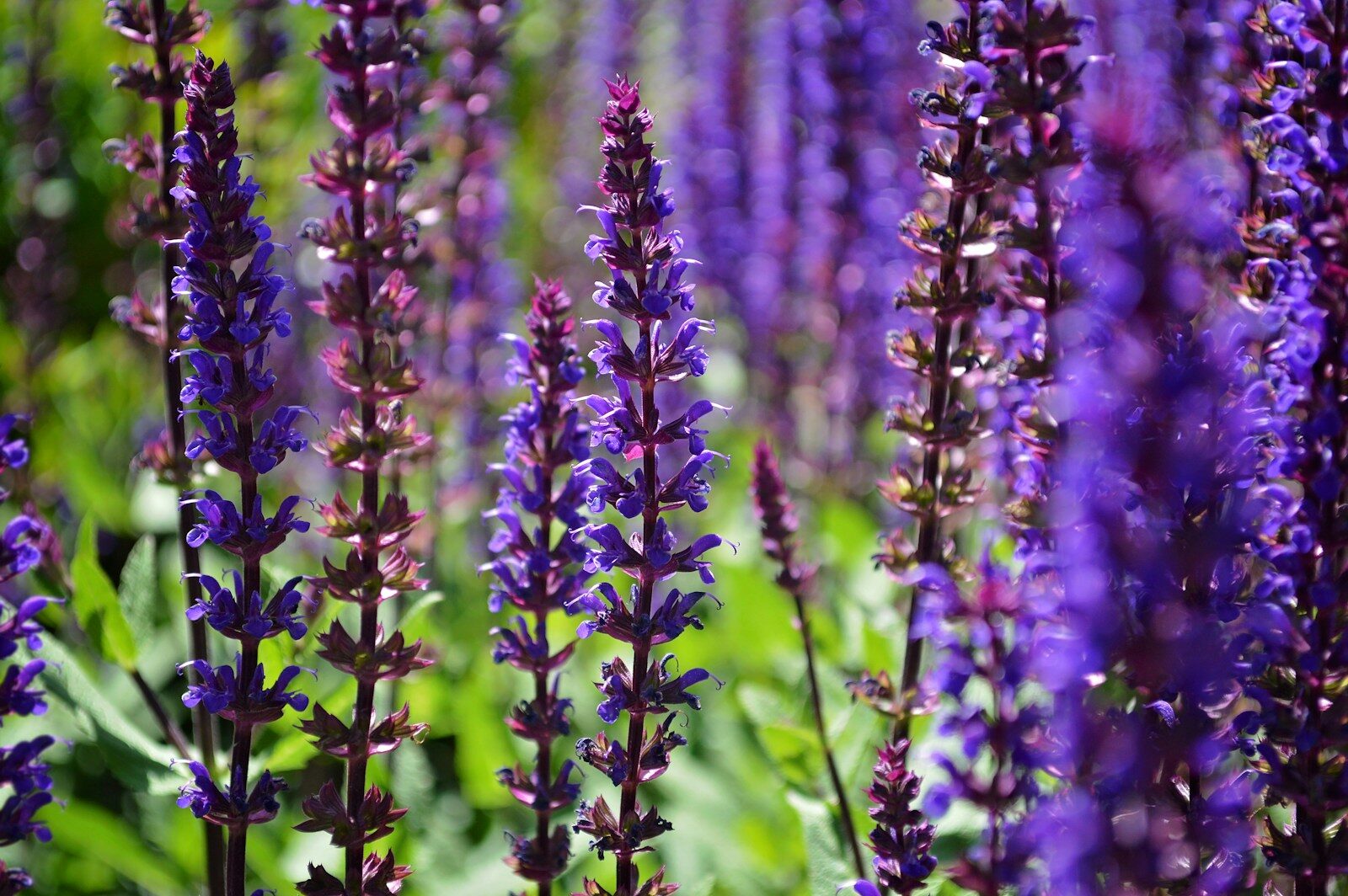
What unites the salvia genus, despite its wild diversity, is a recognizable flower structure: tubular, two-lipped blooms arranged in whorls along upright spikes, often with deeply aromatic foliage. That tube shape is not accidental — it’s a long evolutionary handshake with specific pollinators, particularly long-tongued bees, hummingbirds, and certain butterflies.
What makes Salvia so compelling for home growers is exactly that diversity. You can find species suited to tropical conditions, bone-dry Mediterranean hillsides, cold mountain meadows, and humid subtropical forests. The learning curve isn’t about mastering one thing — it’s about picking the right Salvia for your specific situation.
The Four Main Types of Salvia
Sorting salvias into four broad groups makes it much easier to understand their care requirements. These aren’t rigid scientific categories — they’re practical gardening distinctions.
1. Annual Salvias
Annual salvias complete their entire life cycle — germination, flowering, seed set — in a single season. The most familiar are Salvia splendens (scarlet bedding sage), Salvia farinacea (mealycup sage), and Salvia coccinea (Texas sage or blood sage). These are your classic summer bedding plants. They’re grown from seed or transplant each year, perform brilliantly from early summer until frost, and are then pulled out.
Salvia farinacea in particular deserves more attention than it typically gets. The variety ‘Victoria Blue’ — with its intense cobalt-violet spires — holds color better under heat stress than almost any other bedding annual I’ve grown. Pair it with ‘Mystic Spires Blue’ for an extended-season display that genuinely runs from late May through October with minimal fuss.
Annual salvias prefer full sun, regular deadheading, and moderate water. They’re less drought-tolerant than their perennial cousins, but they forgive a missed watering day far better than petunias or impatiens.
2. Hardy Perennial Salvias
These are the backbone of any serious salvia collection. Salvia nemorosa and its many cultivars — ‘Caradonna’, ‘May Night’, ‘Marcus’, ‘Pink Friesland’ — are among the most reliable hardy perennials in temperate gardening. They die back to the ground in winter and return vigorously in spring. Cut them back hard after the first flush in early summer, and most will give a second — sometimes even third — flowering before autumn.
Salvia x sylvestris hybrids work the same way. ‘Blue Hill’, ‘Rose Queen’, and ‘Mainacht’ (also sold as ‘May Night’) are old favorites that remain excellent choices even as newer cultivars emerge each season.
What I particularly value about Salvia nemorosa is its architectural quality. The upright spikes, reaching 18–24 inches, create strong vertical lines in a border that softer plants can’t provide. Combined with the silvery-gray foliage of artemisia or the flat golden heads of achillea, you get a composition that looks designed by someone who knew exactly what they were doing — even if you arrived at it accidentally.
3. Tender Perennial Salvias
Tender perennials are where Salvia gets genuinely exciting — and where many growers unnecessarily lose plants. Salvia greggii (autumn sage), Salvia microphylla (baby sage), Salvia guaranitica (anise-scented sage), and Salvia elegans (pineapple sage) fall into this category. They’re perennial in warm climates (typically USDA Zones 7–9 and above), but will die if left unprotected through a hard frost.
Salvia guaranitica ‘Black and Blue’ is arguably the showiest of the lot. Its deep cobalt-blue flowers emerging from near-black calyces are dramatic in a way that’s hard to overstate. Hummingbirds absolutely mob it. Growing it in a large pot that can be moved to a sheltered position in November is the most reliable approach in colder zones.
Salvia elegans, the pineapple sage, brings a different pleasure: crush a leaf, and there’s a genuine, unmistakable pineapple fragrance. The late-season red flowers are edible and extraordinary in salads or as cocktail garnishes. It’s a tender perennial that most gardeners treat as an annual, replanting each spring.
The famous ‘Amistad’ — a hybrid salvia introduced about a decade ago — has become a modern classic. Its near-black stems and rich purple flowers have earned it awards across the UK and Europe, and it performs beautifully in containers or at the back of a sunny border.
4. Shrubby Salvias
Shrubby salvias — primarily Salvia x jamensis and Salvia microphylla hybrids — are sub-shrubs with woody basal stems that persist through winter in milder climates. ‘Hot Lips’, perhaps the most recognizable of all hybrid salvias, produces two-toned red and white flowers through a very long season. The color ratio actually shifts with temperature — cooler weather produces more white; heat brings out the red. It’s endlessly entertaining to watch.
Salvia leucantha (Mexican bush sage) is another shrubby type worth knowing. Its soft, velvety purple and white flower spikes arrive late in the season — September through November — when most other plants are winding down. It’s spectacular planted in mass, and the dried spikes hold up beautifully in arrangements.
How to Grow Salvia: Essential Care
Sunlight
Nearly all salvias perform best in full sun — at least 6 to 8 hours of direct sunlight per day. Some species tolerate partial shade, but reduced sun means reduced flowering, period. If your Salvia looks leggy and produces few blooms, move it to a sunnier spot before you do anything else.
Soil
Good drainage is the single most important soil factor. Salvia roots sitting in cold, waterlogged soil through winter is the primary reason gardeners lose what they think are perennial plants. Loose, moderately fertile, slightly acidic to neutral soil (pH 6.0–7.0) suits most species well.
Interestingly, salvias from Mediterranean or Mexican origins — which evolved in thin, rocky soils — often perform better in lean conditions than in rich, heavily amended beds. Over-fertile soil produces lush foliage at the expense of flowers. If your Salvia is all leaves and no spikes, the soil may be too rich.
Watering
Once established, most salvias are genuinely drought-tolerant. Young transplants need consistent moisture for their first few weeks as they establish roots, but after that, the instinct to water frequently is more likely to harm than help. Let the top inch or two of soil dry out between waterings.
Container-grown salvias are a different story — pots dry out quickly, especially terracotta ones. Check them every day in summer heat and water deeply when needed, ensuring water drains freely from the bottom.
Fertilizing
Restraint is the rule here. A light application of a balanced, slow-release granular fertilizer in early spring is usually all a perennial salvia needs for the year. For annuals grown in containers, a diluted liquid feed every two to three weeks supports continuous flowering. Never fertilize in late summer or autumn — you want the plant hardening off, not pushing tender new growth before winter.
Pruning and Deadheading
This is where many growers leave blooms on the table — sometimes literally.
For annual salvias, remove spent flower spikes as they fade. This redirects energy into new bud formation rather than into seed production, significantly extending the bloom period.
For hardy perennials like Salvia nemorosa, cutting the entire plant back by about a third after the first bloom flush in early summer triggers a fresh flush of growth and a second flowering. Don’t be afraid to be fairly aggressive here — these plants respond very well to hard cuts.
For shrubby types, prune in early spring just as new growth begins to show. Remove dead and crossing stems, then reduce the overall size by about a third to promote a compact, well-branched structure. Avoid pruning into completely bare, old wood — most shrubby salvias won’t regenerate from purely woody stems the way roses will.
For tender perennials overwintered indoors or under cover, hold off on any major pruning until you can confirm the plant has survived and new growth is emerging. Premature cutting of a marginally alive plant can finish it off.
Propagation: Growing More Plants for Free
Salvia propagates readily through both seed and cuttings, depending on the type.
Seed: Annual salvias grow easily from seed sown indoors 8–10 weeks before the last frost date. Surface sow, keep consistently moist at 70–75°F, and expect germination in 10–21 days. Species salvias — as opposed to named hybrids — also grow true from seed.
Softwood cuttings: This is the preferred method for tender perennials and shrubby types. Take 3–4-inch cuttings from non-flowering shoots in late summer, strip the lower leaves, and place them in a free-draining potting mix. Rooting happens within 3–6 weeks. Overwintering rooted cuttings under cover is far more reliable than trying to overwinter parent plants in the ground in cold regions.
Division: Hardy perennial clumps like Salvia nemorosa can be divided in spring every 3–4 years to reinvigorate the plant and multiply your stock. Dig the whole clump, tease apart sections with healthy roots, and replant at the same depth.
Salvia as a Pollinator Magnet
This deserves its own section because it’s genuinely one of Salvia’sSalvia’s most significant real-world contributions to any garden.
The tubular flower structure of most salvias is optimized for specific pollinator interactions. Long-tongued bumblebees and honeybees work the blooms relentlessly. Hummingbirds — if you’re in the Americas — are drawn to red-flowered species like Salvia coccinea and Salvia greggii almost exclusively. Butterflies, particularly swallowtails and monarchs, are regular visitors to the broader, more open-flowered species.
In an era when pollinator habitat has contracted sharply due to land-use change and pesticide use, planting a range of Salvia species provides a season-long nectar and pollen resource that most ornamental garden plants can’t match. If I were designing a pollinator garden from scratch today, Salvia would be its spine.
Companion Planting: What Grows Well with Salvia
Salvia doesn’t exist in isolation in any garden I’d want to spend time in. Some combinations that genuinely work well:
- Blue-purple salvias + yellow coreopsis or rudbeckia: Classic complementary color contrast, both sets of plants thriving in identical conditions.
- Salvia nemorosa + alliums: The sphere-shaped allium flowers and salvia spikes create a memorable contrast in early summer.
- Salvia guaranitica + ornamental grasses: The tall, airy grass stems offset the bold salvia flowers beautifully.
- Salvia microphylla ‘Hot Lips’ + silvery artemisia: The warm reds against the cold silver is one of the most satisfying combinations in any summer border.
- Salvia elegans + citrus-scented herbs: Group pineapple sage with lemon verbena and lemon thyme for an extraordinary sensory patch that serves as both an herb garden and an ornamental feature.
Common Problems and How to Handle Them
Salvia is genuinely low-maintenance, but a few issues crop up regularly.
Powdery mildew: Usually a sign of poor air circulation, overwatering, or planting in too much shade. Improve conditions rather than reaching for fungicide. Hardy perennials that mildew badly in late season have often already set their flower spikes — cut them back, improve airflow, and the following year’s growth will be cleaner.
Root rot: Almost always caused by waterlogged soil. The solution is a raised bed or improved drainage, not different watering habits. Once root rot sets in, the plant is difficult to rescue.
Legginess: Too little sun. Move the plant or trim it back hard and move it somewhere sunnier.
Failure to rebloom: Either the spent flowers weren’t removed, or the plant was over-fertilized. Deadhead promptly and reduce fertility.
Winter loss of perennial types: Usually soil wetness combined with cold, not cold alone. Improve drainage, apply a dry mulch of gravel or straw around the crown in autumn, and consider taking insurance cuttings each late summer.
Varieties to Know in 2026
The salvia world moves quickly, with new cultivars introduced every season. A few names that are generating serious interest right now:
- ‘Unplugged So Blue’ (Salvia farinacea hybrid): A strong annual performer with particularly intense color and better heat resistance than older farinacea types.
- ‘Rockin’ Playin’ the Blues’ (Salvia guaranitica hybrid): Extended bloom, compact habit, exceptional hummingbird attraction.
- ‘Mirage Deep Purple’ (Salvia greggii): Reliable, vivid, and notably more cold-tolerant than earlier greggii hybrids.
- ‘Color Spires Violet Riot’ (Salvia nemorosa hybrid): Very compact form, excellent for edging and containers, with rich violet spikes over a very long season.
- Salvia nemorosa ‘Caradonna’: Not new, but consistently one of the best — dark near-black stems contrasting with violet flowers. If you grow only one hardy Salvia, grow this.
Frequently Asked Questions
Is SalviaSalvia a perennial or an annual? Both, depending on the species. Hardy perennials like Salvia nemorosa return reliably year after year. Annual types like Salvia splendens complete their life cycle in one season. Tender perennials like Salvia greggii are grown as annuals in harsh-winter climates but are perennial in warm climates.
How do I keep Salvia blooming all season? Regular deadheading is the key. For perennial types, a hard cutback after the first bloom flush typically produces a second wave of flowers. Avoid over-fertilizing with nitrogen-heavy feeds.
Can SalviaSalvia grow in containers? Very well. Use a free-draining, gritty compost mix; ensure the pot has drainage holes; water when the top inch of soil dries out; and place in full sun. Compact cultivars like ‘Marcus’ and ‘Crystal Blue’ are particularly suited to pots.
When should I plant Salvia? For perennial types, plant in spring after the last frost date, or in early autumn to allow root establishment before winter. For annuals, plant out after all frost risk has passed. Most salvias establish more quickly when planted in warm soil.
Is Salvia deer-resistant? Yes — the aromatic foliage is generally unpalatable to deer. It’s one of the plants regularly recommended for gardens in areas with high deer pressure.
Can I eat Salvia? Culinary sage (Salvia officinalis) is, of course, a staple herb. Pineapple sage (Salvia elegans) flowers are edible and delicious. Ornamental varieties are generally non-toxic but not typically grown for eating. Salvia divinorum, the psychoactive species, is a different matter entirely and is not what any reputable nursery will sell you as a garden plant.
A Final Thought
There’s a tendency in gardening to overcomplicate plants that are trying very hard to cooperate with you. Salvia, across almost all its varieties, wants to succeed. It wants full sun, decent drainage, and the occasional hard trim. Give it those things, and it will reward you with months of color, a garden full of bees and butterflies, and — if you pick the right species — a fragrance that stops you every time you brush past.
The broader salvia genus is also a quiet reminder that plant diversity matters. Each species in this thousand-strong genus has evolved in response to specific soil, climate, and pollinator conditions. In growing them, we’re not just planting flowers — we’re hosting a small piece of that ecological conversation.
Start with Salvia nemorosa ‘Caradonna’ if you want something virtually guaranteed to perform. Add Salvia guaranitica ‘Black and Blue’ for drama. Slip in a pot of pineapple sage if you want to be charmed every time you walk past.
Then stand back and watch what arrives in your garden once the flowers open.