



By James Hartwell, Luxury Bathroom Design Consultant & Stone Materials Specialist | Black Marble Bathtub
1. Why Black Marble Deserves More Than a Pinterest Board
I’ve helped clients specify bathroom materials for over fifteen years, and there’s a pattern I’ve noticed: black marble bathtubs appear on almost every luxury mood board, but a fraction of those projects actually follow through. The hesitation isn’t really about budget — though cost is always part of the conversation. It’s about uncertainty. People don’t know what they’re buying, whether the material will perform the way it looks, or whether they’ll regret the decision in two years.
That uncertainty is legitimate, but mostly unnecessary. Black marble is one of the most historically proven bathroom materials in existence — it’s been used in Roman thermal baths, Renaissance palaces, and high-end hospitality design for centuries. What changes is the quality of information available to buyers, and the quality of installation and maintenance that follows the purchase.
This guide is written for anyone seriously considering a black marble bathtub: whether you’re renovating a primary bathroom in a family home, designing a boutique hotel suite, or building a new property and trying to understand what a specification like this actually involves. I’ll give you the kind of frank, detailed information that showroom salespeople often can’t — or won’t.
2. Types of Black Marble Used in Bathtubs
Not all black marble is the same material, and the differences matter enormously for appearance, durability, and maintenance. Here are the most commonly specified types for bathtub applications:
Nero Marquina (Spain)
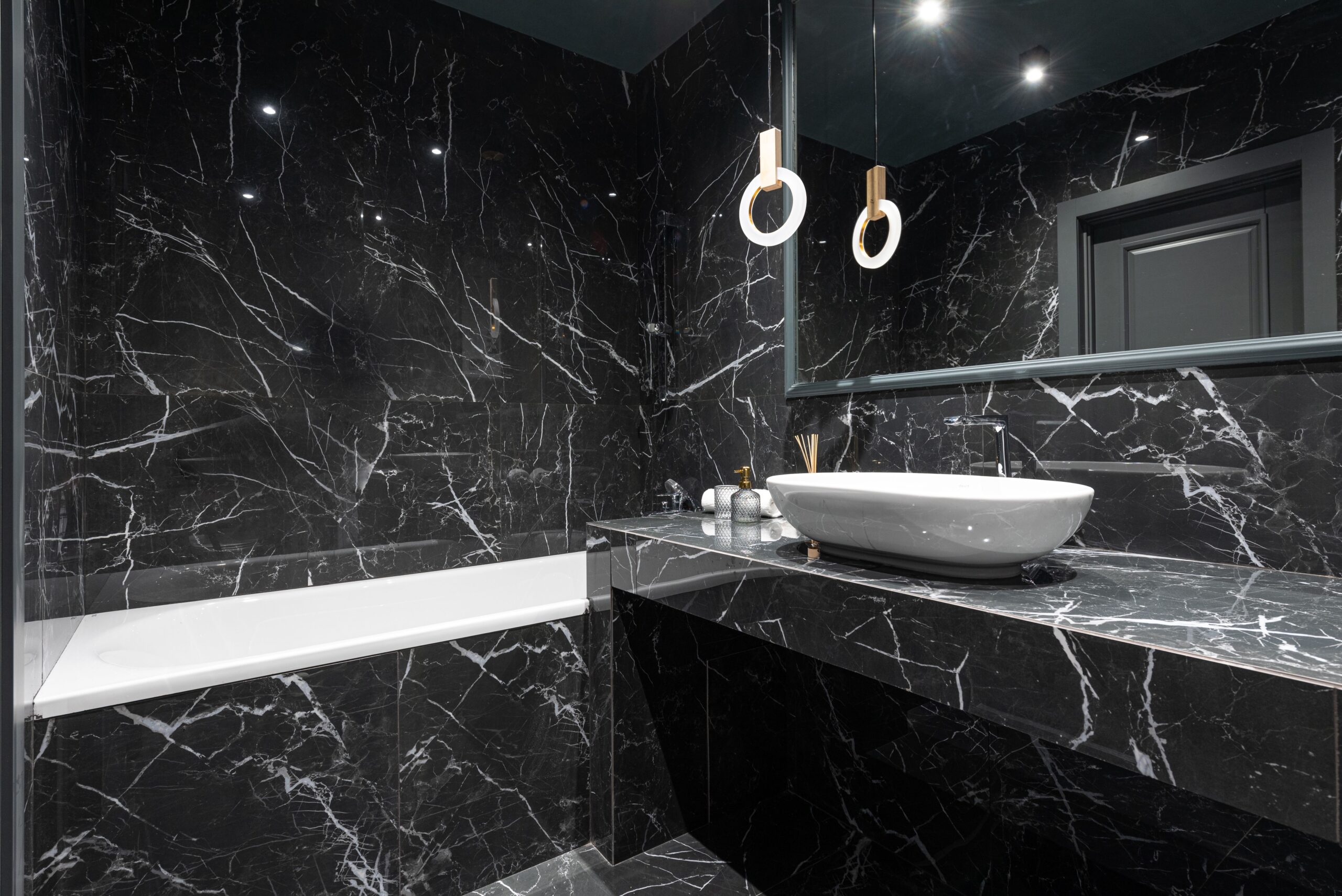
The most widely recognized black marble in luxury interiors, Nero Marquina is quarried in the Basque Country of northern Spain. Its defining characteristic is the dramatic white veining that runs across an intensely dark, near-matte black background. The contrast is extraordinary under natural light and even more striking under warm artificial light. It’s a medium-hard marble — softer than granite but harder than some of the Italian varieties — and polishes to a high gloss. For bathtub use, Nero Marquina is the specification I recommend most often for clients who want visual impact combined with reasonable durability.
Nero Portoro (Italy)
Quarried in La Spezia, Liguria, Nero Portoro is arguably the most prestigious black marble in the world and prices reflect this. Its background is a deeper black than Marquina, closer to pure obsidian, and its veining is gold and white — occasionally finer, occasionally more dramatic. It has been used in some of the world’s most significant interiors, from the Palace of Versailles to contemporary five-star hotels. For bathtub applications, Portoro is specified when the stone itself needs to be the primary design statement. It requires careful maintenance given its slightly higher porosity.
Black Absolute Granite (India/Zimbabwe)
Technically not marble but often grouped with black stone bathroom specifications, Black Absolute is a fine-grained granite with virtually no veining — pure, uniform black. For buyers who want darkness without visual complexity, it’s the more practical choice: significantly harder than marble, lower porosity, less demanding maintenance. The trade-off is that it lacks marble’s organic visual character. Under light, it reads as sophisticated but cool, occasionally impersonal.
Marquinia Polished vs. Honed Finish
For any marble variety, the surface finish dramatically changes both appearance and maintenance requirements. Polished marble has a high-gloss mirror finish that intensifies color depth and veining drama but shows fingerprints, watermarks, and light scratches more readily. Honed marble has a matte or satin surface that is more forgiving visually and slightly less prone to etching, but requires the same sealing discipline. For bathtubs specifically — surfaces that will be touched, entered, exited, and in regular contact with water and product residue — honed finishes are often the more practical recommendation.
Cultured Marble and Engineered Stone
I’ll cover these in the comparisons section, but worth noting here: many products marketed as “black marble bathtubs” are actually cultured marble (a composite of crushed marble powder and resin) or engineered stone (quartz composite). Neither is natural marble. Understanding what you’re actually buying is the most important thing this guide can help you do.
3. Freestanding vs. Built-In: Which Format Works Best?
Black marble bathtubs come in two primary configurations, and the choice between them is architectural as much as aesthetic.
Freestanding Marble Bathtubs
A freestanding black marble tub is a sculptural object in the truest sense. The stone surrounds the entire form — base, sides, and interior — and the tub sits independently on a floor surface without being recessed into a platform or enclosed by walls. Visually, this is the format that produces the most dramatic statement: the mass of the stone is fully visible, the silhouette reads clearly against the floor material, and the bathtub becomes the unambiguous focal point of the room.
From a practical standpoint, freestanding marble bathtubs are typically heavier than built-in versions because the stone forms the entire structure. A full natural marble freestanding tub can weigh anywhere from 250kg to over 500kg depending on stone thickness, dimensions, and carving method. This has significant structural implications for floor reinforcement, which I’ll cover in the installation section.
Freestanding tubs work best in spacious bathrooms where the surrounding floor area can be appreciated — ideally with at least 60–90cm of clearance on all sides. They suit rooms with statement flooring (large-format tile, polished concrete, warm timber) that can hold its own as a complementary surface rather than competing with the tub.
Built-In Platform Bathtub
Built-in Black Marble Bathtub are integrated into a platform or deck structure, with the stone forming the interior basin and typically the deck surround. The weight distribution is different — more of the structural load is taken by the platform rather than a single floor point — and the visual effect is more architectural than sculptural. This format suits bathroom designs where the tub is part of a broader material composition: a marble platform that extends to a vanity surround, or a stone deck that connects the bath space to an adjacent shower.
Built-in formats often allow for larger soaking dimensions because the external structure is partially constructed rather than carved. They also make it easier to integrate features like overflow jets, lighting beneath the deck edge, or a step-up entry.
4. Key Features to Look For Before You Buy
Stone Thickness and Carving Method
The wall thickness of a marble bathtub affects both structural integrity and thermal performance. For freestanding tubs, walls thinner than 20mm carry risk of cracking under use; 25–40mm is the standard specification for quality production pieces. Some premium manufacturers carve tubs from a single block of stone — a process that eliminates the micro-fracture risk present in assembled pieces but dramatically increases cost. Assess whether you’re purchasing a monolithic carved tub or one assembled from multiple stone sections (which requires careful inspection of joint quality and sealing).
Internal Surface Treatment
The interior of a marble bathtub — the surface your body will contact — requires specific finishing. A high-polish interior is visually beautiful but extremely slippery when wet, creating both safety and comfort issues. Quality manufacturers apply either a honed interior finish or a specifically textured anti-slip treatment. Ask explicitly about the interior surface treatment before purchasing, and request samples or showroom visits to assess the tactile quality.
Overflow and Drain Integration
How the overflow and drain are integrated into the stone is a detail that separates well-engineered tubs from poorly specified ones. Drains should be set flush with the interior surface or recessed — proud drain flanges catch toes and accumulate grime. Overflows should be cleanly integrated into the stone wall with a finish that matches the surrounding surface. Inspect these details carefully in any tub you’re seriously considering.
Thermal Performance
Natural marble has lower thermal conductivity than acrylic or steel, which means it takes longer to warm up from cold but retains heat longer once warmed. On a cold winter morning, a marble tub will feel dramatically cold to the touch before filling. Experienced buyers address this by running hot water over the surface before filling, or specifying an underfloor radiant heat panel beneath the tub structure to pre-warm the stone. This is not a deal-breaker but it’s a behavioral adaptation worth understanding before purchase.
Structural Reinforcement (for Freestanding)
Some manufacturers reinforce freestanding Marble Bathtub with internal fiberglass or resin backing applied to the exterior stone surface. This significantly reduces the risk of cracking from temperature stress or point impact. Ask specifically whether your tub includes reinforcement and what method was used — it’s not always disclosed proactively.
5. How Much Does a Black Marble Bathtub Actually Cost?
This is the question most buyers arrive with, and the honest answer is: the range is wider than most people expect. Here’s a realistic breakdown by category:
Entry-Level Natural Marble (Production Pieces)
Mass-produced natural marble bathtub sourced from Chinese or Indian manufacturers, typically in Nero Marquina or Black Absolute, retail between $3,500–$8,000 in the US market (£2,800–£6,500 in the UK). At this price point, you’re getting natural stone but with thinner walls (often 15–20mm), less precise finishing, and more variable quality control. These tubs can be excellent value with careful selection, but inspection before purchase is critical.
Mid-Range Italian or Spanish Origin
Tubs quarried and processed in Italy or Spain, with verified provenance and higher manufacturing standards, typically retail between $8,000–$20,000 (£6,500–£16,000). Nero Marquina in this range will have consistent veining selection, appropriate wall thickness (25–35mm), and proper interior finishing. This is the sweet spot for most serious residential buyers.
Premium Monolithic / Custom Carved
Custom-carved tubs from a single block of premium stone — Nero Portoro, select Nero Marquina, or rare black marbles from European quarries — can range from $20,000 to $80,000+ (£16,000–£65,000+). At this level, you’re commissioning an object as much as purchasing a product. Lead times of 12–24 weeks are typical.
Installation and Additional Costs
It’s a consistent mistake to budget only for the tub itself. Here are the additional costs that buyers regularly underestimate:
| Cost Item | Typical Range (USD) |
|---|---|
| Structural floor assessment | $300–$800 |
| Floor reinforcement (if required) | $1,500–$5,000 |
| Professional installation labor | $800–$2,500 |
| Plumbing modifications | $500–$2,000 |
| Sealing and finishing products | $100–$300 |
| Annual maintenance sealing | $50–$150/year |
Total realistic budget for a mid-range tub with full installation: $12,000–$28,000.
6. Real Benefits And What Marketing Doesn’t Tell You
What the Marketing Says (And What’s Actually True)
“Marble bathtubs last forever.” Partially true. Natural marble is extraordinarily durable against structural wear — a well-maintained marble tub will outlast its owner. What it doesn’t resist well is chemical attack from acidic products, hard water mineral deposits, and physical impact. “Forever” is conditional on correct maintenance.
“They add significant property value.” True, with qualifications. A black marble bathtub in a well-proportioned bathroom that suits the property’s broader character and condition will add value. A black marble bathtub installed in a bathroom with cheap tile, inadequate lighting, and mismatched fixtures is a liability, not an asset. The material alone doesn’t create value — the total design context does.
“They’re the ultimate luxury experience.” Genuinely true, and this is where the marketing undersells rather than oversells. Bathing in a stone vessel that has been carved from a material formed over millions of years, that holds heat differently than any manufactured material, and that has a visual depth that changes under different light conditions — this is a qualitatively different experience from bathing in acrylic. The sensory reality of a good marble bathtub justifies serious consideration.
Genuine Benefits Worth Emphasizing
The thermal mass of marble creates a bath experience that acrylic simply cannot replicate — the water stays warmer longer because the stone itself stores heat. The visual permanence of natural stone means the tub improves with age in ways that engineered materials don’t: the patina deepens, and minor variations become part of the object’s character rather than defects. And there’s the environmental argument — a properly maintained natural stone tub has an effective lifespan of many decades, which compares favorably to acrylic tubs that typically require replacement every 20–30 years.
7. Maintenance: The Honest Reality of Owning Natural Stone
I’m going to be direct here because this is where buyers most often feel misled. Black marble requires genuine maintenance discipline. If you’re not prepared for it, you should consider an alternative material — and I’ll tell you what those alternatives are in the next section.
Sealing. Natural marble is porous. Unsealed or inadequately sealed marble in wet applications will absorb water, soap residue, bath oils, and the pigments present in bath products. This causes staining that can be difficult or impossible to reverse. A penetrating stone sealer should be applied to all exterior and interior surfaces before first use, and reapplied annually or biannually depending on use intensity. This is not optional.
Cleaning Products. Marble is calcium carbonate. Acidic substances — including many common bathroom cleaners, vinegar-based products, and citrus-derived anything — will etch the surface on contact. Etching appears as dull, lighter patches on polished surfaces and is visible against dark marble even at low severity. Use only pH-neutral stone-safe cleaners. This means reading the label on everything you use in the bathroom, every time.
Hard Water. If your local water supply is hard (high in dissolved calcium and magnesium), mineral deposits will accumulate on marble surfaces quickly. These deposits are alkaline and won’t etch the surface, but they are visually noticeable on dark stone. Addressing them requires specific stone-safe descaling products — standard limescale removers are typically too acidic for marble. A water softener installed upstream of the bathroom supply is the most effective long-term solution.
Daily Habits. After each use: wipe down the interior and rim with a soft cloth to remove standing water and product residue. This takes about 90 seconds and prevents 80% of maintenance problems. It’s a habit that marble ownership requires. Buyers who aren’t willing to build this habit should not purchase natural marble.
8. Black Marble vs. Black Marble-Effect Alternatives
The market for black stone-look bathtubs is larger than the market for actual black marble bathtubs. Here’s how the main categories compare:
Natural Black Marble vs. Cultured Marble
Cultured marble — a composite of crushed marble powder, resin, and pigment — is significantly less expensive ($800–$3,000 for comparable dimensions), lighter (important for floor loading), non-porous (no sealing required), and repairable if scratched or chipped with gel coat compounds. Its weakness: it doesn’t look like natural marble under close inspection. The surface lacks the depth, translucency, and organic veining variation of real stone. It reads as convincing from a distance and unconvincing up close. For buyers on a genuine budget who want the aesthetic reference, it’s a reasonable choice. For buyers for whom authenticity matters, it isn’t a substitute.
Natural Black Marble vs. Engineered Quartz Stone
Engineered stone (brands like Silestone, Caesarstone in darker colors) is harder than natural marble, non-porous, and significantly more resistant to staining and etching. For kitchen applications, this makes it strictly superior to marble. For bathtub applications, the case is more nuanced — the visual depth of engineered stone is less compelling than natural marble, and the experience of bathing in it is not meaningfully different from acrylic. If pure practicality drives the decision, engineered stone is easier to maintain. If the sensory and visual experience of natural stone is part of what you’re buying, it isn’t equivalent.
Natural Black Marble vs. Black Acrylic / Resin
High-quality black acrylic or solid resin bathtubs (from manufacturers like Victoria + Albert, Bette, or Kaldewei in dark finishes) are lighter, warmer to the touch on initial contact, available in a wider range of forms, easier to maintain, and dramatically less expensive. They’re also not marble. For buyers who genuinely want the dark aesthetic but aren’t attached to the material itself, these are excellent products. For buyers who want the specific experience of natural stone, they’re a different thing entirely.
| Feature | Natural Marble | Cultured Marble | Engineered Stone | High-End Acrylic |
|---|---|---|---|---|
| Visual depth | Exceptional | Moderate | Good | Good |
| Maintenance demand | High | Low | Very low | Low |
| Weight | Very heavy | Moderate | Heavy | Light |
| Price (tub only) | $3,500–$80,000+ | $800–$3,000 | $2,000–$8,000 | $1,500–$6,000 |
| Heat retention | Excellent | Moderate | Good | Moderate |
| Longevity | Decades+ | 15–25 years | 20–30 years | 15–25 years |
9. How to Choose the Right Size and Shape for Your Bathroom
Standard Dimensions
Most freestanding marble bathtub fall within these ranges:
- Length: 140cm–180cm (55″–71″)
- Width: 70cm–90cm (27″–35″)
- Height: 50cm–65cm (20″–26″)
- Interior depth: 35cm–50cm (14″–20″)
For soaking comfort, interior depth matters more than overall tub height — a deep soak requires at least 40cm of water depth from drain to overflow. Taller bathers (above 185cm/6’1″) should assess internal length carefully; some marble tubs have thick walls that reduce internal length by 10–15cm from the stated external measurement.
Room Proportion
A freestanding marble tub requires generous visual breathing room. In a bathroom smaller than 8–10 square meters, a large freestanding tub will overwhelm the space and make it feel smaller, not more luxurious. In this situation, a built-in platform installation with a smaller basin often delivers more of the desired effect. If your bathroom is larger than 12 square meters, a freestanding tub becomes the natural centerpiece around which everything else should be arranged.
Entry and Exit Clearance
Don’t overlook practical egress. Freestanding marble tubs should have at least 60cm of clear floor on the entry side — the high sides of stone tubs require a deliberate stepping motion that needs space. For elderly users or those with mobility considerations, entry height is a critical specification point.
10. Installation Considerations You Must Address First
Floor Load Capacity
This is the single most important structural consideration and the one most often overlooked until it becomes expensive. A filled freestanding marble bathtub — stone weight plus water plus occupant — can impose a point load of 600–900kg on a relatively small floor area. Most modern concrete slab construction can accommodate this. Timber joist floor construction (common in older UK and North American housing) typically cannot without reinforcement.
Before purchasing any marble bathtub, have a structural engineer or experienced contractor assess your floor’s load capacity for the installation location. This assessment costs $300–$800 and can save you from discovering the problem after the tub has been delivered.
Access and Delivery
Marble bathtubs cannot be carried up stairs in one piece. Most deliveries require ground-floor access or a service lift capable of handling the weight. Measure all doorways, corridors, and any tight turns between the delivery entrance and the installation location. The minimum opening width for most freestanding marble tubs is 85cm — narrower than the tub itself because the stone can be tilted during transit.
Plumbing Requirements
Freestanding tubs require floor-mounted or freestanding tub filler taps, as wall-mounted taps typically cannot reach the center of the bath. Floor-mounted tap installation requires stub-out plumbing beneath the floor surface — a consideration for both new construction and renovation projects. Confirm your plumber’s experience with this configuration before proceeding; it’s more complex than wall-mounted installation and errors are expensive to correct through a finished floor.
11. Top Questions Buyers Ask Before Purchasing
Will a black marble bathtub make my bathroom feel smaller?
Only if the room is already small and the tub is oversized for it. In a well-proportioned bathroom, the visual weight of dark stone creates a sense of grounded luxury rather than compression. The key is ensuring adequate floor space around the tub and balancing the dark material with appropriate lighting, mirrors, and lighter wall or floor finishes.
How do I verify that I’m buying genuine natural marble?
Request a provenance document from the supplier confirming quarry source and stone variety. Genuine natural marble has visible crystalline structure under magnification — you can see the interlocking crystals that distinguish it from composites. Cultured marble will have a uniform, slightly plastic-looking surface under close inspection. If a supplier cannot or will not provide provenance documentation, treat that as a significant red flag.
Can black marble bathtub be repaired if chipped or cracked?
Minor chips can be filled with color-matched epoxy compounds applied by a stone restoration specialist. The repair will be visible under close inspection on polished surfaces but less so on honed finishes. Structural cracks — running through the wall thickness — are more serious and may indicate either a manufacturing defect or a structural problem. Genuine structural cracks typically require professional stone restoration assessment.
Is marble safe for bathtub with children?
Yes, with appropriate precautions. The primary safety consideration is slip resistance on the interior surface — ensure the tub has a honed or textured interior finish, and use a non-slip mat during use. The tub’s edges should be smooth and rounded, which reputable manufacturers will provide as standard.
How long does a Black Marble Bathtub last?
With correct maintenance — regular sealing, pH-neutral cleaning products, and daily wipe-down — a natural marble bathtub will last the lifetime of the building. The oldest marble bathtubs in continuous use are centuries old. Neglected marble in a wet environment will degrade within 5–10 years through staining, etching, and eventual surface deterioration.
What’s the best color palette to pair with a black marble bathtub?
Black marble works with more palettes than buyers expect. The most successful combinations: white or off-white plaster walls with warm timber accents; warm grey limestone flooring; brushed brass or unlacquered brass fixtures (which pick up the gold veining in Nero Portoro); polished concrete with matte white walls for a more contemporary register. Avoid pairing black marble with other bold pattern materials — the stone has enough visual complexity on its own.
12. Final Buying Checklist
Before committing to purchase, confirm the following:
About the Product
- Stone variety, quarry provenance, and country of origin confirmed in writing
- Wall thickness specification (minimum 25mm for freestanding)
- Interior surface finish type (honed recommended for safety and practicality)
- Carving method: monolithic or assembled (and if assembled, joint sealing specification)
- Drain and overflow integration quality reviewed in person or via detailed photos
- Any internal reinforcement (fiberglass/resin backing) disclosed
About Your Space
- Structural floor assessment completed by a qualified professional
- Delivery route measured (all doorways, corridors, lifts)
- Plumbing configuration confirmed with your plumber (floor-mount vs. wall-mount taps)
- Bathroom dimensions verified against tub dimensions with clearance margins checked
Your Budget
- Full installation cost budgeted (not just tub price)
- Annual maintenance cost understood and accepted
- Sealing products sourced and ready for installation day
Your Commitment
- Daily wipe-down habit is realistic for your household
- pH-neutral cleaning products will replace existing bathroom cleaners
- Annual professional sealing is on the maintenance calendar
A Final Word
A black marble bathtub is one of the most considered purchases a homeowner or designer can make for an interior space. When it’s right — when the room is proportioned for it, the installation is correct, and the maintenance is maintained — it is genuinely one of the most beautiful and satisfying objects you can live with. The material carries the weight of centuries of use in the finest interiors in the world, and it earns that weight.
When it’s wrong — rushed into an undersized bathroom, poorly installed, or neglected after purchase — it becomes an expensive problem. The difference between those two outcomes is almost entirely determined by the quality of information buyers have before they commit.
This guide exists to put you firmly in the first category.
Author Bio
James Hartwell is a luxury bathroom design consultant and natural stone materials specialist with seventeen years of experience specifying high-end residential and hospitality interiors across Europe and North America. He trained as an architect before transitioning to materials consultancy, and holds an advanced certification from the Natural Stone Institute. His work has been featured in Architectural Digest, House & Garden, and The World of Interiors. He has specified natural stone installations in projects ranging from private townhouses in London and New York to five-star hotel suites in the Maldives and Tuscany. He writes about materials, interiors, and the intersection of design intelligence and practical decision-making.
This guide was written independently. No manufacturer, retailer, or supplier provided compensation or editorial direction for its content. All cost figures reflect market conditions as of mid-2025 and may vary by region and supplier.