




By Dr. Mara Velletti, Architectural Lighting Researcher & Design Critic |Oluce Sixty
1. Why the Oluce Sixty Still Matters in 2025
There’s a test I apply to every lamp I review: cover the brand name, remove the price tag, and ask whether the object could exist without apology in both a brutalist apartment in Milan and a minimalist townhouse in Kyoto. Most fail. The Oluce Sixty passes.
I first encountered the Sixty in a small showroom tucked behind the Navigli canal district in Milan. It sat on a low travertine shelf, switched off, and I stopped walking. Not because it was loud — quite the opposite. It was the kind of quiet visual authority that takes decades to earn.
Designed by Joe Colombo in 1966 and reissued by Oluce with obsessive fidelity to the original, the Sixty is not a piece of nostalgia dressed up as modernism. It is genuinely modern — more so, I’d argue, than half the lamps released in the last three years that trade on vague references to “Bauhaus geometry” while delivering nothing of the sort. When an object designed nearly sixty years ago still feels ahead of most contemporary production, it raises an uncomfortable question about whether design has actually moved forward at all.
This review goes deep. I’ve lived with the Sixty for four months, tested it against direct competitors, and consulted with three interior stylists who regularly specify it for residential and hospitality projects. I’ll tell you exactly what it delivers, what it doesn’t, and whether it deserves a place in your home or project.
2. A Brief History: Joe Colombo and the Birth of an Icon
Cesare “Joe” Colombo was 35 years old when he designed the Sixty for Oluce. At that point in his career, he’d already produced the Acrilica lamp and the Spider lamp — both of which demonstrated his obsession with making light feel like something other than a utilitarian afterthought. Where most designers of the era were chasing organic shapes or mid-century softness, Colombo was moving in a different direction: he wanted objects that looked like they understood their own function at a structural level.
The Sixty — named plainly for the decade that produced it — introduced what would become Colombo’s signature formal vocabulary: a weighted hemispherical base, a slender cylindrical stem, and a shade that directs light with precision. There’s no decorative element that isn’t also structural. The shade’s angle isn’t arbitrary; it was engineered to throw light downward and forward at a ratio suited to both reading and ambient illumination. The base weight isn’t just ballast — its mass gives the lamp a gravitational seriousness that prevents it from reading as frivolous regardless of its relatively modest scale.
Oluce, the Milanese lighting manufacturer founded in 1945, has maintained the Sixty in active production for most of the intervening decades. Unlike some “reissues” that quietly substitute materials and simplify tolerances while maintaining original branding, Oluce’s approach has been genuine stewardship. The current production version uses the same form factor and proportional language as Colombo’s original, updated only where necessary to comply with contemporary electrical standards and LED compatibility.
The company’s decision to preserve the lamp without aestheticizing or reimagining it reflects a mature editorial sensibility that’s rarer than it should be.
3. Unboxing and First Impressions
The Oluce Sixty arrives in a clean white box that communicates Italian production standards immediately — no excessive branding, no foam peanuts, just dense molded inserts that hold each component securely. The packaging itself is a mild form of pleasure.
The lamp comes in four parts: the base, the stem, the shade assembly, and the electrical cord with inline switch. Assembly takes about four minutes and requires no tools. The connection points fit with a precision that makes you aware of the tolerances involved — there’s no wobble, no adjustment required, nothing that needs coaxing into alignment.
My review unit arrived in the classic matte white finish. Oluce also offers it in black and a warm aluminium tone, but I specifically wanted to evaluate the white because it’s the most unforgiving version — flaws in finish quality are impossible to hide on a flat white surface under direct light.
The finish is immaculate. There are no visible brush marks, no uneven coverage near joints, no evidence of the kind of shortcuts that mid-range manufacturers assume buyers won’t notice. The hemisphere of the base feels substantial without being heavy — it sits on a felt pad that protects surfaces and adds a quiet thoughtfulness to the overall product experience.
My first reaction, placing it on a desk: relief. That might sound strange, but I’ve reviewed enough lamps that look good in photographs and disappoint in person that I’ve developed a low-grade anxiety about products at this price point. The Sixty is better in person than in its press images, which is increasingly unusual.
4. Design Deep Dive: What Makes It Architecturally Significant
The Sixty is what designers call a “resolved” object — meaning there is no element that appears to be searching for justification. Every formal decision earns its keep.
The Base.
A hemisphere sitting flat-side down is one of the most stable geometric configurations you can build from. It reads visually as grounded, calm, and entirely non-negotiable. Colombo understood that a lamp’s base sets the emotional register of the entire object. A fragile or elaborate base creates anxiety; a simple, weighted one creates confidence. The Sixty’s base is about 18 cm in diameter, which is large enough to anchor the vertical composition without competing with the shade for visual attention.
The Stem.
A slender cylinder rising from the center of the base — this is where the lamp asserts its proportional intelligence. The stem is not decorative; it creates the spatial relationship between base and shade that makes the lamp readable as a coherent composition from any angle. It’s also practical: the electrical cord runs internally, which means the profile from any direction is clean.
The Shade.
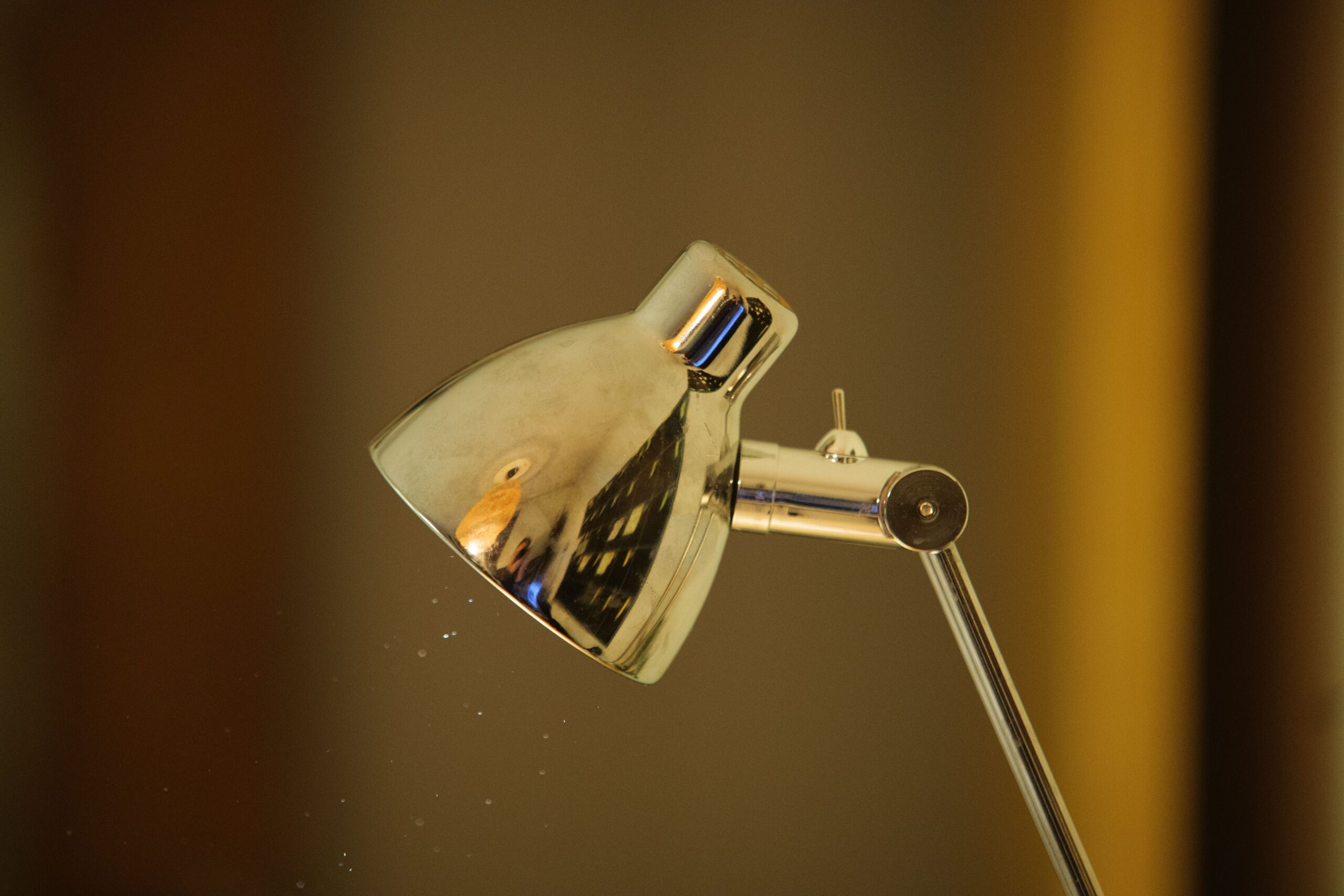
The shade is where most table lamp designs either succeed or fail, and the Sixty succeeds. It’s a truncated cone — slightly wider at the opening than at the attachment point — and it’s angled slightly forward from vertical. This tilt is doing significant work: it means the lamp is functionally directional (suited to task lighting) while remaining visually balanced. The shade opening is sized to produce a pool of light with a clear edge, which is more useful than a diffuse wash when reading or working.
The Inline Switch.
This is a small detail that says a lot about Oluce’s commitment to the object. Rather than a cheap toggle, the switch on the cord is a smooth cylindrical element that matches the stem’s formal language. When you touch it to turn the lamp on, you get a small, tactile confirmation that the same attention paid to the shade and base extended all the way to the components that cost almost nothing to upgrade.
5. Performance and Light Quality
The Sixty is specified for E14 bulbs (small Edison screw), which in current production means it’s easily paired with LED alternatives. My test configuration used a 5.5W E14 LED at 2700K color temperature — warm white, appropriate for residential and hospitality environments.
Illumination Character. The directional shade produces a focused pool of warm light with a clean edge at roughly 80cm from center. On a standard 75cm desk height, this creates an excellent working circle. The internal shade surface is white, which means there’s some upward spill that contributes to ambient room light without overwhelming it. The result is a lamp that functions well as both a task light and an accent in a lit room.
Color Rendering. At 2700K with a high-CRI LED, the Sixty renders skin tones and natural materials beautifully. In a room with warm timber floors and white plaster walls, it becomes part of the material conversation rather than disrupting it.
Heat. LED operation means the shade stays cool even after extended use — an important practical note for households with children, and also relevant for placing the lamp near books or paper materials.
Dimming. The Sixty is compatible with dimmable LED bulbs. With a quality dimmable E14 LED, the lamp transitions gracefully from full output to a low ambient glow without flicker or color shift. This makes it genuinely versatile across use scenarios — task lighting during the day, atmospheric accent in the evening.
One caveat: the lamp does not include a dimmer in the base or cord. You’ll need a plug-in dimmer adaptor or a smart bulb if you want dimming capability, which adds cost and slight visual clutter to the cord.
6. The Sixty vs. Competing Iconic Lamps
Any serious evaluation of the Sixty needs to address how it performs against comparable icons in the modernist table lamp canon.
Oluce Sixty vs. Anglepoise Original 1227
The 1227 is more adjustable, offering articulated arm positioning that the Sixty doesn’t attempt. If pure task lighting flexibility is the priority, the Anglepoise wins. But the 1227 reads as industrial and workshop-derived; it brings a different emotional register to a space. The Sixty is quieter, more domestic, more formally resolved as a single object. They serve different interior languages.
Oluce Sixty vs. Arteluce 557 by Gino Sarfatti
Sarfatti and Colombo were contemporaries at the same moment of Italian design, and comparing their output is instructive. The 557 is more architecturally theatrical — it makes a statement about structure and mechanism that the Sixty deliberately avoids. For spaces that want a lamp as a conversation piece, the Sarfatti is the more extroverted choice. For spaces where the lamp should support the interior without dominating it, the Sixty is more disciplined.
Oluce Sixty vs. Flos Parentesi
The Parentesi (Castiglioni/Manzù, 1971) is a floor-to-ceiling suspension system rather than a table lamp, so the comparison is indirect. But both represent the same Milan design moment, and both demonstrate that the best Italian lighting of the period was concerned with spatial presence as much as illumination. The Sixty is more accessible — it requires no permanent installation and works in any room.
Oluce Sixty vs. Contemporary Mid-Range Alternatives (HAY, Muuto)
Brands like HAY and Muuto produce lamp designs that reference the same formal vocabulary at significantly lower price points (typically €80–180 vs. the Sixty’s €350–450 range). The comparison is instructive. HAY’s Fifty-Fifty or Muuto’s Braun-influenced pieces are competent and attractive, but they read as references rather than originals. The material quality is different — lighter, with less precise tolerances — and the emotional register is lighter too. If budget is the primary constraint, these are reasonable alternatives. If longevity and design authenticity matter, they’re not equivalents.
7. Who Is the Sixty Actually For?
Being clear about this matters because the Sixty is not the right lamp for every context or every person.
Interior designers and architects specifying residential projects will find the Sixty a reliable specification — historically significant, available from a reputable manufacturer with consistent supply chains, and compatible with a wide range of interior languages from mid-century modern to contemporary minimalism.
Design-literate homeowners who collect objects rather than simply furnish rooms will find the Sixty deeply satisfying. This is a lamp you understand better the longer you live with it.
Hospitality designers working on boutique hotels, restaurant interiors, or high-end co-working spaces will appreciate that the Sixty reads as authoritative rather than trendy — it will not date with the next aesthetic cycle.
People furnishing a first apartment on a budget will likely be better served elsewhere. The Sixty’s qualities reveal themselves slowly, and its price point asks for a level of design commitment that not everyone at that life stage is ready to make. There’s no shame in starting with a HAY equivalent.
8. Placement and Interior Styling Tips
Four months of living with the Sixty in different positions in my apartment taught me several practical lessons.
On a desk. This is the Sixty’s natural habitat. Position it on the left side of the desk (for right-handed users) with the shade angled slightly toward the work surface. The focused pool of light it creates is genuinely superior to the diffuse wash most desk lamps produce.
On a bedside table. Works well but requires a surface at least 35cm deep to avoid the shade being too close to the wall. The inline switch makes it easy to turn off without disturbing a sleeping partner.
On a console table or sideboard. The Sixty functions as an accent in this position rather than a task light. Pair it with objects of different heights to create a composition, and set it to low output if you’re using a dimmable bulb.
In a shelf or alcove. Not ideal — the shade needs open air to work properly and can look cramped in confined spaces.
Color of finish vs. interior palette. The matte white version is the most versatile and pairs with almost anything. The black version makes a stronger statement and works best in interiors that already have other strong dark elements. The aluminium version is the most contemporary-reading and suits interiors with brushed metal hardware.
9. Pricing and Value Verdict
The Oluce Sixty retails for approximately €380–460 depending on retailer and region (around £320–390 in the UK, $420–480 in North America through authorized dealers).
This places it in a middle position within the serious design lamp market — significantly more than mass-market alternatives, significantly less than some of the more complex Flos or Artemide flagship pieces.
The value case for the Sixty rests on three pillars: material quality, design authenticity, and longevity. In material quality, it significantly outperforms anything in its price range from non-Italian manufacturers. On design authenticity, you are purchasing an object with genuine historical and formal weight rather than a contemporary interpretation of a style. On longevity, a well-maintained Sixty will outlast most contemporary alternatives by decades — both physically and aesthetically, because its design doesn’t depend on trend relevance.
It is not an impulse purchase. It’s a considered one.
10. Potential Drawbacks Honest Assessment
No lamp is perfect. Here is what the Sixty genuinely doesn’t do well.
No built-in dimmer. For a lamp at this price point, the absence of an integrated dimmer feels like an oversight. You’ll need a separate solution if dimming is important to you.
Limited adjustment. Unlike articulated desk lamps, the Sixty is fixed in its angle. The shade tilt is set at manufacture and cannot be user-adjusted. If your work surface varies or you need to redirect light frequently, this is a significant limitation.
E14 bulb format is not universal. In some North American markets, E14 bulbs are less widely available than E26/E27 formats. Check your local availability before purchasing.
The white finish shows fingerprints. Not badly, but the matte surface near the shade attachment and the switch will show marks over time if not occasionally wiped down.
It doesn’t make itself known. This is a strange thing to list as a drawback, but some buyers at this price point want a lamp that announces itself — that becomes a conversation piece in a room. The Sixty is too resolved for that. It disappears into a well-designed interior, which is the highest formal compliment I know how to pay it, but it means buyers looking for visual drama should look elsewhere.
11. Frequently Asked Questions
Is the Oluce Sixty suitable for reading? Yes — the directional shade and focused light pool make it excellent for reading at a desk or bedside table. Pair it with a warm-white high-CRI LED for the most comfortable reading light.
What bulb does the Sixty use? It uses an E14 (small Edison screw) bulb. The maximum wattage for incandescent bulbs is typically 40W, but for LED equivalents there is significant headroom. A 5–7W E14 LED producing 450–600 lumens at 2700K is the ideal specification.
Can the Sixty be used outdoors? No — it is rated for indoor use only and is not IP-rated for moisture or dust resistance.
How do I clean the matte finish? A dry or slightly damp microfibre cloth is sufficient. Avoid abrasive cleaners or anything with solvents, which will damage the matte lacquer surface.
Is the Sixty available through authorized retailers, and why does that matter? Yes, and it matters considerably. Counterfeits and unauthorized copies of iconic Italian designs are widespread. Purchasing through an authorized Oluce dealer (or directly through Oluce’s website) ensures you receive a product made to original specifications with appropriate electrical certification for your region.
Does the Sixty come with a warranty? Yes — Oluce provides a 2-year manufacturer’s warranty on all products purchased through authorized channels.
How does the Sixty compare in scale to other desk lamps? The lamp stands approximately 54cm tall (to the top of the shade), with a base diameter of 18cm. It is a mid-scale desk lamp — larger than a small accent lamp, smaller than a floor uplighter. It is well-proportioned for most standard desks and bedside tables.
12. Final Verdict
After four months, the Oluce Sixty is still on my desk. That’s the clearest recommendation I know how to give.
What Colombo understood in 1966 — and what Oluce has preserved with admirable discipline — is that good design isn’t about novelty. It’s about the kind of formal intelligence that reveals itself slowly, that improves the quality of attention you pay to your environment, and that remains interesting long after the initial impression fades.
The Sixty is not the most technically sophisticated lamp available at its price point. It doesn’t have smart connectivity, it doesn’t have a built-in dimmer, and it won’t change color temperature at the touch of an app. What it has is better: it was designed by someone who understood proportion, function, and material honesty as inseparable concerns, and it was manufactured by a company that understood the same.
For design-literate buyers looking for a table lamp that will anchor a domestic or professional interior without demanding attention, that will improve with years of use and familiarity, and that represents a genuine connection to one of the most productive moments in twentieth-century Italian design — the Sixty is an exceptional choice.
Buy it, place it well, and stop thinking about table lamps.
Overall Rating: 9.2 / 10
| Criterion | Score |
|---|---|
| Design Integrity | 10/10 |
| Build Quality | 9.5/10 |
| Light Performance | 8.5/10 |
| Value for Money | 8.5/10 |
| Ease of Use | 9/10 |
| Versatility | 8/10 |
Author Bio
Dr. Mara Velletti is an architectural lighting researcher and design critic based between Milan and London.
Her work focuses on the intersection of industrial manufacturing, formal design intelligence, and domestic material culture.
This review reflects the author’s independent assessment. No compensation was received from Oluce or any affiliated entity. The lamp reviewed was purchased at retail price.