




I’ve measured more hallways than I’d like to admit for clients, for my own three houses over the years, and once, memorably, for a friend who bought a gorgeous console table that ended up blocking her front door by four inches. That table sat in her garage for six months before she found it a new home. The lesson stuck with me: a hallway table looks simple, but it’s one of the easiest pieces of furniture to get wrong.
This guide pulls together what I’ve learned from that process the measuring mistakes, the material trade-offs nobody mentions in showrooms, and the styling tricks that make a $150 table look like it cost three times that.
Table of Contents
- Why Your Hallway Table Choice Matters More Than You Think
- Measuring Your Space (The Step Everyone Skips)
- Console Table vs. Sofa Table vs. Demilune: Sorting the Terminology
- Material Showdown: Wood, Metal, Glass, and Rattan
- Style Matching: Finding a Table With the Right Personality
- Storage: Drawers, Shelves, and Open Frames
- Narrow Hallway Solutions
- Budget Breakdown: What You Actually Get
- My Honest Verdicts on Popular Table Types
- Placement and Styling Tips
- Common Mistakes I See Again and Again
- Future Trends in Entryway Furniture
- FAQs
- Final Thoughts
- About the Author
1. Why Your Hallway Table Choice Matters More Than You Think
A hallway table is the first thing guests touch when they walk in — keys land on it, mail piles up there, a candle or a vase sits on top. It’s a small piece of furniture doing a disproportionate amount of work. It sets the tone for the entire home before anyone even reaches the living room.
What makes it tricky is that hallways are unforgiving spaces. There’s usually one workable wall, a fixed width, and often a door swing or stairway eating into your options. Unlike a living room where you can shuffle furniture around for weeks until it feels right, a hallway table either fits or it doesn’t. There’s very little margin for “close enough.”
2. Measuring Your Space (The Step Everyone Skips)
Here’s the part almost nobody does properly: measuring the clearance, not just the wall length.
Building codes and basic ergonomics suggest leaving at least 30 to 36 inches of walking space in a hallway after the table is in place. If your hallway is 42 inches wide, that means your table — including any pulls, knobs, or decorative edges that stick out — shouldn’t be deeper than about 10 to 12 inches.
I always tell people to do this before they shop:
- Measure the wall length where the table will sit, then subtract 6 inches on each side for breathing room (tables pushed flush into corners look cramped).
- Measure the hallway’s total width, then subtract your table’s depth to confirm you still have safe walking clearance.
- Check door swings. Open every nearby door fully and mark where it lands. I’ve seen beautiful tables returned because a closet door clipped the corner every single time it opened.
- Tape it out on the floor with painter’s tape for 24 hours. It sounds excessive, but living with the outline for a day reveals problems a tape measure alone won’t catch.
3. Console Table vs. Sofa Table vs. Demilune: Sorting the Terminology
Furniture retailers throw around terms as if everyone already knows the difference, and honestly, most people don’t.
Console table is the catch-all term for a narrow table designed to sit against a wall — typically 12 to 18 inches deep and anywhere from 30 to 60 inches long. This is what most people mean when they say “hallway table.”
Sofa table is technically a console table sized to match the back of a sofa, usually a bit taller than standard so it sits flush with sofa-back height. It works in hallways too, but it’s designed with a sofa pairing in mind, so proportions can feel slightly off if your hallway doesn’t have a sofa nearby.
Demilune (or half-moon) table has a curved front edge instead of straight corners. These exist almost entirely to solve the clearance problem — the curve hugs the wall without losing usable surface space in the middle, and it removes the sharp corner that’s easy to bump into in a narrow space.
Hall tree is a different animal entirely — it combines a small table or bench with hooks and sometimes a mirror, built for the actual entry zone rather than a corridor. If your “hallway” is really more of a small mudroom-style entry, a hall tree often serves you better than a standalone console.
Knowing these distinctions matters because search filters on furniture sites are inconsistent. I’ve found genuinely better console tables filed under “sofa tables” simply because of their height, so it pays to search all three terms when you’re browsing.
4. Material Showdown: Wood, Metal, Glass, and Rattan
This is where most buying guides get vague. I’d rather give you the real trade-offs.
Solid wood (oak, walnut, mango, acacia) is the gold standard for longevity. It takes scratches and dings as character rather than damage, and it can be refinished decades later. The catch: it’s heavy, often the most expensive option, and it reacts to humidity — I’ve seen solid wood drawers swell and stick in homes with no climate control during humid summers.
Engineered wood / MDF with veneer
Gets unfairly dismissed. Good MDF construction with a quality veneer is dimensionally stable (it won’t warp the way solid wood can) and significantly cheaper. The honest downside is that veneer can chip at the edges over years of bumps, and it generally can’t be refinished or repaired the way solid wood can.
Metal
(iron, steel frames, often paired with a wood or stone top) brings a slim, almost architectural profile that’s perfect for narrow hallways where bulk is the enemy. It’s also remarkably durable against scratches and humidity. The trade-off is sound — metal-framed tables can creak or ring slightly when bumped, and cheaper powder-coated finishes can chip to reveal bare metal underneath.
Glass tops
Make a hallway feel more open, which matters enormously in tight or dark corridors. But practically speaking, glass shows fingerprints and dust constantly, and it’s the one material I’d avoid entirely in a household with toddlers or large dogs with enthusiastic tails.
Rattan and woven materials have had a real resurgence over the last few years, and for good reason — they’re lightweight, visually textured without being busy, and they soften a hallway that otherwise feels like a straight, hard corridor. The downside is durability in humid climates; rattan can become brittle if a hallway gets direct sun or sits near an exterior door with weather exposure.
My honest take: if budget allows, a solid wood table with simple joinery will outlast almost everything else here. If budget is tight, well-made engineered wood with a real wood veneer (not printed laminate) gives you 80% of the look for half the price.
5. Style Matching: Finding a Table With the Right Personality
A hallway table doesn’t need to match every other piece of furniture in your home, but it should feel like it belongs to the same conversation.
- Modern/minimalist homes do well with clean-lined metal or wood consoles, often with hairpin or angular legs and zero ornamentation.
- Traditional homes suit turned-leg wood tables, sometimes with a single drawer and brass hardware.
- Transitional spaces (the most common style in real homes, in my experience) benefit from a simple wood top paired with slightly more architectural metal legs — it bridges old and new without committing fully to either.
- Coastal or boho interiors lean into rattan, light woods, and curved silhouettes.
A trick I use constantly: pick the hallway table’s finish to echo one other element already in the space — the stair banister, a door frame, or even a picture frame nearby. That single shared tone does more to make a room feel “designed” than almost anything else.
6. Storage: Drawers, Shelves, and Open Frames
Storage is the most underrated decision factor. Ask yourself honestly what’s actually going to live in or on this table.
Drawers are ideal for keys, mail, sunglasses, and the general clutter that otherwise piles up on the surface. The catch: cheaper drawers (especially under $150) often use plastic glides that wear out within a year or two of daily use. Pull a drawer open in the showroom and feel for resistance or wobble before buying.
Open shelving below the tabletop works well for baskets, shoes, or decorative boxes, and it visually lightens a table in a way closed storage can’t. It does mean everything underneath is visible, so it only works if you’re disciplined about what goes there.
No storage, just a slim tabletop is often the right call in very narrow hallways, where every extra inch of depth from a drawer box matters. Sometimes the most functional table is the one that does the least.
7. Narrow Hallway Solutions
If your hallway is under 36 inches wide, your real depth ceiling is around 8 to 10 inches. Most “console tables” on the market are deeper than that, which is genuinely frustrating when you’re shopping.
What’s worked for me and for clients in tight corridors:
- Wall-mounted floating shelves styled as a table. No legs to navigate around, and you reclaim the full floor width.
- Demilune tables, as mentioned earlier — the curved front reduces the chance of catching a hip or elbow.
- Slim metal-and-glass consoles, which read as visually “thin” even at the same physical depth as a bulkier wood piece, because there’s less visual mass.
- Ladder-style or X-frame leg designs, which create the illusion of more open floor space even when the tabletop itself is a standard size.
8. Budget Breakdown: What You Actually Get
Under $150: Mostly MDF or particleboard construction with printed laminate finishes. Fine for a first apartment or low-traffic hallway, but expect wobble over time and limited weight capacity on shelves.
$150–$400: This is the sweet spot for most households. You’ll find solid engineered wood with real veneer, decent metal-leg construction, and drawers with metal glides rather than plastic. This range is where I tell most people to shop.
$400–$800: Solid wood becomes realistic here, along with better joinery, soft-close drawers, and more refined finishes. Worth it if the table is a focal point or you want something that lasts 15+ years.
$800+: Designer pieces, often with hand-finished detailing, mixed materials (stone tops, brass inlays), or limited production runs. You’re paying for craftsmanship and exclusivity as much as function at this point.
9. My Honest Verdicts on Popular Table Types
Mango wood console tables — Genuinely good value. Mango wood has become popular precisely because it offers solid-wood durability at a fraction of oak or walnut pricing. The grain variation means no two tables look identical, which I personally like, though it bothers buyers who want uniformity.
Marble-top metal consoles — Beautiful, photogenic, and increasingly common in mid-range retail. My honest verdict: real marble tops are heavy and can crack if dropped during a move; “marble-look” engineered stone or quartz composite tops give you 90% of the visual impact with far less fragility.
IKEA-style flat-pack consoles — Perfectly functional for the price, but the predrilled holes for shelf pins and drawer glides wear out faster than furniture built with traditional joinery. Fine for a 3–5 year horizon, not a forever piece.
Vintage or secondhand tables — Often the best value in the entire market. A well-built table from the 1960s–80s frequently has better joinery than a new $400 piece, and refinishing costs $80–150 at a local shop. I’ve furnished two hallways this way and wouldn’t hesitate to do it again.
10. Placement and Styling Tips
Once the table is in place, resist the urge to overdecorate it. A hallway table gets walked past, not sat at — it should read clearly at a glance, not require studying.
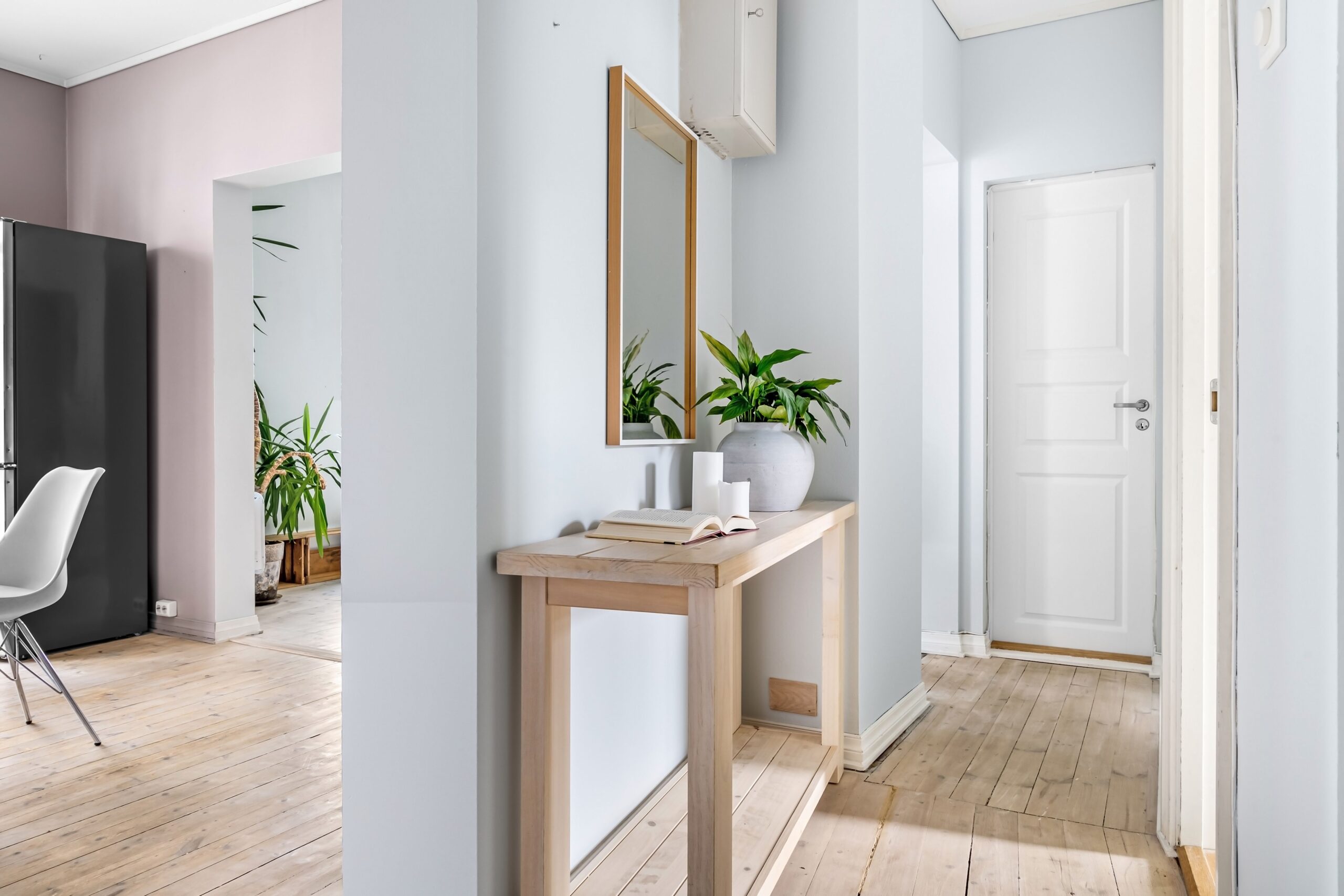
A simple rule that works in almost every hallway: one anchor object (a lamp, a tall vase, or a mirror above), one mid-height item (a small bowl or stack of books), and one low, organic touch (a small plant or candle). Three items, varying heights, done.
If your hallway is dim, a table lamp does more for the space’s ambiance than overhead lighting ever will — it creates a warm pool of light right at eye level when you walk in, which makes the whole entry feel intentional rather than just a pass-through.
11. Common Mistakes I See Again and Again
- Buying based on the table alone without taping out the floor space first.
- Choosing a deep table because it “looked normal” in a large showroom, forgetting showrooms are far more spacious than home hallways.
- Ignoring drawer or door swing clearance, which causes daily friction nobody notices until they’re tripping over it.
- Picking glass or glossy finishes in low-light hallways, where reflections and smudges show up more, not less.
- Over-styling the top with too many small objects, which makes a narrow space feel cluttered rather than welcoming.
12. Future Trends in Entryway Furniture
A few shifts I’ve noticed gaining momentum and expect to continue:
Multi-functional consoles with built-in charging ports or hidden cable management are becoming more common, since the hallway table has quietly become a charging station for keys, phones, and wallets.
Curved and organic silhouettes continue to grow, partly as a reaction against the sharp minimalism of the last decade, and partly because curves genuinely solve real clearance problems in tight homes.
Mixed-material designs — wood paired with stone, metal paired with rattan — are replacing single-material pieces, giving more visual interest without needing larger furniture to do it.
Lighter, more transparent designs are also gaining ground as average home sizes shrink in many markets; furniture that visually “disappears” a little is increasingly valued over heavy, statement pieces.
13. FAQs
How tall should a hallway table be? Standard height runs 30 to 36 inches, similar to a kitchen counter. This keeps it comfortable for setting things down without bending and pairs naturally with a mirror hung above.
Can a hallway table be too narrow to be useful? Tables under 8 inches deep can still hold keys, mail, and a small lamp comfortably. They start feeling impractical below about 6 inches, where even a single decorative object risks tipping.
Do I need a mirror above my hallway table? It’s not required, but it’s one of the highest-impact additions for a narrow or dim hallway, since it bounces light back into the space and visually doubles the perceived width.
What’s the most durable material for a high-traffic entry? Solid wood with a sealed finish or a metal-framed table with a stone or quartz composite top both hold up exceptionally well against daily bumps, bags, and weather coming in from outside.
Should the table match my dining or living room furniture? It doesn’t need to match exactly, but sharing one element — wood tone, leg style, or hardware finish — keeps the home feeling cohesive rather than like each room was furnished separately.
14. Final Thoughts
A hallway table is a small purchase that gets judged by a strange double standard it has to be functional enough for daily use and good-looking enough that it’s the first impression of your entire home. The good news is that getting it right doesn’t require luxury pricing. It requires accurate measuring, an honest read on the materials you’re choosing between, and restraint when it comes to styling the top.
If I had to boil this whole guide into one piece of advice, it’s this: measure twice, tape it out on the floor, and buy the table that fits your actual hallway — not the one that looked perfect in a wide-open showroom. Everything else, the finish, the style, the price point, is genuinely a matter of personal taste once the fit itself is right.
About the Author
This guide was researched and written by a home furnishings writer and interior consultant with over a decade of hands-on experience sourcing, measuring, and styling furniture for residential clients across multiple home renovations. The author has personally tested furniture across price points — from flat-pack basics to solid hardwood pieces — and draws on real installation experience, not just retail descriptions, to evaluate durability, construction quality, and everyday practicality. Research for this piece included direct measurement comparisons, material durability testing over multi-year use, and consultation with furniture makers on construction standards.