




By Serena M. Caldwell | Furniture Design Researcher & Interior Space Consultant | Pedestal Table
Why Pedestal Tables Deserve More Credit Than They Get
When I was redesigning my dining room two years ago, I spent weeks fixated on four-legged tables. I’d measured the space, shortlisted a dozen options, and nearly pulled the trigger on a solid oak farmhouse table with tapered legs. Then a friend who designs residential interiors looked at my floor plan, looked at me, and said simply: “You need a pedestal.”
I pushed back. Pedestal tables felt old-fashioned to me — the kind of thing you’d find in a Victorian tearoom or a grandmother’s breakfast nook, not a modern dining room. She smiled and pulled out her phone. What she showed me over the next ten minutes quietly changed the direction of my renovation.
Pedestal tables — those with a single central column or base rather than four corner legs — have been a staple of furniture design for centuries for reasons that go well beyond aesthetics. They solve real problems: awkward corner seating, wasted floor space, the impossible geometry of fitting six chairs around a table in a room that’s barely wide enough for four. And in the past decade, design has caught up with the practicality. Contemporary pedestal tables are being produced in materials, proportions, and finishes that look nothing like the dusty mahogany antiques most people picture.
This guide is a serious look at pedestal tables — what they are, where they shine, where they fall short, and how to pick one that actually fits your space, your style, and your daily life.
The Anatomy of a Pedestal Table: What Makes It Different
Understanding a pedestal table’s structure helps you evaluate quality and predict how it will perform in real use.
A pedestal table has three main components: the tabletop, the column (or pedestal shaft), and the base.
The Tabletop can be any shape — round, oval, square, or rectangular. Round and oval tops are most commonly paired with pedestal bases, because the absence of corner legs makes the round format both visually and functionally coherent. Square and rectangular tops on pedestal bases are less common but increasingly popular in contemporary design.
The Column is the defining structural element. It can be a single turned post (classic and traditional), a fluted or carved architectural column (formal), a simple straight cylinder (modern), a sculptural tapered form, or a split-pedestal design with two or three columns supporting a single top (common on larger rectangular tables). The column’s diameter and material determine the structural integrity of the whole piece — a thin metal column on a heavy marble top is a red flag; a thick, well-anchored cast iron column on the same top is engineering done right.
The Base — the foot of the pedestal — spreads the load from the column to the floor. It can take many forms: a simple flat disc, a four-pronged cross base (the most common modern design), a claw-foot or tripod design (traditional), or an architectural plinth. The base’s footprint determines how close chairs can be pushed in and how stable the table feels when weight is applied off-center.
The connection point between column and base, and between column and top, is where quality variation is most dramatic. Cheap pedestal tables use thin metal brackets and minimal fastening. Quality pieces use mortise-and-tenon joinery, heavy steel flanges, or cast-iron mounting plates that distribute load properly and prevent wobbling over years of use.
A Brief History: From Victorian Parlors to Modern Dining Rooms {#brief-history}
The pedestal table has a longer and more culturally interesting history than most people realize.
The basic concept — a tabletop supported by a central column rather than four legs — dates to ancient Rome and Greece, where stone and marble pedestal tables called cartibula were used in entrance halls as display surfaces. Their primary appeal then, as now, was visual: a single column beneath a tabletop creates an illusion of floating, making a room feel more open.
The design entered European mainstream furniture during the Renaissance, when Italian craftsmen began producing elaborately turned pedestal bases for writing tables and display pieces. By the 18th century, British cabinetmakers had refined the tripod pedestal table into one of the most recognizable furniture forms in history — the tilt-top tea table, with a circular top that folded vertically for storage. Thomas Chippendale and Thomas Sheraton both produced iconic variations.
The Victorian era brought the pedestal table into the dining room in earnest. Heavy mahogany and walnut center-column dining tables became status symbols in middle and upper-class homes, often with elaborate carved columns and massive claw-foot bases. The aesthetic was dramatic but the function was practical — a central pedestal allowed more flexible seating around a round table than a four-legged design.
The 20th century saw modernist designers strip the pedestal back to its essential geometry. Eero Saarinen’s 1956 Tulip table — a single molded fiberglass column supporting a round top — is arguably the most influential pedestal table design of the modern era, and its silhouette remains in continuous production today. It proved that a pedestal table could be radically simple without losing structural integrity.
Contemporary pedestal tables borrow from all of these traditions while incorporating new materials — cast concrete, blackened steel, terrazzo, live-edge wood — that give the format a distinctly modern vocabulary.
Pedestal Table Styles Explained
The pedestal table spans an unusually wide range of visual vocabularies. Understanding the main style categories helps you find pieces that work with your existing space.
Traditional / Classic Pedestal Tables
Feature turned or carved wooden columns, ornate bases (claw feet, scroll feet, or reeded plinths), and rich wood tones — mahogany, cherry, walnut. They suit formal dining rooms, traditional interiors, and period-style homes. The column is often the visual focal point, with decorative detailing that reflects the craftsmanship tradition of the piece.
Farmhouse / Cottage Style
Brings the pedestal column into a more relaxed aesthetic — thicker, simpler columns, often in painted finishes (white, cream, gray), with round or oval tops in pine or poplar. These tables work beautifully in kitchen dining areas, breakfast nooks, and casual family spaces. They tend to be more affordably priced than formal traditional pieces.
Mid-Century Modern
Pedestal tables take cues from Saarinen and his contemporaries — clean lines, minimal ornamentation, a single tapered or tulip-shaped column, and round tops in white laminate, walnut veneer, or marble. This style has never really gone out of fashion and integrates well into contemporary, transitional, and eclectic interiors.
Industrial Pedestal Tables pair heavy cast-iron or blackened steel columns and bases with raw wood or reclaimed timber tops. The contrast between the refined geometry of a metal column and the rough texture of a live-edge top has become one of the signature aesthetics of the past decade in casual dining furniture.
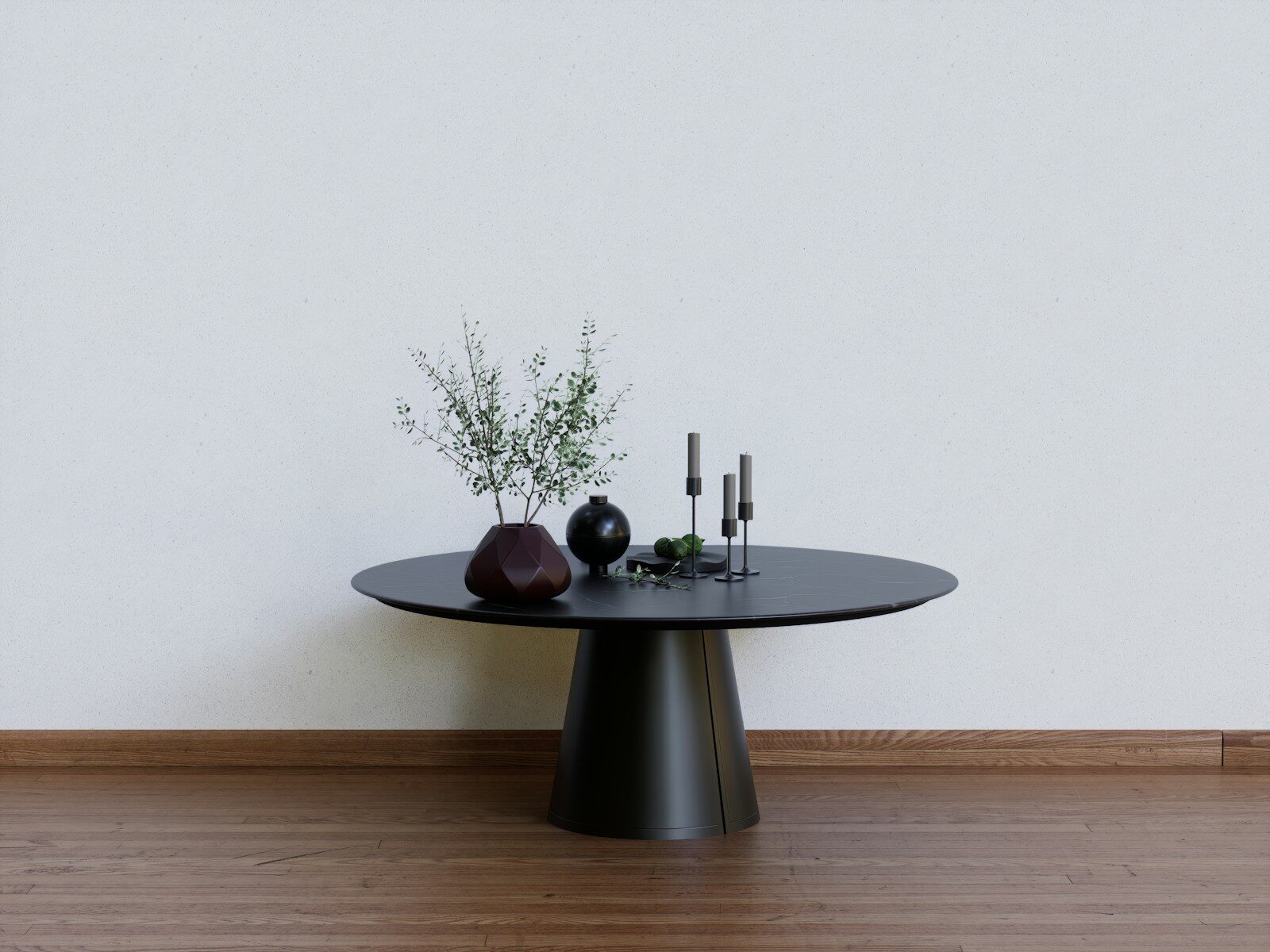
Contemporary / Minimalist pedestal tables push the column toward abstraction — geometric prisms, architectural cylinders, sculptural forms in concrete, terrazzo, or brushed metal. These are statement pieces that work best when the rest of the room gives them space to breathe.
Marble Pedestal Tables occupy their own category because the material so strongly defines the look. Whether the column is metal, stone, or wood, a marble top immediately elevates the visual register of a space. They read as both classic and contemporary depending on the base design and room context.
The Real Benefits of Choosing a Pedestal Base
The reasons to choose a pedestal table over a four-legged design are more practical than most people expect.
Seating Flexibility
Is the most significant functional advantage. Without corner legs, there are no fixed seating positions. A 48-inch round pedestal table that’s officially rated for four can comfortably seat five or six in a pinch — chairs slide in from any angle, including the corners that a four-legged design makes inaccessible. For families who regularly host guests, this flexibility is genuinely valuable.
Legroom
Is dramatically better. Four-legged tables place legs at the corners where people naturally sit, forcing everyone to straddle the table structure. A pedestal base keeps the structural element at the center, leaving the perimeter entirely clear for legs. Anyone who’s ever fought a table leg at a dinner party understands how meaningful this difference is in practice.
Visual Space
A pedestal base takes up less visual real estate than four legs. In a small room, this matters. The eye reads the floor space as more continuous, making the room feel less cluttered even when a large table is present.
Easier Cleaning — there are no corner legs to vacuum around, mop around, or accidentally kick. One central column means cleaning the floor beneath a pedestal table takes roughly half the time and effort of a four-legged equivalent.
Expandability — many pedestal dining tables are designed with extension leaves that work more elegantly than four-legged designs. Because there are no corner legs defining the perimeter of the top, leaves can be added symmetrically without creating awkward leg-to-seating conflicts.
Aesthetic Versatility — a round or oval top on a pedestal base creates an inherently more intimate seating arrangement than a rectangular table. Everyone faces the center; sightlines are naturally shared. This is why round pedestal tables have historically been associated with conversation and egalitarian seating — there’s no “head of the table.”
Materials Compared: Wood, Metal, Marble, and More
The material combination of top and base significantly affects both aesthetics and performance.
Solid Wood Tops
On wooden pedestal bases are the most traditional combination and remain the most durable for daily family use. Hardwoods — oak, walnut, maple, cherry — resist denting and scratching better than softer alternatives. Solid wood moves with humidity changes; quality manufacturers account for this in their joinery. Expect to pay more for solid wood tops than veneer equivalents, but expect meaningfully better longevity.
Veneer Tops
Over engineered wood cores offer good aesthetics at lower price points but are more vulnerable to moisture and edge damage. The top surface of a veneer table can be refinished once, sometimes twice — after that, the veneer is too thin to work with.
Marble Tops
Are beautiful and heat-resistant but require more maintenance than most buyers anticipate. Marble is porous and will stain without regular sealing. It etches (surface dulling from acid contact) from citrus, wine, and vinegar. White marbles like Carrara show etching more visibly than darker stones. For a dining table used daily for family meals, marble requires conscious maintenance discipline. For a less-used occasional table or breakfast nook, it’s more manageable.
Sintered Stone and Porcelain Tops are increasingly popular alternatives to marble that offer similar aesthetics without the maintenance demands. These engineered materials are non-porous, scratch-resistant, heat-resistant, and genuinely low-maintenance. Several manufacturers now produce sintered stone tops on pedestal bases that are essentially indistinguishable from marble at a glance but far more forgiving in use.
Concrete Tops have a distinctive industrial-organic aesthetic. They’re heavy, which actually improves stability on a pedestal base. Raw concrete requires sealing but is otherwise extremely durable. The aesthetic doesn’t suit every interior, but in the right space, a concrete-top pedestal table is a serious design statement.
Metal Bases in cast iron, blackened steel, or brushed brass offer different structural and aesthetic qualities. Cast iron is the heaviest and most stable — a cast iron pedestal base genuinely doesn’t move. Blackened steel is lighter and more design-forward. Brass and gold-tone bases add warmth and work particularly well under marble or light wood tops.
Top Pedestal Table Picks by Category: Honest Verdicts
Best Overall: West Elm Marble Topped Pedestal Dining Table
Style: Contemporary Best For: Dining rooms, design-forward spaces
West Elm’s marble pedestal tables consistently represent good value in the mid-premium category. The marble tops are genuine stone (not sintered stone at this price range), the metal bases are well-proportioned, and the overall build quality is better than the price suggests. The bases are stable without being excessively heavy — moving the table for cleaning or rearranging isn’t the two-person operation it is with cast-iron alternatives.
Honest Verdict: A strong mid-range choice. Seal the marble top before first use and keep a stone cleaner on hand for daily maintenance. Not a forever piece, but a genuinely good 10-15 year purchase.
Best Budget: IKEA DOCKSTA
Style: Mid-Century Modern (Tulip-inspired) Best For: Small apartments, first homes, minimalist spaces
The DOCKSTA is IKEA’s take on the Saarinen Tulip design — a molded fiberglass-like column in white supporting a round white tabletop. For under $300, it’s a remarkably faithful translation of the classic silhouette. The tabletop surface is durable and easy to clean. The base is stable for its weight class.
Where it falls short: the column-to-base connection can develop a very slight wobble over years of use, and the white surface shows scuffs on the column with daily use. It’s also rated for four people comfortably, and five is genuinely tight.
Honest Verdict: Exceptional value at its price point. The right choice if you want the Tulip aesthetic without Knoll pricing.
Best Splurge: Knoll Saarinen Dining Table
Style: Mid-Century Modern (Original) Best For: Long-term investment, serious design collectors
The original Saarinen Tulip, still manufactured by Knoll to Saarinen’s specifications. The column is cast aluminum, not fiberglass or plastic. The engineering is precise in a way that becomes apparent the first time you compare it to an imitation side by side. It won’t wobble. This won’t yellow. It’s was designed to last a lifetime, and it does.
The price is significant — several times the cost of any alternative in this roundup. But it’s one of the few pieces of modern furniture that genuinely qualifies as an investment. Original Knoll Saarinen tables in good condition hold value well and are periodically sold through design resellers for close to their original purchase price.
Honest Verdict: Buy it once, keep it forever. If the budget exists and the style fits, there’s no better pedestal dining table in its category.
Best for Families: Pottery Barn Banks Extending Pedestal Table
Style: Traditional / Transitional Best For: Family dining rooms, everyday heavy use
Pottery Barn’s Banks table is a solid hardwood pedestal table with a well-engineered extension leaf system. The wood quality is genuine — not veneer — and the finish holds up to the kind of daily contact that family dining involves. The extension system is smooth and the leaf stores securely inside the table rather than separately.
It’s not a design statement, but it’s not trying to be. It’s a well-made, honest dining table that will serve a family well for 15-20 years.
Honest Verdict: The right choice if durability and practicality matter more than visual drama. Solid investment for a primary family dining table.
Best for Small Spaces: Article Seno Dining Table
Style: Mid-Century Modern / Scandinavian Best For: Apartments, breakfast nooks, compact dining areas
Article’s Seno hits a sweet spot between price, proportion, and design quality. The table is sized for real small spaces — available in configurations that seat two to four without overwhelming a compact room. The walnut-finish top and natural brass-accented base are visually warm and work well with a range of chair styles.
Honest Verdict: One of the best-proportioned small pedestal tables in the mid-range market. The brass details elevate it above its price point.
How to Choose the Right Size
Size decisions for pedestal tables are more forgiving than four-legged tables because of the flexible seating the base design allows, but basic spatial math still applies.
For the room: Allow at least 36 inches between the edge of the table and any wall or furniture to allow comfortable chair movement. 42-48 inches is more comfortable for regular use. A table that fits perfectly with chairs tucked in will feel tight once people are seated and moving.
For seating capacity:
- 36-inch round: seats 2-3
- 42-inch round: seats 4 comfortably, 5 in a squeeze
- 48-inch round: seats 4-5 comfortably, 6 possible
- 54-inch round: seats 6 comfortably
- 60-inch round: seats 6-8
Oval and rectangular pedestal tables follow similar logic to their four-legged equivalents — allow 24 inches of table edge per person as a minimum, 28-30 inches for comfortable elbow room.
For ceiling height: Tall, dramatic pedestal columns can look cramped under standard 8-foot ceilings. Low-profile pedestal bases with wide, flat columns work better in rooms without generous vertical space.
Pedestal Tables for Small Spaces: What Actually Works
Small space dining is where pedestal tables genuinely outperform every alternative.
A round pedestal table in a square or slightly irregular room resolves layout problems that rectangular tables can’t. You don’t need to account for chair clearance at corners, and the table can be positioned closer to walls without creating uncomfortable seating positions.
For very small spaces — breakfast nooks, studio apartment dining areas, galley kitchen eat-in zones — a 36-inch round pedestal table with two or three chairs is often the most space-efficient dining solution available. The visual lightness of the central column (especially in white or metal) keeps the room from feeling dominated by furniture.
Drop-leaf pedestal tables are particularly clever for genuinely tight spaces. With leaves down, they function as side tables or two-person surfaces. With leaves up, they expand to seat four. Several manufacturers produce well-engineered versions of this format that don’t sacrifice stability when expanded.
Pairing Chairs with a Pedestal Table
The absence of corner legs gives you more chair flexibility than any other table format, but a few principles improve the result.
Chair height should be calibrated so there’s 10-12 inches between the seat and the underside of the tabletop. Standard dining tables (28-30 inches tall) pair with standard dining chairs (17-19 inch seat height). Counter-height pedestal tables (34-36 inches) require counter stools.
Chair width becomes more important with round tables. Wide upholstered dining chairs look proportionally wrong around a 36 or 42-inch round table — they crowd the perimeter and make the table feel smaller than it is. Slimmer chairs (under 20 inches wide) or armless designs work better at smaller round tables.
Visual balance with the base: a delicate tulip column pairs well with visually light chairs — thin metal legs, woven seats, acrylic designs. A heavy cast-iron industrial base can hold its own against substantial upholstered chairs. Mismatching visual weights creates an imbalanced composition that’s subtle but noticeable.
Mixing chair styles works particularly well with pedestal tables because the table itself is often a strong visual anchor. A round marble-top pedestal table with a mix of upholstered armchairs and simple wooden side chairs can look intentional and interesting rather than mismatched.
Pedestal Table Care and Maintenance
Care requirements vary significantly by top material.
Wood Tops: Wipe spills immediately. Use coasters and trivets consistently — wood doesn’t forgive hot pans or prolonged moisture. Refinishing is possible every 10-15 years if needed. Apply furniture oil or wax annually for solid wood surfaces; avoid excessive moisture on veneer edges.
Marble Tops: Seal on arrival and reseal annually. Use pH-neutral stone cleaner for daily cleaning — avoid vinegar, citrus, and any acidic cleaner. Use trivets for hot dishes. Address spills immediately, especially wine and oil.
Metal Bases: Dust regularly. For cast iron and blackened steel, a light application of paste wax annually prevents surface oxidation. Brass bases may develop a natural patina over time — whether to maintain the original finish or allow the patina depends on personal preference and can be managed either way.
Base Connection Points: Periodically check that the column-to-base and column-to-top connections remain tight. Vibration from daily use can gradually loosen bolts in some designs. A five-minute check and tighten once a year prevents the wobble that develops in neglected pedestal tables.
Common Buying Mistakes and How to Avoid Them
Buying based on photos without checking dimensions. Round tables read differently in photographs than in rooms. Always tape out the table’s footprint on your floor before purchasing and walk around it with chairs at the table. This simple exercise has prevented more regrettable furniture purchases than any other technique.
Ignoring base stability in favor of top aesthetics. A beautiful marble top on a thin, poorly anchored column is a stability problem waiting to happen. Lean across the table — does it rock? Does the base slide? Test it in the showroom, or find reviews that specifically address stability before buying online.
Underestimating maintenance requirements for marble. Marble pedestal tables photograph magnificently and sell fast for that reason. The number of disappointed buyers who discover that a marble top requires genuine ongoing maintenance is high. If you want the marble look without the work, buy sintered stone.
Buying too small. The most common pedestal table sizing mistake is underestimating how much table surface daily life requires. People think about seated meals and forget about serving dishes, centerpieces, laptop use, homework, and the general surface demands of a household. When in doubt, size up.
Neglecting chair clearance from the base. The cross-shaped or four-pronged bases on many pedestal tables extend further from the column than buyers expect. Measure the base footprint, not just the table diameter, when calculating how close chairs will sit to the table edge.
Future Trends in Pedestal Table Design
Several directions in contemporary design are reshaping what pedestal tables look like and how they function.
Sculptural bases are becoming the design conversation in premium pedestal tables. Rather than treating the column and base as structural necessities to be hidden or minimized, designers are making them the visual centerpiece — organic stone columns, cast terrazzo bases, asymmetrical sculptural forms in bronze or aluminum. The base is increasingly a piece of art in its own right.
Sintered stone tops are continuing to replace marble at all price points as buyers become more aware of the performance advantages. The technology has improved to the point where the best sintered stones are genuinely difficult to distinguish from natural marble, which removes the primary hesitation buyers had about the material.
Extendable round pedestal tables are improving in engineering quality. The traditional problem with round extension tables — that leaves create oval shapes that feel less intentional than either a round or oval design — is being solved by designers who embrace the oval extension as a distinct shape rather than a compromise.
Sustainable materials are increasingly prominent, with reclaimed wood tops, recycled metal bases, and FSC-certified hardwood gaining market share as buyers ask harder questions about provenance and longevity.
FAQs
Are pedestal tables stable? A well-made pedestal table is very stable. The key variables are base footprint (wider is more stable), column thickness and material, and the quality of the connections between components. Budget pedestal tables with thin columns and minimal base flanges can wobble; quality pieces with substantial cast bases do not.
Can you add leaves to a pedestal table? Many pedestal dining tables are designed with extension leaves. The mechanism works differently than four-legged tables — the top separates at the center and leaves are inserted. It’s a simple, elegant system when well-engineered.
How many people can sit at a round pedestal table? A 48-inch round pedestal table seats 4-5 comfortably. A 54-inch round seats 5-6. A 60-inch round seats 6-8. Pedestal bases allow slightly more seating than four-legged designs of the same diameter because there are no corner legs restricting chair positions.
Is a pedestal table good for small dining rooms? It’s often the best choice. The absence of corner legs makes seating more flexible, the visual footprint is lighter than four-legged alternatives, and round or oval tops navigate tight spaces more easily than rectangular designs.
Do pedestal tables wobble? Cheap ones can, especially with thin columns and small base flanges. Quality pedestal tables with well-engineered bases — particularly cast iron or heavy steel designs — are extremely stable. Read reviews specifically for wobble complaints before purchasing a budget pedestal table online.
What’s the difference between a pedestal table and a trestle table? A pedestal table has a single central column (or occasionally two columns). A trestle table has two A-frame or H-frame supports connected by a stretcher running beneath the top. They solve similar problems differently — trestle tables handle rectangular tops better; pedestal bases are more natural under round and oval tops.
Conclusion
The pedestal table is one of those furniture designs that reveals its brilliance slowly. It doesn’t announce itself the way a reclaimed wood farmhouse table does, or demand attention the way a dramatic glass-and-chrome piece might. What it does is solve a series of practical problems — seating flexibility, legroom, visual space, room flow — in a way that becomes more apparent every time you use it.
What I’ve come to appreciate, after two years with the round pedestal table that replaced my planned farmhouse design, is how much the format changes the quality of the time spent around it. There’s no bad seat. Conversations move around the table easily. When we have one extra guest, a fifth chair simply slides in without anyone rearranging. The table doesn’t dominate the room — it lives in it, at a human scale, doing exactly what it should.
The buying decision comes down to knowing what you actually need: a budget-friendly design statement, a durable family workhorse, a marble-topped showpiece, or a compact solution for a tight space. The pedestal format serves all of these purposes. The material, the base design, and the size determine which version serves yours.
Whatever you choose, buy it with the base construction in mind. A beautiful top on a poorly engineered base is a frustration waiting to happen. A well-anchored, quality-built pedestal table — even a modest one — will serve you for a decade or more without drama. That’s what good furniture is supposed to do.
About the Author
Serena M. Caldwell is a furniture design researcher and interior space consultant with over 14 years of experience evaluating residential and commercial furnishings across traditional, contemporary, and transitional design categories. She has worked alongside architects, interior designers, and furniture manufacturers on projects ranging from single-room renovations to full residential builds, with a particular focus on how furniture proportion, material selection, and spatial planning intersect. Serena has contributed to editorial publications covering home design, consumer product evaluation, and sustainable furnishings, and holds a degree in Interior Architecture. She currently consults independently with clients navigating the increasingly complex landscape of furniture purchasing — from budget flat-pack to heirloom investment pieces — and believes strongly that the most enduring furniture decisions are made with equal parts aesthetic intention and practical honesty. She has owned and tested more pedestal tables than she originally expected to.
Last updated: June 2026 | Independent research — no brand sponsorships or affiliate arrangements influenced the product assessments in this guide.