


By Dr. Miriam Calloway, Botanical Horticulturist & Floral Preservation Specialist | Everlasting Flowers
1. What Are Everlasting Flowers? Beyond the Romance of the Name
The term “everlasting flowers” sounds poetic — almost mythological. But it has a precise botanical meaning that goes beyond sentiment.
Everlasting flowers are plants whose blooms retain their shape, structure, and much of their colour after the plant dies, without requiring any chemical preservation. The mechanism behind this is structural rather than magical: the petals of most everlasting flowers are made not from soft, water-filled tissue like conventional blooms, but from papery, straw-like bracts — modified leaves that surround the actual (often tiny) true flower at the centre. These bracts dry naturally without collapsing, withering, or losing their form because they never depended on cellular hydration to maintain their shape in the first place.
I’ve spent over a decade studying ornamental horticulture with a particular focus on dried and preserved floristry, and the distinction matters practically: not every flower that dries well qualifies as a true everlasting. Roses can be dried, for instance, but their petals shrink and darken considerably in the process. A true everlasting like Helichrysum bracteatum (strawflower) looks almost identical dried as it does the day it was cut — same form, same colour saturation, same upright bearing.
The botanical family most associated with everlasting flowers is Asteraceae (the daisy family), though everlastings appear across several families including Amaranthaceae and Proteaceae. What unites them is that papery, low-moisture bract structure — an evolutionary adaptation, in many cases, to hot, dry climates where water conservation is critical and pollinators need a durable landing platform that won’t wilt between visits.
Understanding this from the start changes how you grow them, harvest them, and use them. These aren’t flowers you’re preserving against their nature — they’re flowers whose nature already inclines toward permanence.
2. The Symbolism and Cultural Meaning of Everlasting Flowers
Across cultures and centuries, the quality of endurance has made everlasting flowers powerful symbols. Their use in ritual, mourning, celebration, and art is as old as written horticulture itself.
Ancient Egypt and the Afterlife
Archaeologists have found dried everlasting flowers — particularly Helichrysum species — placed in Egyptian tombs dating back over 3,000 years. The symbolic logic was transparent: flowers that refuse to die were appropriate offerings for the journey into eternity. Dried floral wreaths were discovered in Tutankhamun’s tomb, several of which included what appear to be everlasting species remarkable for their state of preservation.
Victorian Flower Language (Floriography)
In the 19th century, when emotional communication was frequently encoded in floral gifts, everlasting flowers carried specific meanings. Helichrysum (strawflower/immortelle) meant “never-ceasing remembrance” — a message of enduring love or loyalty. Amaranth, another everlasting, symbolised immortality and undying affection. These meanings weren’t arbitrary; the flowers themselves embodied what the words tried to convey.
French Immortelle Tradition
In France, the immortelle — a general term for everlasting flowers, particularly Helichrysum stoechas — became deeply associated with All Saints’ Day (La Toussaint), when dried immortelle wreaths were placed on graves as symbols of eternal memory. This tradition continues in rural France today, though increasingly replaced by plastic flowers — a transition many French horticulturalists find genuinely melancholy.
Japanese Dried Floral Arts Within the Japanese craft tradition of hana, dried everlastings have found a natural home in arrangements that prize wabi-sabi — the beauty of impermanence and natural ageing. Interestingly, Japanese practitioners often deliberately allow the slow colour fade of dried everlastings to become part of the aesthetic rather than something to resist.
Contemporary Meaning Today, everlasting flowers in wedding bouquets have seen a significant resurgence, particularly among couples who want a bouquet they can keep indefinitely. They appear in dried flower subscription boxes, sustainably-minded gift wrapping, and as a counterpoint to cut flower culture’s disposability problem. Their symbolism has evolved: alongside the traditional messages of remembrance and enduring love, they now carry associations with sustainability, intentional living, and care for objects that last.
3. The Science of Why They Last: What Makes These Blooms Different
The durability of everlasting flowers comes down to cell structure, water content, and the biological role their “petals” actually play.
In a conventional flower — a peony, a tulip, a dahlia — the petals are composed of parenchyma cells filled with water and pigment. The cell pressure (turgor pressure) is what gives them their plumpness and brightness. When cut and dried, those cells collapse, the petals shrivel, and colour fades or shifts as the pigment molecules are exposed to oxidation.
Everlasting flowers have bracts composed primarily of sclerenchyma cells — thicker-walled, structurally rigid cells designed for support rather than hydration. These cells don’t depend on water pressure to maintain their shape. They’re essentially already dry in their living state — or close enough to it that the transition to full dryness involves minimal structural change.
The pigments in everlasting bracts also tend to be more stable than those in conventional petal cells. Many of the bold oranges, reds, and yellows seen in Helichrysum species come from flavonoids and carotenoids that bind tightly to the cell wall structure rather than being held loosely in solution, making them more resistant to fading under exposure to light and air over time.
There’s also the matter of water activity. Microorganisms that cause rot and decay require water to function. Everlasting bracts, with their naturally low moisture content, provide insufficient water activity to support the mould and bacterial growth that rots conventional dried flowers. This is why a properly dried strawflower can sit on a shelf for years without decomposing — it was never wet enough to rot in the first place.
4. The Most Celebrated Types of Everlasting Flowers
The category is broader than most people realise. Here are the key species worth knowing, with honest assessments of each.
Strawflower — Helichrysum bracteatum (syn. Xerochrysum bracteatum)
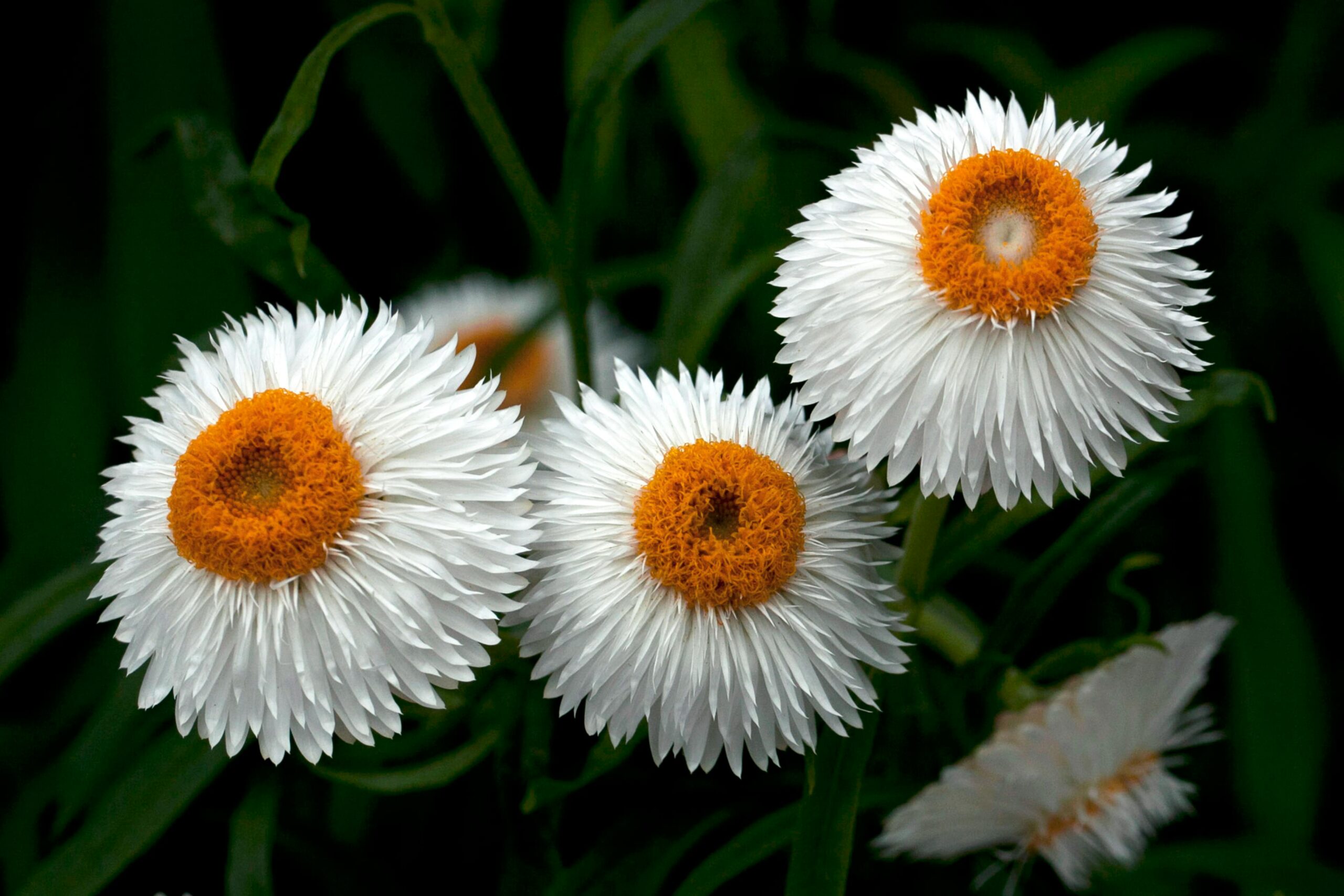
The archetype. Strawflowers produce vividly coloured papery blooms in a wide palette from white and cream through yellow, orange, pink, red, and deep burgundy. They’re easy to grow, prolific, and among the most reliably colourful of all everlastings once dried. The bracts are stiff enough that they hold their form even without drying wire support. My personal go-to for beginners.
Statice — Limonium sinuatum
One of the most commercially important everlasting flowers in the floristry industry. The tiny paper-like florets come in purple, pink, white, yellow, and bicolour forms, and they hold their colour exceptionally well — statice from a well-stored dried arrangement can look vivid after two to three years. The stems are winged and angular, giving arrangements an interesting structural quality beyond just the flowers themselves.
Globe Amaranth — Gomphrena globosa
Clover-like rounded heads in magenta, pink, white, orange, and purple. Globe amaranth is unusual among everlastings because it’s genuinely heat- and humidity-tolerant in the garden, making it more viable in subtropical climates where other everlastings struggle. The dried flowers shrink slightly but maintain their round shape and colour admirably.
Winged Everlasting — Ammobium alatum
An underappreciated species that deserves more attention. White petals with yellow centres on tall winged stems — the “wings” on the stem are a distinctive identification feature. Ammobium dries to a clean, bright white that holds better than almost any other white-flowered everlasting, making it invaluable in mixed arrangements.
Rhodanthe / Sunray — Rhodanthe chlorocephala
Native to Western Australia, this delicate annual produces pink and white papery daisies with prominent yellow centres. The flowers are more delicate than strawflower but have a natural grace that makes them popular for fine dried arrangements and wedding work. They require good drainage and dislike humidity.
Globe Thistle — Echinops ritro
Technically a thistle rather than a traditional everlasting, but it dries with exceptional form retention. The spherical metallic-blue flower heads are architecturally striking and add height and texture to dried arrangements that the softer everlastings can’t provide. Perennial in most temperate climates, meaning you plant once and harvest for years.
Immortelle / Curry Plant — Helichrysum stoechas
The classic French immortelle. Yellow button-like flowers with a distinctive curry-like fragrance when fresh. Smaller and more delicate than strawflower, but the fragrance lingers faintly even after drying — an unexpected quality that makes it particularly pleasant in indoor arrangements.
Strawflower Daisy — Bracteantha bracteata
Often confused with standard strawflower (the taxonomy has been reorganised multiple times), this Australian native produces slightly larger flowers with more distinctly paper-like bracts. The heritage varieties bred in Australia tend to be more vigorous than northern hemisphere seed strains.
Sea Lavender — Limonium latifolium
A perennial species related to statice with a more open, airy growth habit. The tiny lavender-blue flowers create a haze-like effect in both fresh and dried arrangements. Excellent for filling space and creating softness around more structural everlasting stems.
5. Growing Everlasting Flowers: A Practical Guide from Seed to Harvest
Most everlasting flowers come from Australia, the Mediterranean, and South Africa — regions defined by dry summers, thin soils, and intense sun. Growing them well means mimicking those conditions as much as possible, not compensating for them with extra water and rich compost.
Starting from Seed
Most everlastings are best grown from seed, either started indoors 6–8 weeks before the last frost date or direct-sown after frost risk has passed. Strawflower, statice, globe amaranth, and rhodanthe all respond well to indoor starting.
Key germination notes:
- Light requirement: Most everlasting seeds need light to germinate. Press seeds onto the surface of moist seed-raising mix rather than burying them. Covering the tray with clear plastic maintains humidity while allowing light through.
- Temperature: 18–22°C (65–72°F) is optimal for most species. Bottom heat from a seedling heat mat significantly improves germination rate and speed.
- Moisture: Keep evenly moist until germination, then reduce watering immediately. Damping off (fungal collapse at the stem base) is the primary risk at the seedling stage, and it’s caused almost entirely by overwatering.
Soil Preparation
This is where most gardeners go wrong. Everlasting flowers evolved in lean, fast-draining soils. Rich, moisture-retentive garden soil loaded with organic matter produces lush, floppy plants with fewer flowers and lower disease resistance.
Ideal soil: moderately fertile, pH 6.0–7.0, with excellent drainage. If your garden has heavy clay, raise the bed by 15–20cm and incorporate horticultural grit or coarse sand to improve drainage. Avoid adding more than a light dressing of compost at planting — these plants perform better when they have to work slightly for their nutrients.
Spacing and Planting
- Strawflower: 30cm apart in rows 45cm wide
- Statice: 25–30cm apart
- Globe amaranth: 30cm apart; tolerates slight crowding
- Rhodanthe: 20–25cm apart; sow in succession for extended harvest
- Globe thistle: 60cm apart; it’s a large perennial
Full sun is non-negotiable for all species listed above. A minimum of 6 hours of direct sun daily — ideally 8 or more. In partial shade, everlastings grow taller and weaker searching for light, produce fewer flowers, and are more vulnerable to fungal disease.
Watering and Feeding
Water deeply but infrequently once established — weekly in dry weather, less in cool or overcast periods. Allow the soil surface to dry between waterings. Everlasting flowers have moderate to good drought tolerance and punish overwatering more than underwatering.
Feeding: a single application of slow-release balanced fertiliser at planting is generally sufficient. Additional nitrogen encourages excessive leaf growth at the expense of flowers. If you must feed mid-season, use a low-nitrogen, high-potassium formulation (a tomato feed works well) to encourage blooming.
Supporting Tall Varieties
Strawflowers and statice in productive cutting garden conditions can reach 60–90cm. Horizontal netting stretched over the bed at 30cm height (raised as plants grow) provides unobtrusive support that keeps stems straight — straight stems are essential for both display and commercial value.
6. Harvesting and Drying: The Critical Window Most Gardeners Miss
Timing the harvest is the most consequential decision in growing everlasting flowers, and it’s consistently the point where beginners make costly mistakes.
The Golden Rule: Harvest Early
For strawflowers specifically, harvest when the outer two or three rings of bracts have opened but the central bracts remain closed or partially furled. If you wait until the flower looks “fully open” — which is the intuitive moment most people wait for — the flower will continue opening during drying and may expose a fuzzy seed head at the centre, which dramatically reduces visual quality.
For statice, harvest when roughly two-thirds of the individual florets on a stem have opened colour. Stems cut too early may not fully develop; too late and the florets shatter.
For globe amaranth, harvest when the rounded heads are fully coloured but haven’t yet started to soften or elongate.
Timing of Day
Cut in the mid-morning after any dew has evaporated but before midday heat has stressed the plants. Flowers cut in the afternoon after a hot day are more dehydrated and will dry with less vitality.
Drying Methods
Air drying (hanging): The standard method for most everlastings. Bundle 8–12 stems together (not too densely — air circulation matters), secure with a rubber band (which tightens as stems shrink), and hang upside down in a warm, dark, well-ventilated space. Darkness is critical — UV light degrades the flavonoid pigments responsible for the vivid colours.
Two to three weeks is the typical drying time at 20–25°C with good airflow. In humid conditions, a small dehumidifier in the drying space makes a significant difference.
Desiccant drying: For flowers where perfect form retention is paramount — particularly rhodanthe and ammobium — burying blooms face-up in silica gel crystals and leaving them for 48–72 hours produces exceptional results. The colour retention is noticeably superior to air drying, though the process is more labour-intensive.
Glycerine preservation: Not technically drying, but worth mentioning. Stems placed in a 1:2 glycerine-water solution absorb the glycerine as water evaporates, replacing cellular water with glycerine and producing a supple, preserved specimen rather than a brittle dried one. Works better for foliage than flowers but can produce interesting results with some everlasting species.
7. Using Everlasting Flowers in Design, Décor, and Crafts
The applications for dried everlastings are wider than most people imagine when they first encounter them.
Dried Flower Arrangements and Bouquets The most obvious use. Mixed everlasting arrangements work best when they combine contrasting textures: the bold rounds of strawflower, the airy filler of statice, the architectural spikes of globe thistle, and the delicate grasses or seed heads that add movement. Avoid the temptation to use only bright colours — arrangements with a mix of saturated and muted tones have more visual depth and age more gracefully.
Wedding Floristry Dried everlastings have transformed the wedding industry in the past several years. Bridal bouquets made from everlastings can be assembled weeks before the wedding, removing the time pressure of fresh flower work. They can be kept as keepsakes afterwards. Leading dried floral wedding designers now achieve extraordinary results that most people initially assume are fresh flowers.
Wreaths and Door Decorations Everlastings are ideal wreath material because they’re lightweight and their stems wire easily. A well-made strawflower wreath can last five or more years with basic care (keep out of direct sunlight and away from high humidity).
Pressed Flower Art Many everlasting species press beautifully for botanical art, stationery, resin jewellery, and decorative framing projects. Rhodanthe and ammobium press particularly flat and cleanly.
Herbal and Aromatic Products Helichrysum stoechas (curry plant immortelle) retains its distinctive fragrance when dried, making it useful in potpourri, herb cushions, and natural room fragrance products. The essential oil extracted from Helichrysum italicum has also gained considerable attention in natural skincare for its skin-regenerative properties.
8. Comparison: Which Everlasting Flower Should You Grow?
| Flower | Difficulty | Best Climate | Colour Range | Longevity Dried | Best Use |
|---|---|---|---|---|---|
| Strawflower | Easy | Temperate–dry | Full spectrum | 3–5 years | Arrangements, wreaths |
| Statice | Easy | Temperate | Purple, pink, white, yellow | 2–4 years | Filler, bouquets |
| Globe Amaranth | Easy | Warm, humid-tolerant | Pink, red, white, orange | 2–3 years | Tropical/subtropical gardens |
| Rhodanthe | Moderate | Dry, temperate | Pink, white | 2–3 years | Fine arrangements |
| Ammobium | Easy | Temperate | White/yellow | 3+ years | White arrangements |
| Globe Thistle | Easy (perennial) | Temperate | Blue, silver | 3–4 years | Structural elements |
| Immortelle | Moderate | Mediterranean | Yellow | 2–4 years | Fragrant arrangements |
| Sea Lavender | Moderate | Temperate/coastal | Lavender, white | 2–3 years | Airy filler |
Recommendation for beginners: Start with strawflower and statice. Both are forgiving to grow, reliable to dry, and produce enough volume to practice with. Once you’ve mastered the basics of harvest timing and drying conditions, add rhodanthe for its elegance and globe thistle for architectural contrast.
9. Common Problems, Pests, and Honest Troubleshooting
Damping off (seedling collapse) Cause: Fungal disease at the soil surface caused by overwatering or poor airflow around seedlings. Solution: Water from below using a tray; ensure seedling trays aren’t sitting in standing water; use a well-draining seed-raising mix. Once established outdoors, this problem largely disappears.
Botrytis (grey mould) on drying flowers Cause: Humidity in the drying space. This is the single biggest problem for home dryers in humid climates. Solution: A small dehumidifier or fan in the drying area resolves most cases. Ensure bundles aren’t too dense — airflow through the bundle matters.
Colour fade faster than expected Cause: Almost always direct sunlight or UV exposure. Even indirect bright light accelerates pigment breakdown. Solution: Display everlasting arrangements away from windows, or use UV-filtering glass in frames for pressed work. Rotate arrangements periodically.
Aphids on growing plants Strawflower and statice can attract aphid colonies, particularly in spring. A strong jet of water dislodges most infestations; insecticidal soap spray handles persistent cases. Avoid systemic insecticides in a cutting garden if you intend to use flowers for any food-adjacent purposes.
Failure to germinate Most common cause: seeds buried too deep (everlastings need light) or soil kept too wet before germination. A secondary cause is old seed — everlasting seed loses viability fairly quickly; use fresh seed each season.
Leggy, floppy stems Insufficient sunlight. There is no workaround — these plants need full sun. Moving containers to a sunnier position or choosing a different planting location is the only genuine solution.
10. Preserving Colour: The Biggest Challenge Nobody Talks About
Everyone focuses on getting everlasting flowers to dry correctly. Far fewer people talk about what happens after — specifically, why the colours in that beautifully vibrant arrangement start looking washed out after twelve months.
Colour fade in dried everlasting flowers has two primary drivers: photodegradation (UV light breaking down pigment molecules) and oxidation (the slow chemical reaction between pigment compounds and atmospheric oxygen). Both are unavoidable, but both can be significantly slowed.
Practical steps to extend colour life:
Keep dried arrangements away from south-facing windows or any direct sunlight. If a room receives strong natural light, positioning matters enormously — even placing an arrangement against an interior wall rather than near a window can extend vivid colour retention by a year or more.
Floral UV-protective sprays (available from craft suppliers) create a thin coating over dried blooms that filters some UV exposure. They don’t eliminate fading but meaningfully slow it. Apply in light coats from 30cm distance in a well-ventilated space.
Low humidity slows oxidation. Bathrooms and kitchens (high humidity environments) are genuinely poor locations for dried flower displays, despite their visual appeal there. A living room or bedroom with normal domestic humidity is far better.
The inherently most stable pigments in everlastings are the carotenoids (yellows, oranges) and certain flavonoids. Reds and pinks based on anthocyanin pigments — found in some strawflower and rhodanthe varieties — are less stable and will fade faster regardless of care. This is worth factoring into variety selection if longevity is a priority.
11. Future Trends in Everlasting Floristry
The dried flower sector is growing faster than most corners of the floristry industry, driven by sustainability awareness and a consumer culture increasingly interested in objects that last. Several trends worth watching:
Sustainable Wedding Floristry The cut flower industry generates considerable environmental impact — refrigerated transport, pesticide use, water consumption, and near-total disposal after a single event. Dried everlasting bouquets and installations eliminate the single-use problem entirely and are genuinely growing in market share. Several leading florists now specialise exclusively in dried work.
Biodegradable Resin Alternatives Embedding dried everlasting flowers in resin for jewellery and decorative objects is already popular. The next iteration — using plant-based biopolymer resins rather than petrochemical acrylic resin — is in active development and will make these products considerably more sustainable.
Heritage and Wildflower Seed Conservation Botanical gardens and seed libraries are documenting and preserving heritage everlasting varieties, many of which were developed in the late 19th and early 20th centuries and have fallen out of commercial circulation. These varieties often have superior colour and fragrance characteristics compared to modern F1 hybrids bred for yield rather than quality.
Everlasting Flowers in Wellness and Aromatherapy Helichrysum italicum essential oil has attracted growing scientific interest for its anti-inflammatory and wound-healing properties. This has driven renewed commercial cultivation of everlasting species for essential oil production, creating economic incentives for more growers to take on these crops.
12. FAQs
Q: How long do everlasting flowers actually last indoors?
With reasonable care — avoiding direct sunlight and high humidity — quality dried everlasting arrangements typically remain attractive for two to four years. Some species in ideal conditions will hold their form and colour for five or more years. The form lasts longer than the colour; structurally, many dried everlastings are essentially permanent.
Q: Can I grow everlasting flowers in pots?
Yes, with caveats. Choose compact varieties (dwarf strawflower varieties work particularly well), use a free-draining compost mixed with perlite or grit, and ensure the container gets full sun. Pots dry out faster than garden beds, which everlastings generally prefer — just ensure they’re not going bone dry in hot weather for extended periods.
Q: Do everlasting flowers attract bees and pollinators?
Genuinely yes — and more importantly than some ornamentals, because their long blooming season (often several months in good conditions) means they provide forage across a wide period. Strawflower is particularly good for native bees that collect pollen as well as nectar.
Q: Can children help grow and dry everlasting flowers?
They’re among the best plants for introducing children to gardening and craft projects. The seeds are large enough to handle, germination is reasonably reliable and satisfying, and the drying process produces a tangible result that children can then use in wreaths or pressed art. Globe amaranth and strawflower are particularly child-friendly varieties.
Q: Why do my dried strawflowers keep opening after I’ve dried them?
This is a well-known characteristic of strawflower specifically — the bracts continue to respond to humidity even after drying, opening wider in humid conditions and closing slightly in dry air. It’s a natural behaviour of the bract structure rather than a sign of incomplete drying. To minimise it, display in a consistently low-humidity environment, or glue the bracts lightly in position with a small drop of clear floral adhesive after drying.
Q: Are any everlasting flowers suitable for cutting and using fresh before drying?
All of them — that’s rather the point. Strawflower, statice, and globe amaranth are all excellent fresh cut flowers with a vase life of one to two weeks. The drying is optional; many growers use them fresh throughout the season and harvest later bunches for drying as the season ends.
Conclusion
There’s something almost philosophical about growing plants whose whole design tendency is toward endurance. In a gardening culture often dominated by the drama of brief-blooming roses and peonies, everlasting flowers make a quieter but equally compelling argument — that there is beauty in things built to last.
What I’ve found working with these plants over many years is that they reward a kind of restraint that goes against gardening instinct. Less water, leaner soil, less intervention. They prefer being left to do what they evolved to do, which is to thrive under pressure and produce flowers that outlast the growing season by years.
For the beginner, a packet of strawflower seeds and a sunny patch of ground is genuinely all that’s needed to start. For the experienced gardener looking to add a new dimension to their practice — and produce something they can keep, display, give, and craft with — the full range of everlasting species opens up a world that most ornamental horticulture doesn’t touch.
They’ve been placed in tombs, woven into mourning wreaths, tucked into love letters, and suspended in wedding bouquets across thousands of years of human culture. The fact that the flowers themselves were present for all of it — unchanged, unhurried, lasting — seems entirely appropriate.
About the Author
Dr. Miriam Calloway is a botanical horticulturist and floral preservation specialist with over fourteen years of research and practical experience in dried and everlasting flower cultivation. She holds a doctorate in ornamental horticulture from the University of Reading, with a thesis examining the pigment stability mechanisms of Asteraceae tribe Gnaphalieae — the botanical group that contains most commercially important everlasting flower species. Dr. Calloway has consulted for botanical gardens across the United Kingdom and Australia on heritage seed preservation programmes, and her writing on sustainable floristry has been published in academic and horticultural trade journals. She runs an independent research garden in the South Downs where she trials heritage everlasting varieties and develops growing guidance for both small-scale growers and commercial cut-flower producers. She is currently completing a book on the cultural history of dried flowers across world traditions.
Last updated: June 2026